C-beauty’s Southeast Asia expansion is rewriting the region’s mass beauty market – and the numbers make it hard to ignore.
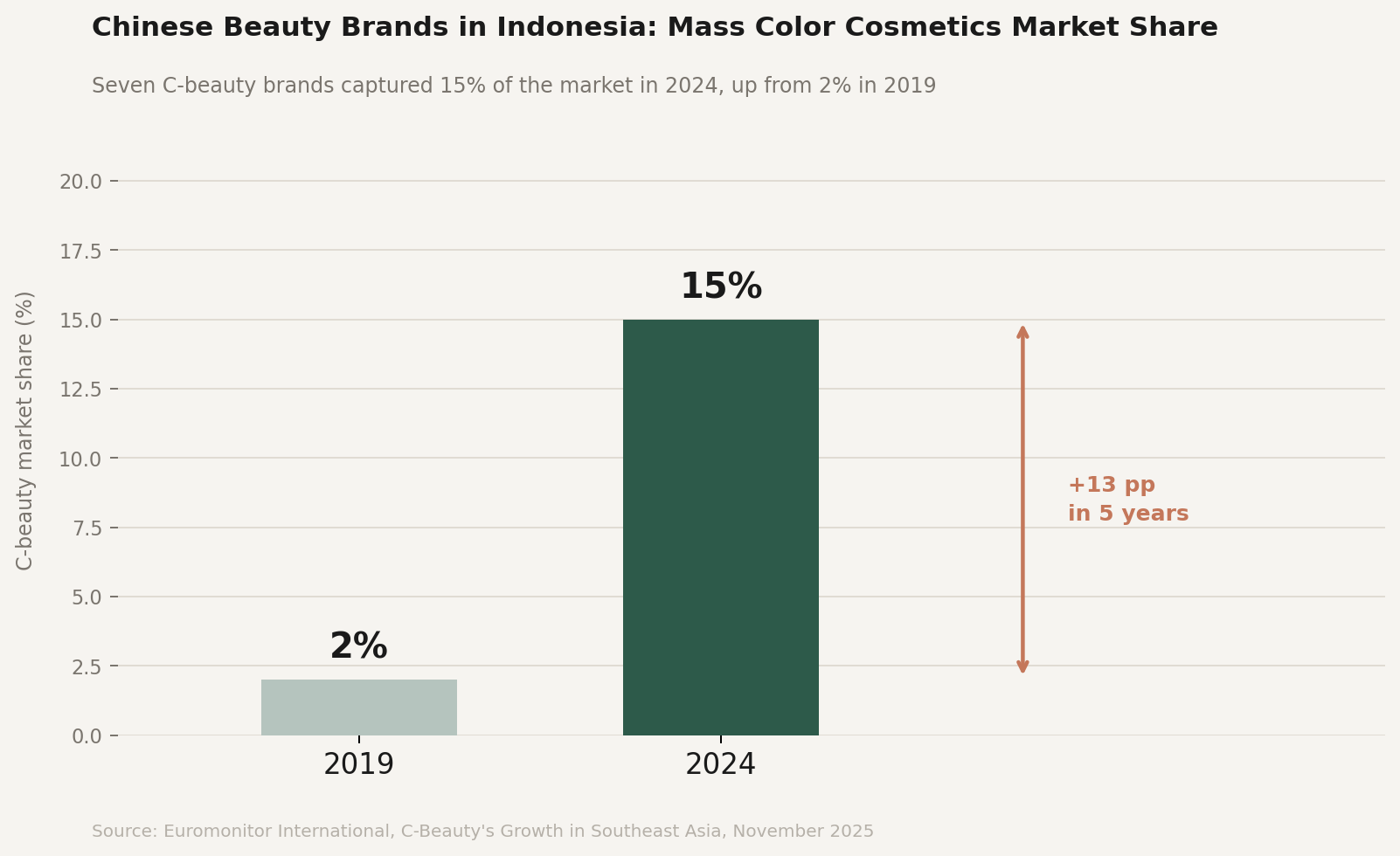
Seven Chinese brands collectively held over 15% of Indonesia’s mass color cosmetics market in 2024, up from 2% in 2019. Skintific ranked first on Shopee Indonesia in Q1 2025. TikTok Shop captured 39% of Vietnam’s entire e-commerce market in H1 2025, with beauty and personal care as its largest category. The expansion is real, measurable, and accelerating – and it is structured in a way that makes it almost impossible to counter through the tools that Vietnamese and other regional brands typically reach for.
Two Strategies, Neither of Them Prestige
The dominant narrative around C-beauty in Western beauty media frames it as a premium play – Florasis with its guócháo packaging, Perfect Diary with its museum collaborations, and Maogeping with its luxury positioning. That framing describes a real segment but misidentifies which part of C-beauty is actually reshaping Southeast Asia.
The SEA expansion is being driven by two distinct strategies that share almost nothing with premium positioning.
The first is aggressive price-to-SKU density. Focallure operates over 250 SKUs per country Shopee store – more than most local competitors carry across their entire product range. Prices sit at $2–5, matching what Euromonitor identifies as the actual spend ceiling for 68% of Indonesian Gen Z consumers on color cosmetics.
Pinkflash, a sister brand under the same Guangzhou Jizhi parent company, targets an even lower price floor with lip tints and eyeliners priced at $0.90–4. The model is not brand-building. It is category capture: more products, at lower prices, available in every market simultaneously.
The second strategy is origin erasure. Skintific, which became TikTok Shop’s global sales champion in 2022 and reached cumulative SEA sales of $114 million within two years of launch, does not present itself as a Chinese brand. Its positioning – science-led formulations, dermatologist-tested claims, and clinical ingredient language – is designed to be indistinguishable from Korean dermocosmetics.
Skintific and Y.O.U have emphasized science-led formulations paired with local influencer campaigns, subtly distancing from Chinese origin identity. The brand’s packaging carries no visual cues of Chinese origin. Its marketing is conducted entirely in local languages through local influencers. Consumers in Indonesia, Malaysia, and Vietnam who purchase Skintific frequently do not know they are buying a Chinese-owned brand.
Why Platforms Are the Actual Competitive Moat
As Chinese companies expand into Southeast Asia, they bring well-established digital marketing strategies honed through domestic success. The structural parallel between Douyin and TikTok Shop is the mechanism that makes C-beauty’s SEA expansion qualitatively different from K-beauty’s or J-beauty’s earlier expansions into the region.
Korean and Japanese brands entered SEA through retail distribution: department store counters, Watsons, Guardian, and specialty beauty retailers. That model requires physical logistics, retail partnerships, and significant capital investment per market. It is slow, expensive, and creates natural barriers for smaller brands.
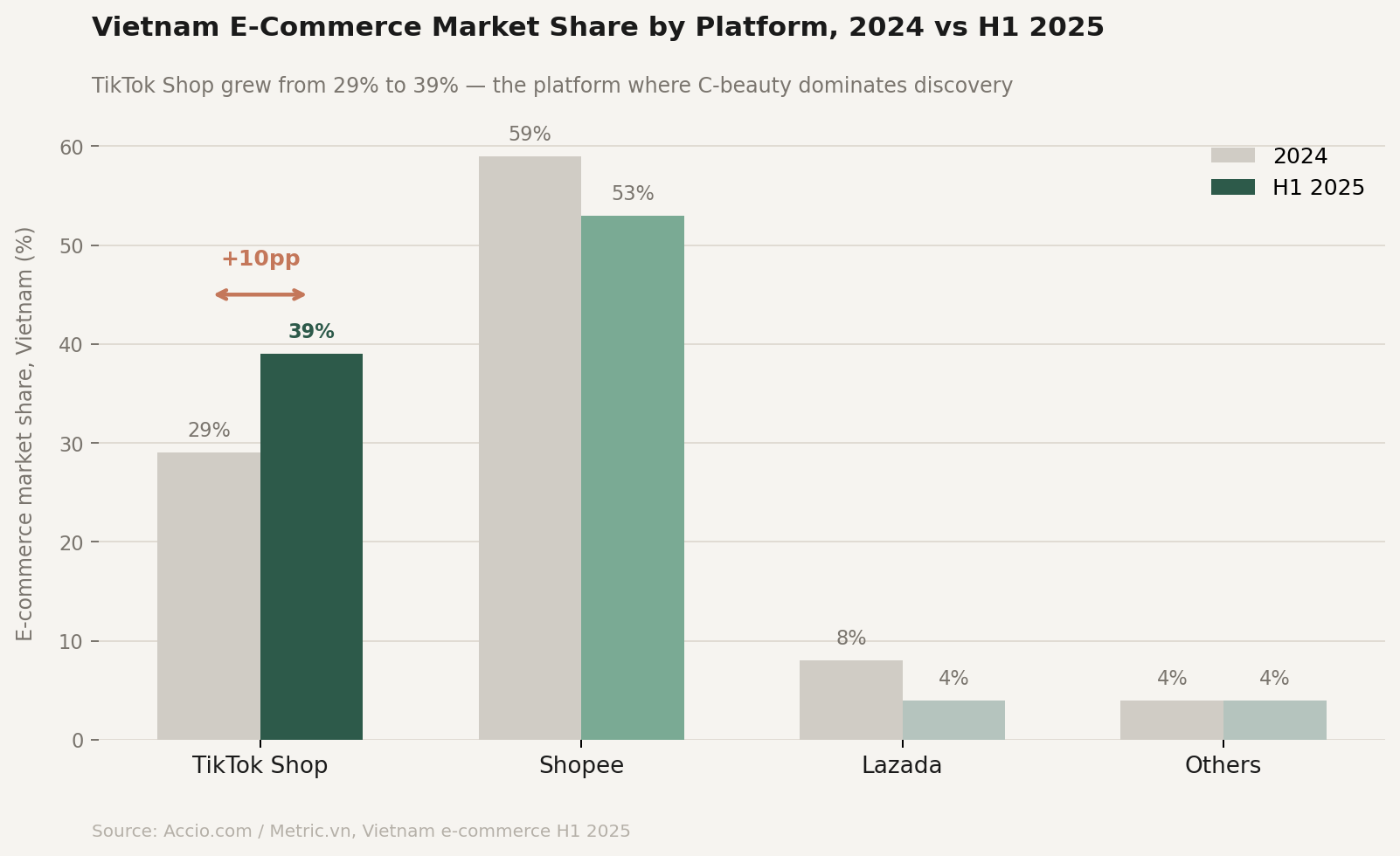
C-beauty entered through TikTok Shop and Shopee Live – platforms whose operational logic is identical to Douyin and Taobao Live, the channels where these brands built their domestic businesses. TikTok Shop has rapidly expanded its presence in Vietnam, capturing 39% of the e-commerce market share in H1 2025, up from 29% in 2024, with GMV surging 69% year-over-year. The brands that arrive via these platforms do not need retail partnerships. They need content, inventory, and logistics – three things Chinese manufacturers have optimized more thoroughly than any competitor.
Focallure’s customer-to-manufacturer model allows it to iterate products based on real-time sales data and reformulate for specific market preferences within weeks. A Vietnamese brand developing a new SKU, navigating domestic regulatory approval, and building retail distribution operates on a timeline measured in months or years. The speed differential is not a function of investment – it is structural.
What This Means for V-Beauty Specifically
The standard competitive response to low-cost market entry is differentiation upward – better ingredients, stronger clinical evidence, premium positioning, and certification that creates barriers. This is the right strategic direction for V-beauty brands competing against C-beauty in the long run. It is not a response to the immediate competitive pressure.
The problem is timing. Vietnamese beauty brands that are correctly pursuing COSMOS certification, building ingredient-origin narratives, and investing in clinical substantiation are working on a two-to-five-year timeline. C-beauty brands that entered Vietnam’s TikTok Shop in 2023 and 2024 are already establishing consumer relationships and category ownership in the mass and accessible premium segments.
By the time V-beauty’s certification and clinical investment matures, the consumer who would have been recruited to Vietnamese skincare will have an established preference for whichever C-beauty brand got there first.
The channel dynamic compounds this. Beauty and personal care leads TikTok Shop Vietnam’s GMV at 22.5% – the largest category on the platform. Vietnamese beauty brands are present on TikTok Shop, but their content mechanics and livestream infrastructure are significantly less developed than their Chinese competitors.
Cocoon, the most internationally visible V-beauty brand, built its domestic presence through Guardian retail and Shopee product listings. TikTok Shop requires a different operational model – content-first, livestream-dependent, algorithmically optimized – that most Vietnamese brands have not yet built.
The Local Response and Its Limits
Southeast Asian local brands are not passive in the face of C-beauty’s expansion. Local giants like Wardah (Indonesia), Mistine (Thailand), and ESQA have responded by introducing premium lines and botanical-based variants to offset Chinese brand momentum. The academic literature confirms what the market data suggests: Wardah, which had grown its market share significantly between 2020 and 2021, saw a notable decline between 2023 and 2024 as C-beauty brands consolidated their position.
The premium and botanical pivot is the correct strategic response – but it requires that local brands execute the pivot faster than C-beauty brands can follow upmarket. The evidence from Indonesia suggests the window to establish premium differentiation before C-beauty arrives in the same segment is narrower than most local brands have planned for. Skintific’s science-led positioning is already competing in the accessible clinical skincare segment that should be V-beauty’s upward migration path.
For Vietnamese brands, the most defensible position is not premium pricing per se – it is premium provenance. Ingredient-origin storytelling (Hung Yen turmeric, Dak Lak coffee, Mekong Delta lotus) is genuinely difficult for Chinese brands to replicate in a Vietnamese market where authenticity and domestic pride remain meaningful purchase drivers.
The limitation is that provenance is a compelling differentiator for the segment of consumers who are already engaged with skincare as a considered category. It is not a barrier at the price point where C-beauty is currently recruiting new consumers.
The bottom-up pressure that C-beauty is applying in SEA cannot be blocked by regulation, certification, or clinical investment. It can only be outrun – upmarket, in channels and categories where provenance and efficacy evidence matter more than price and content volume. Whether V-beauty brands are moving fast enough to outrun it is the question that the next two to three years will answer.
Sources: Euromonitor International, “C-Beauty’s Growth in Southeast Asia: Trends and Opportunities,” November 2025; Future Market Insights, SEA C-Beauty Product Market Forecast to 2035, July 2025; TMO Group, “How Skintific Dominates Southeast Asia’s Beauty and Skincare eCommerce,” October 2025; Accio.com, “TikTok Shop Vietnam 2025 Best Sellers,” September 2025; Databoks/Compas, Top 10 Best-Selling Beauty Brands on Shopee Indonesia Q1 2025; ResearchGate, “Beyond Price and Promotion: Understanding the Dominance of China Beauty Brands in Indonesia,” October 2025.