Most Vietnamese skincare brands tell a story about where their ingredients come from. Herbario’s story is built around something more specific: the traditional Vietnamese herbal pharmacopoeia – the plants that Vietnamese families have used domestically, medicinally, and culinarily for generations, reformulated into modern skincare.
The name is deliberate. “Herbario” comes from the Spanish word for herbarium – a reference collection of preserved plants. It signals the brand’s organizing logic: local Vietnamese herbs, documented and deployed with intention.
This profile covers what Herbario actually makes, what their key botanical ingredients do, how the brand compares to Cocoon, and the honest answer to the question most international readers will have: can I actually buy this outside Vietnam?
Fast track:
- Product lines overview → The Three Pillars
- Key ingredient breakdown → What the botanicals actually do
- Herbario vs. Cocoon → How they compare
- Where to buy → Availability
- Full Vietnamese skincare context → Vietnamese Skincare: The Complete Guide
What Herbario Is
Herbario is a Vietnamese vegan skincare and haircare brand, founded approximately six years ago in Vietnam. All products are 100% vegan and cruelty-free – certified by the brand and cleared by the Ho Chi Minh City Health Department and the Pasteur Institute before reaching market. Products are manufactured to Ministry of Health standards and are free from corticoids, parabens, and banned substances.
The brand positions itself around a specific herbal ingredient set – all plants with documented traditional use in Vietnamese culture – combined with modern functional actives like niacinamide, allantoin, and panthenol. This is the key distinction from Cocoon: where Cocoon organizes products by Vietnamese region (Dak Lak coffee, Hung Yen turmeric), Herbario organizes by traditional herbal function. The reference point is the Vietnamese herbal medicine tradition, not agricultural geography.
Herbario has a modest English-language presence. Their products appear on SkinSort (13 products indexed), at Humanity Hanoi – a curated Vietnamese natural brand stockist – and occasionally in international discussions of domestic Vietnamese skincare. They are not yet a widely exported brand.
The Three Product Pillars
Herbario’s skincare range is built around three hero botanical ingredients, each addressing a different skin profile. The haircare range (grapefruit peel and soapberry) is separate and not covered here.
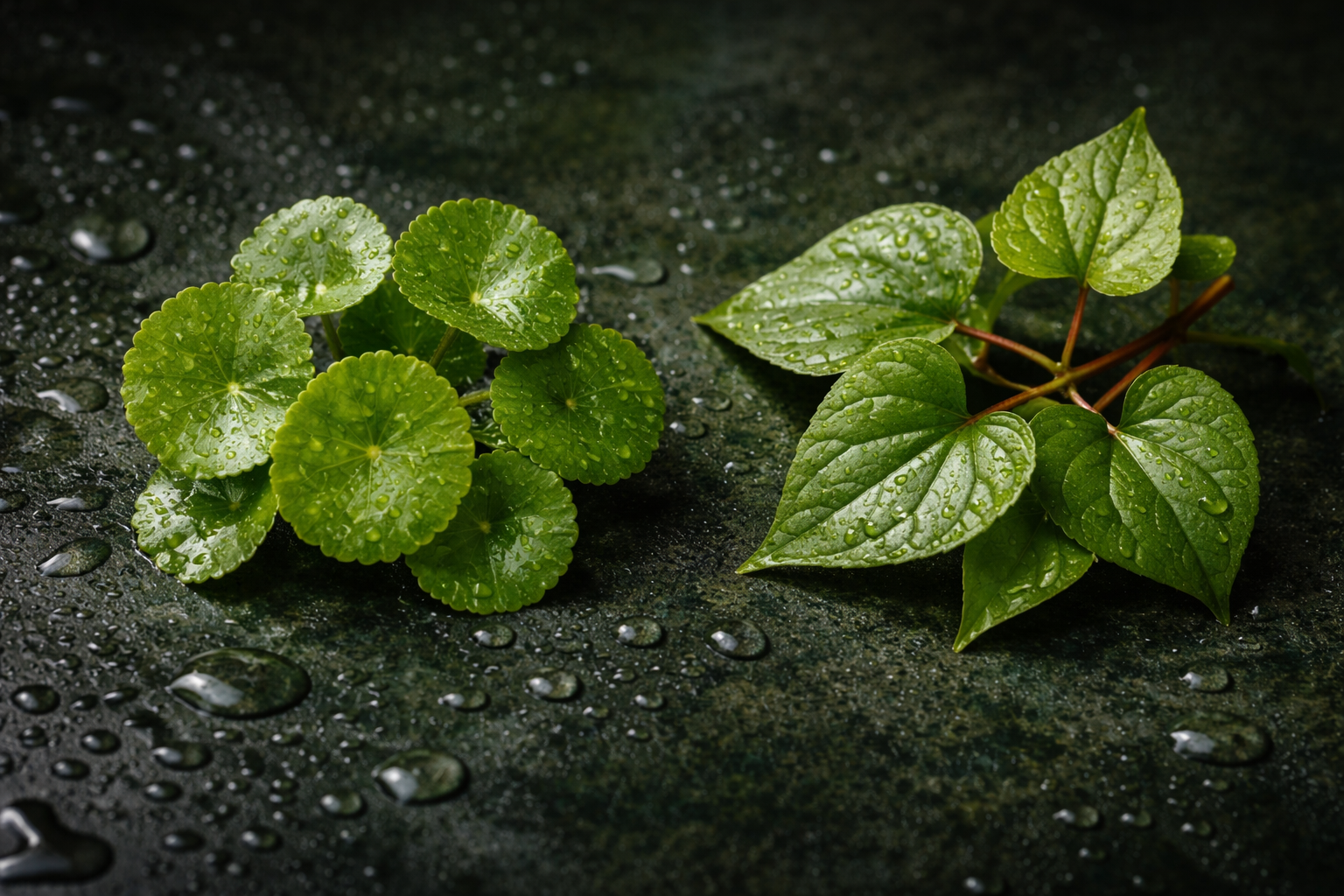
Pillar 1 – Centella & Fish Mint (Rau Má + Diếp Cá): Oily and Acne-Prone Skin
This is Herbario’s most widely discussed line internationally and their clearest positioning against K-beauty cica products.
The ingredients:
Centella asiatica (rau má) – the same soothing, anti-inflammatory, barrier-supporting ingredient found in COSRX and Skin1004 products, with the difference that rau má is genuinely embedded in Vietnamese daily life as food, medicine, and drink. See Centella Asiatica in Vietnamese Skincare for the full ingredient breakdown.
Fish mint (diếp cá / Houttuynia cordata) – a Vietnamese herb with a water content of approximately 80%, used traditionally to balance skin’s pH and reduce inflammation. Less internationally known than centella but documented in Vietnamese herbal medicine for its antibacterial and sebum-regulating properties. The 80% water content means it delivers hydration without occlusion – well-suited to oily skin in humid climates.
Supporting actives: niacinamide, tea tree, kaolin clay (in mask format), and panthenol.
The line: makeup remover, cleanser, face mist, face mask, serum. A full five-step routine built around the same botanical pair.
Best for: oily, acne-prone, and congested skin. The combination of centella (anti-inflammatory), fish mint (pH-balancing, sebum-regulating), and niacinamide (oil control, barrier support) addresses the core oily skin concerns without relying on harsh stripping actives.
Honest limitation: fish mint has a distinctive herbal scent that some users find strong. The brand uses mild fragrance to manage this, but if you’re strictly fragrance-free, check the INCI before purchasing – Lavandula Angustifolia (lavender) oil appears in some formulations.
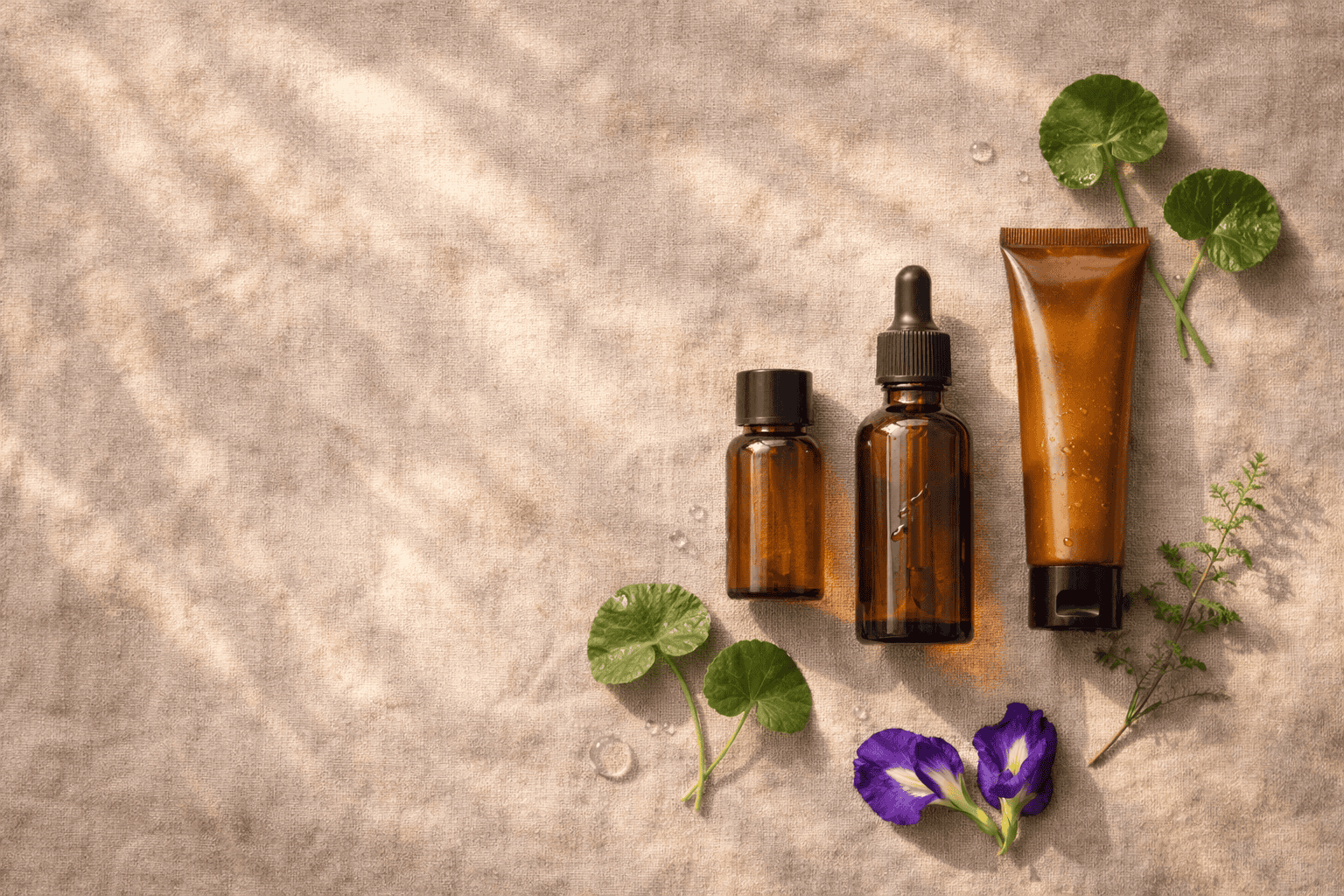
Pillar 2 – Butterfly Pea Flower (Hoa Đậu Biếc): Dry, Aging, and Dull Skin
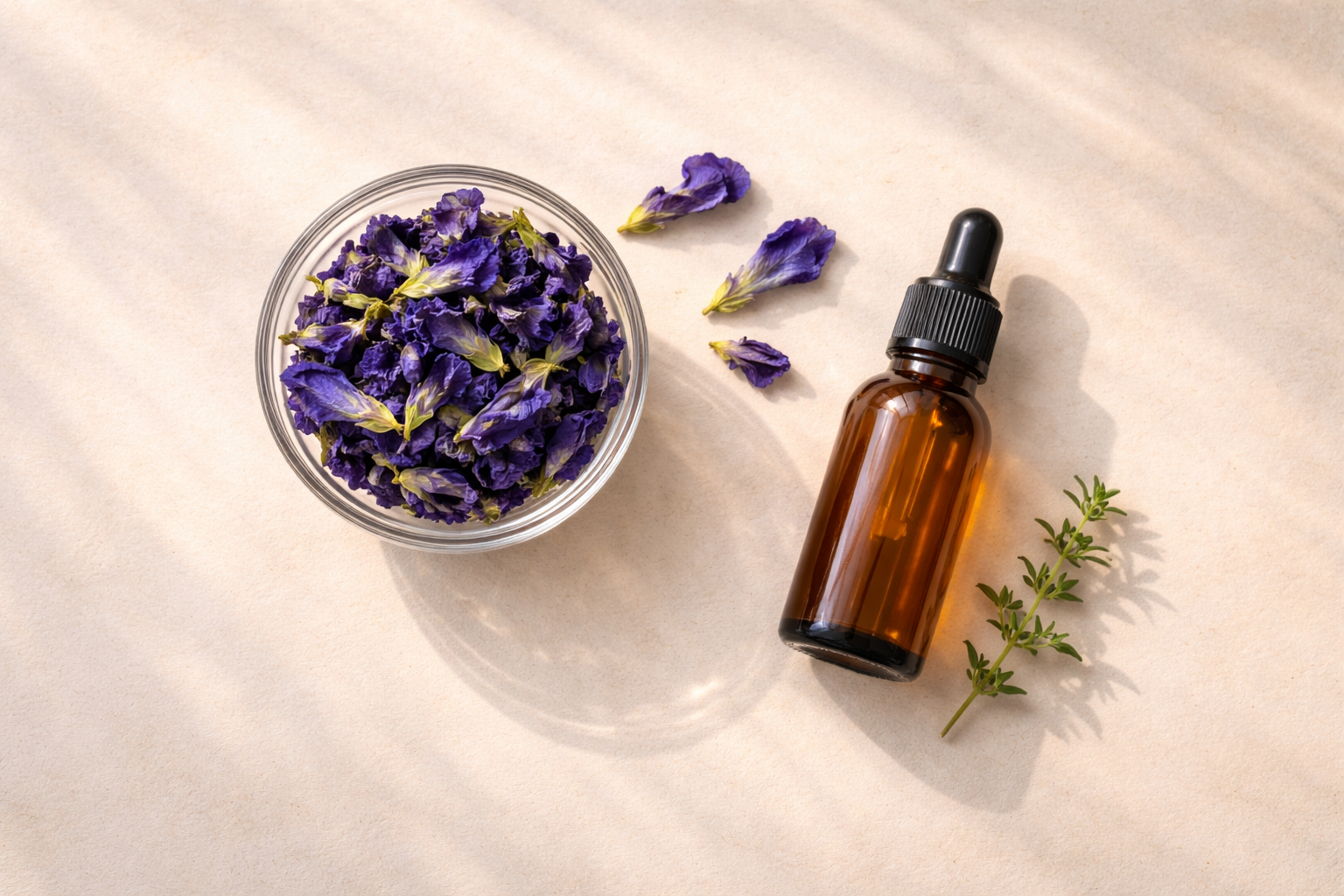
Butterfly pea flower (Clitoria ternatea) is one of Vietnam’s most visually distinctive plants – the intensely blue-purple flower is used to color traditional Vietnamese drinks and food. Herbario’s second skincare pillar uses it as the hero ingredient for a brightening and anti-aging line.
The ingredient:
Butterfly pea flower extract is rich in flavonoids – particularly anthocyanins, which give the flower its distinctive color. Flavonoids have documented antioxidant and anti-inflammatory activity. The anthocyanins in butterfly pea flower extract stimulate collagen and elastin production and have some evidence for improving skin elasticity.
The honest read: butterfly pea flower has promising in-vitro evidence and a solid antioxidant profile. It doesn’t have the same volume of clinical skincare evidence as niacinamide or centella – it’s a well-reasoned botanical active rather than a clinically proven pharmaceutical-grade ingredient.
Supporting actives: niacinamide, allantoin, betaine, panthenol, and bakuchiol (in the Boosted Serum – a plant-derived retinol alternative).
The line: cleansing water, toner, serum, and a Boosted Serum with bakuchiol for users who want a retinol-like effect without actual retinol.
Best for: normal to dry skin concerned with early signs of aging, dullness, or uneven tone. The bakuchiol serum is particularly interesting – a vegan, less-irritating alternative to retinol, appropriate for everyday use where retinol typically requires careful frequency management.
Honest limitation: this line is more focused on prevention and mild correction than active treatment. If you have significant hyperpigmentation or deep wrinkles, a dedicated vitamin C or retinol product from a brand with more clinical backing will likely outperform.
Pillar 3 – Grapefruit Peel & Soapberry (Vỏ Bưởi + Bồ Hòn): Haircare
Grapefruit peel (vỏ bưởi) and soapberry (bồ hòn) are both traditional Vietnamese remedies for scalp health and hair loss. This pillar covers shampoo, conditioner, hair mask, hair serum, and hair spray. It is outside the scope of this skincare guide but worth noting as Herbario’s most developed non-skincare category and a significant part of their domestic market presence.
What the Botanicals Actually Do
A quick, honest translation of Herbario’s ingredient claims into functional terms:
Centella asiatica: anti-inflammatory, barrier repair, hydration support. Well-documented. See the full centella breakdown.
Fish mint (diếp cá): pH-balancing, antibacterial, sebum-regulating. Traditional Vietnamese use is strong; formal clinical skincare evidence is thinner than centella. The high water content and traditional antibacterial reputation make it a reasonable choice for oily skin formulations.
Butterfly pea flower (hoa đậu biếc): antioxidant, collagen-stimulating, flavonoid-rich. The anthocyanin content is real, and the antioxidant activity is documented. The collagen synthesis claim is plausible (flavonoids support fibroblast activity) but not as extensively studied in human skin trials as centella’s equivalent claims.
Soapberry (bồ hòn): natural surfactant used in Vietnamese traditional hair washing. Functions similarly to gentle synthetic surfactants – cleansing action from saponins. Appropriate for scalp care; relevant to haircare products, not skincare.
Niacinamide (across multiple lines): the most conventional active in Herbario’s formulations. Well-documented, oil-controlling, barrier-strengthening, and brightening. Its presence grounds the botanical storytelling in something with consistent clinical backing.
Herbario vs. Cocoon: How They Compare
Both brands are Vietnamese, vegan, cruelty-free, and built around local botanical ingredients. The differences are meaningful:
Target skin profile: Cocoon’s most developed lines (Winter Melon, Lotus) target oily and sensitive skin, respectively. Herbario’s centella/fish mint line explicitly targets oily/acne skin; their butterfly pea line targets dry/aging skin. Herbario covers the dry skin profile more directly than Cocoon’s current range.
Formulation philosophy: Cocoon organizes by geographical ingredient origin (region → ingredient → product). Herbario is organized by traditional herbal function (herb → skin concern → product). Both are botanically led; the storytelling logic differs.
Actives ambition: Cocoon has pushed further into higher-concentration actives – the N15 niacinamide serum at 15%, the Hung Yen turmeric serum with 22% ascorbyl glucoside. Herbario’s actives are more modest in concentration, keeping the formulations closer to the gentle botanical end.
International availability: Cocoon significantly outperforms Herbario here. Cocoon has a verified US storefront, Amazon listing, and ships to multiple markets. Herbario is primarily a domestic Vietnamese brand with very limited international accessibility.
Price: at Vietnamese retail, both brands are accessible. Herbario does not have published international retail pricing because there is no international store.
The honest summary: Herbario is a strong domestic Vietnamese brand with a well-considered herbal framework and legitimate botanical ingredients. For international readers, Cocoon remains the more accessible entry point. For readers in Vietnam – or those planning a visit – Herbario is worth exploring, particularly the centella/fish mint line for oily skin.
For the full Cocoon comparison: Cocoon Vietnam: Everything You Need to Know
Where to Buy
Inside Vietnam:
- Herbario’s official website: herbario.vn
- Shopee Vietnam – Herbario Official Store (with verified badge)
- Lazada Vietnam – Herbario Official Store
- Select natural beauty stockists in Hanoi and Ho Chi Minh City, including Humanity Hanoi
Outside Vietnam:
This is where the honest answer is limiting. Herbario does not have a verified international storefront. Humanity Hanoi ships internationally from Hanoi and carries several Herbario products – this is currently the most verifiable international purchase channel.
For readers outside Vietnam who want Vietnamese skincare that’s readily available internationally, Cocoon remains the more practical option. If you’re traveling to Vietnam, Herbario is worth buying in-country.
Red flags: Herbario’s relatively low international profile makes it a brand where unverified grey-market sellers are harder to assess. Stick to the official Shopee/Lazada stores with the official badge or Humanity Hanoi for international orders.
FAQ
Is Herbario available internationally? Very limited. Humanity Hanoi ships internationally from Hanoi and stocks Herbario. There is no dedicated international e-commerce storefront. This is the primary constraint for non-Vietnamese buyers.
How does Herbario compare to The Ordinary or other actives-focused brands? A different category entirely. Herbario is a botanical-first brand with gentle actives as supporting ingredients. The Ordinary is an actives-focused brand with minimal botanical framing. If your skincare goal is high-concentration actives treatment, Herbario is not the right tool. If you want a gentle, botanically-grounded daily routine with some active support, Herbario is well-positioned.
Is the butterfly pea flower line suitable for oily skin? It’s formulated primarily for dry and aging skin – the emollient profile of the butterfly pea line is richer than the centella/fish mint line. For oily skin, the centella and fish mint line is the better fit. The two lines address different skin profiles intentionally.
Are Herbario products safe for sensitive skin? The brand uses some essential oils (lavender appears in several formulations). If you are strictly fragrance-sensitive or essential-oil-reactive, check INCI lists individually before purchasing. The centella/fish mint line has documented anti-inflammatory ingredients that support sensitive skin; the fragrance inclusion is the caveat.