Indonesia’s halal cosmetics certification becomes mandatory on 17 October 2026, and the technical guidelines defining what a compliant cosmetics ingredient chain actually looks like were still open for public comment on 2 August – eleven weeks before enforcement.
That gap between the deadline and the rulebook is the part of this story that the compliance coverage has almost entirely missed, and it changes what brands should be preparing for: not a certificate to file, but an ingredient-provenance dataset that most cosmetics companies have never built.
Two Documents, One Week in June
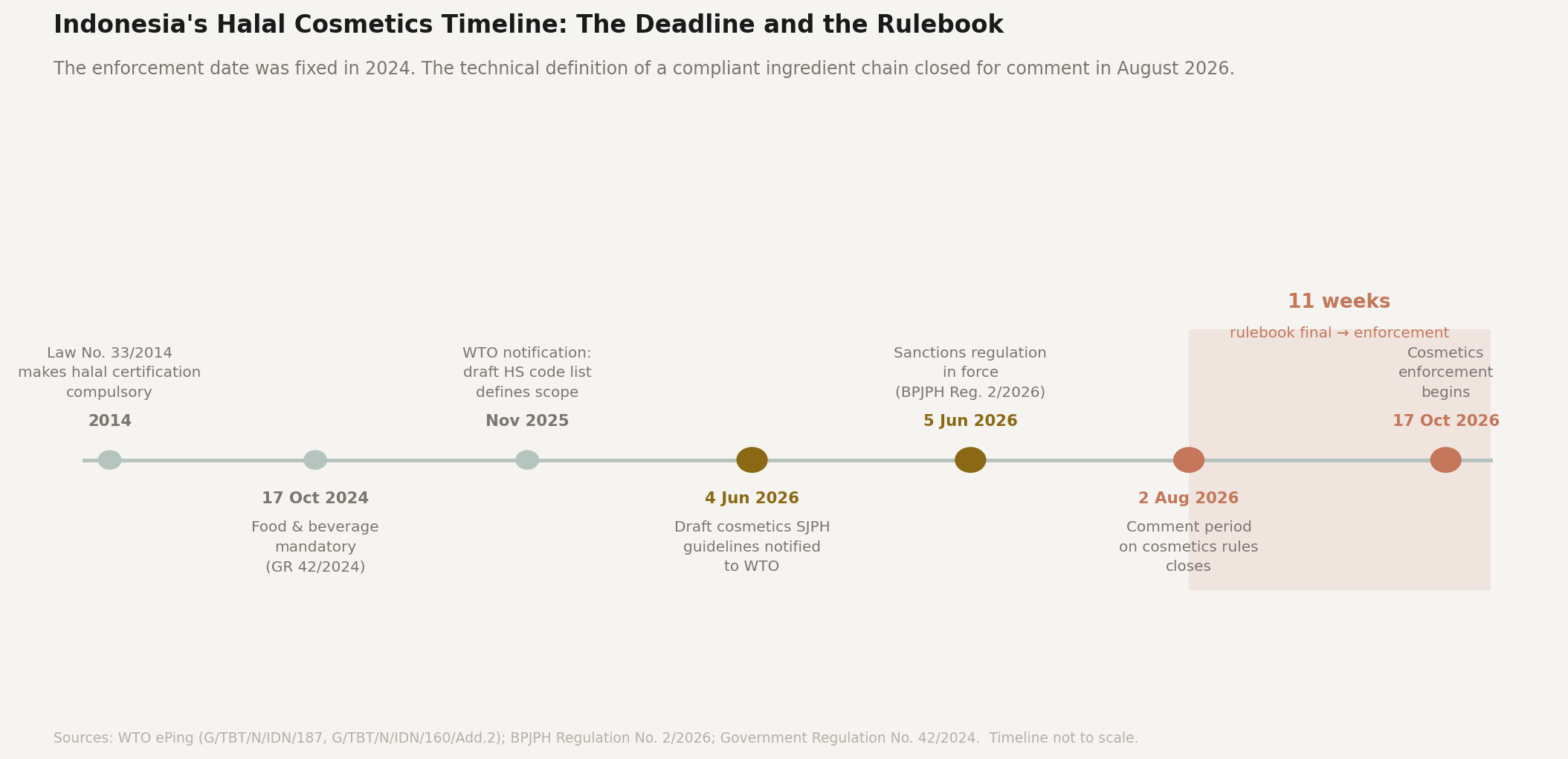
The legal architecture dates to Law No. 33 of 2014 on Halal Product Assurance, which made certification compulsory rather than voluntary, administered by BPJPH – the Halal Product Assurance Organizing Agency under the Ministry of Religious Affairs. Government Regulation No. 42 of 2024 set the phased timeline: food and beverages from 17 October 2024, cosmetics, pharmaceuticals, traditional medicines, and health supplements from 17 October 2026. None of that is news, and every consultancy selling certification services has been publishing the date for two years.
What change happened in a single week of June 2026, and it received almost no coverage outside specialist regulatory press.
On 5 June, BPJPH Regulation No. 2 of 2026 came into force, establishing an escalating administrative-sanctions ladder for halal assurance violations: written warning, administrative fine, revocation of the halal certificate or foreign certificate registration, product recall or withdrawal from circulation, temporary closure of business premises, and public disclosure. The regime reaches business actors, halal auditors, and certification-chain institutions alike – not only the brand placing the product on the market. Enforcement capability existed on paper before; the operational escalation path did not.
The day before, on 4 June, Indonesia notified the World Trade Organization (G/TBT/N/IDN/187) of a draft BPJPH decree setting out Halal Assurance System guidelines specific to cosmetics, identifying the critical control points a manufacturer must manage across the ingredient and production chain. That draft remains open for public comment until 2 August 2026.
The sequencing matters more than either document individually. The sanctions regime became operational in June, four months before the deadline it enforces. The technical definition of compliance for cosmetics is still being finalized, with the comment window closing eleven weeks before the same deadline. Brands are being asked to prepare for conformity with a standard whose final text will land after most of their preparation window has already gone.
A third document completes the picture: a WTO notification filed in November 2025 (G/TBT/N/IDN/160/Add.2) defines scope by HS code rather than product description, meaning tariff classification determines up front whether a given imported SKU falls inside the regime at all. A brand that has not checked its HS codes does not yet know whether it has a compliance problem.
Indonesia Halal Cosmetics: Provenance, Not Formula
The word “certification” invites a particular mental model: submit documents, receive a certificate, print a logo. The draft SJPH guidelines describe something structurally different, and the difference is the operative fact for any brand assessing its exposure.
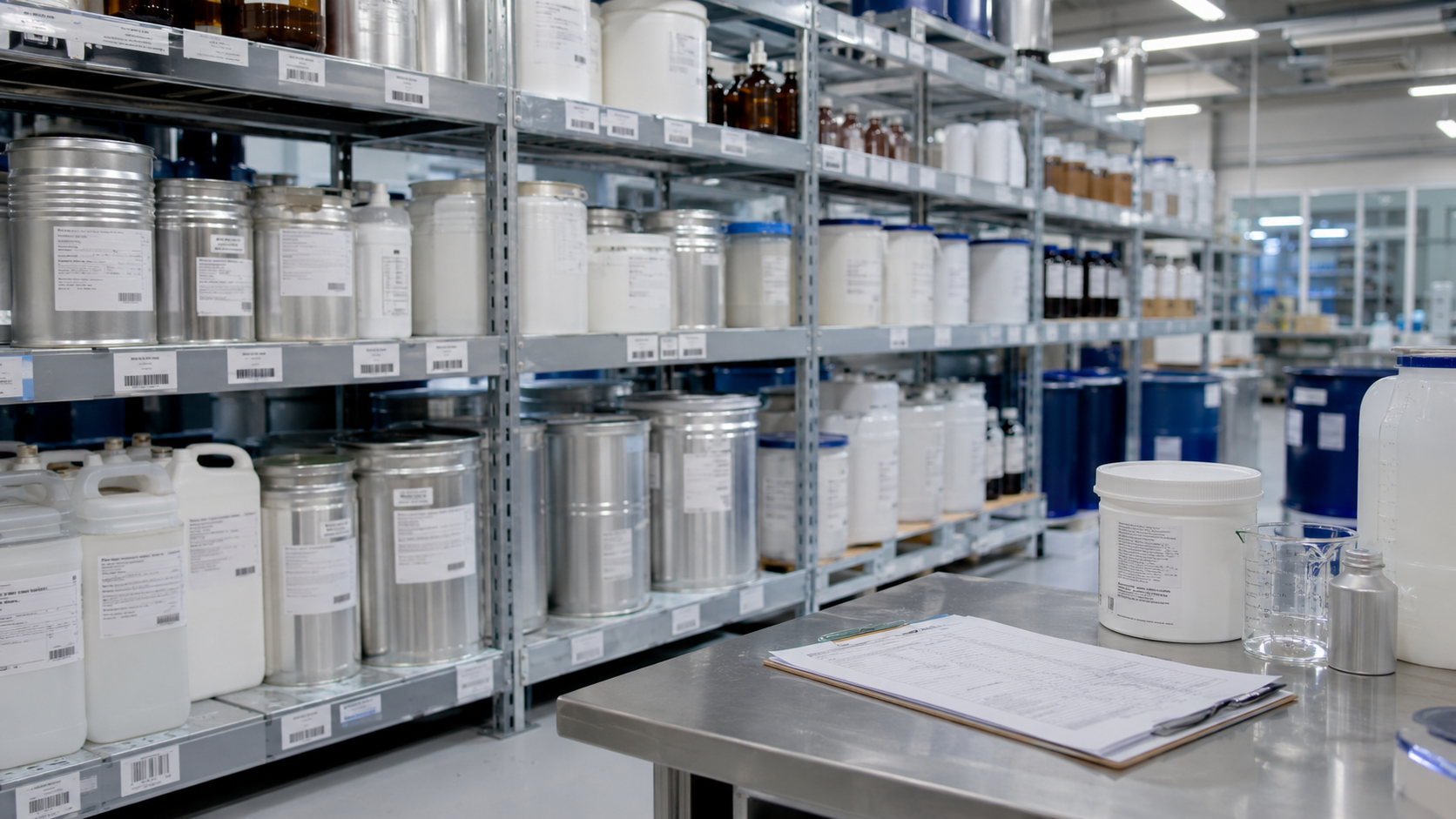
The control points begin at ingredient receipt. They require that halal and non-halal materials are never mixed, that storage facilities keep them physically separated, and that this separation is documented and auditable through production. This is a supply-chain segregation and provenance requirement, not a finished-product claim and not, in most cases, a reformulation requirement.
The distinction is practical. It means knowing, ingredient by ingredient, whether a ubiquitous cosmetics input – glycerin, collagen, gelatin, certain emulsifiers, or the alcohol used as a solvent – is of plant, synthetic, or animal origin. Origin, not function, is what a halal control point examines. Most global brands’ compliance data is organized around what an ingredient does: INCI declarations, safety assessments, and concentration limits. The SJPH framework asks a different question about the same ingredient list, and it is a question that conventional cosmetics documentation was never designed to answer.
Some ingredients will require substitution – animal-derived collagen and gelatin have no halal-compliant equivalent from a non-halal-slaughtered source, and ethanol thresholds constrain certain formulations. But the dominant burden is documentary rather than formulatory. Brands with clean botanical ingredient lists face a paperwork problem. Brands with animal-derived actives and undocumented supply chains face a reformulation problem. Those are different orders of difficulty, and the sector coverage has tended to conflate them.
The Infrastructure Vietnam Built for Someone Else
The standard framing of this regulation as a barrier facing Southeast Asian exporters requires a correction where Vietnam is concerned, because the assumption underneath it – that Vietnamese brands face the slow full-assessment route – is wrong.
BPJPH recognizes foreign halal certification bodies through mutual recognition arrangements, and Vietnam has one. HCA Vietnam holds recognition from BPJPH alongside JAKIM (Malaysia), the GCC Accreditation Center, MUIS (Singapore), MOIAT (UAE), and CICOT (Thailand). A Vietnamese manufacturer certifying through HCA is on the faster of the two available paths, not the five-month domestic-assessment route that brands from countries without a recognized body must take.
The national infrastructure is broader than a single certifier. HALCERT, the National Halal Certification Center operating under QUACERT within the Ministry of Science and Technology, was established under the Prime Minister’s February 2023 program on developing Vietnam’s halal industry to 2030. It is pursuing recognition agreements with BPJPH, JAKIM, GAC, and SMIIC. A draft national decree includes preferential interest rates on halal-related investment and government subsidies for first-time certification – explicitly designed to make the process accessible to small and medium enterprises rather than only to large corporates.
Roughly a thousand Vietnamese enterprises have obtained or are pursuing halal certification, according to the Ministry of Agriculture. Almost all of them are in food and agriculture. The infrastructure Vietnam built for its halal export ambitions was designed around agricultural products, and the cosmetics sector has largely not drawn on it.
That is the actual V-beauty problem here, and it is not the one the consultancy coverage describes. Vietnamese beauty brands are not blocked by a missing certification pathway. They are behind because the pathway that exists was built for a different industry, and nobody in beauty has walked it.
The Same Gap, Two Markets
The requirement Indonesia is imposing – documented ingredient origin, physical segregation, auditable supply-chain traceability – is not a halal-specific demand dressed in religious language. It is a traceability standard, and Vietnamese beauty brands have encountered it before under a different name.
COSMOS and NATRUE certification, the standards that function as gatekeepers to European premium natural beauty retail, do not certify products. They certify supply chains. Every ingredient above a defined threshold must come from a documented source, processed by permitted methods, through audited facilities. Vietnamese brands pursuing COSMOS have run into the same wall: the turmeric from Hưng Yên is real, the centella from Lâm Đồng is real, and the agricultural documentation connecting them to a certifiable supply chain does not exist.
BPJPH asks for provenance and segregation. COSMOS asks for provenance and processing compliance. Both are answered by the same underlying investment: knowing where each ingredient came from, proving it, and demonstrating that it stayed separated from non-conforming material through production. A brand that builds that dataset for one has built most of it for the other.
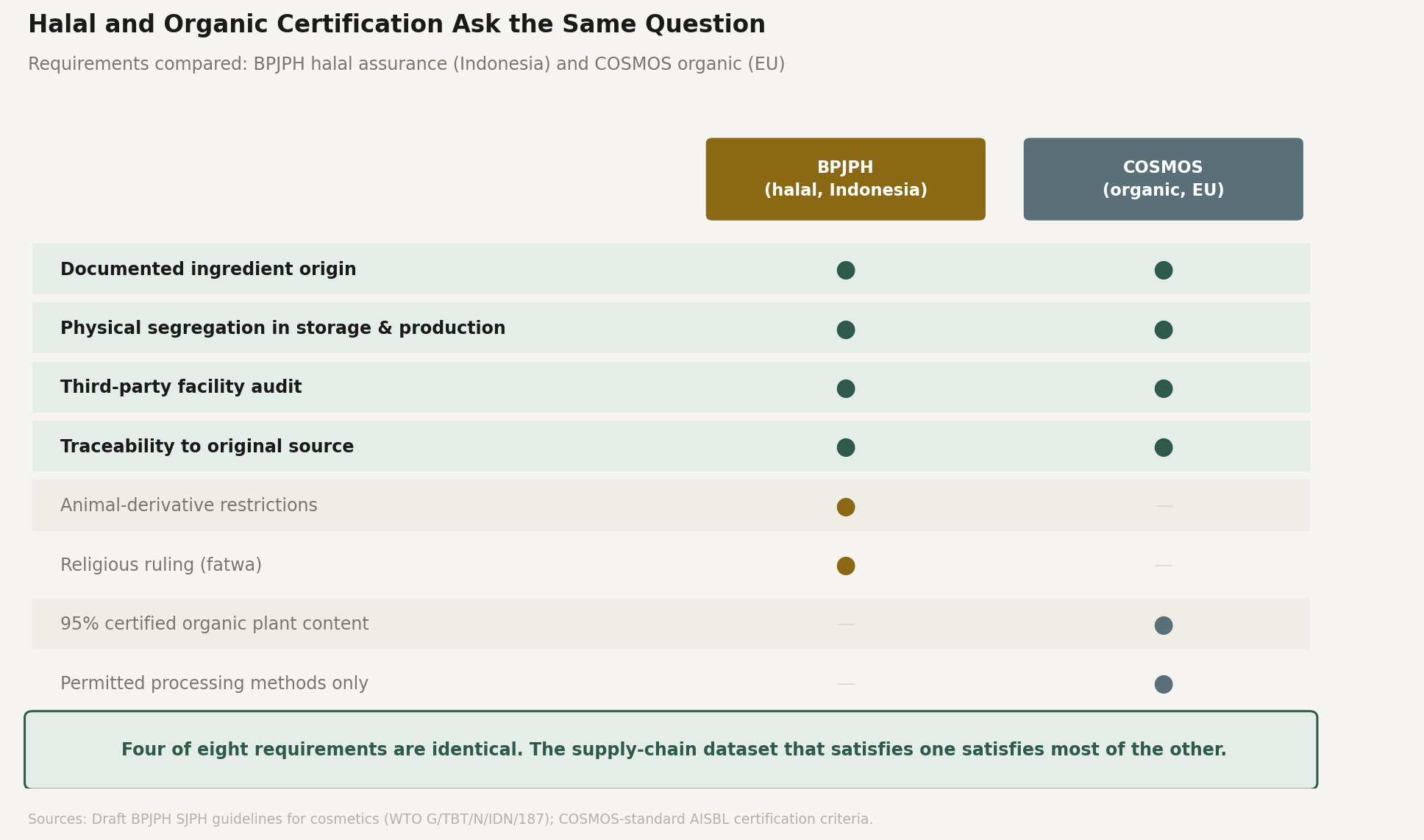
This is the argument that reframes the October deadline for V-beauty. Treated as an Indonesian compliance cost, supply-chain traceability is a defensive expense against losing a single market. Treated as infrastructure, it is the shared prerequisite for two distinct export propositions: halal-certified access across Indonesia, Malaysia, and the wider OIC bloc, where certificates issued under recognized arrangements travel; and COSMOS-substantiated access to European natural beauty retail, where botanical provenance is the entire value proposition.
Vietnamese brands whose positioning rests on ingredient origin – Hưng Yên turmeric, Đắk Lắk coffee, Mekong Delta rice – are selling provenance as their differentiator while lacking the documentation to prove it in any market that asks. The two certification regimes are asking the same question from opposite directions.
What October Sorts
The deadline will not primarily produce compliance. There is a two-year sell-through allowance for stock in packaging already printed, which softens the immediate shelf impact and means October will look less dramatic on Indonesian shelves than the enforcement language suggests. What it will produce is a divide between brands that treated ingredient provenance as a data problem to solve and brands that treated it as a certificate to obtain.
For Vietnamese beauty specifically, the honest read is neither the alarm of the consultancy coverage nor complacency. The certification pathway exists and is comparatively fast. The government subsidy framework exists. The ingredient profile – plant-derived, minimally animal-dependent – is structurally favorable in a way that most global brands’ portfolios are not.
What does not exist is the traceability documentation, and that has been the recurring finding across every export barrier V-beauty encounters. Clean beauty claims in Europe fail on it. Organic certification fails on it. Now halal certification asks the same question, and most Vietnamese cosmetics brands, unlike a thousand Vietnamese food exporters, have no answer prepared.
The deadline is a sorting event, but not the one being reported. It sorts brands that can document their supply chain from brands that can only describe it.
Sources
- BPJPH (Ministry of Religious Affairs, Indonesia) – Cosmetic Products Must Have Halal Certification by October 2026
- WTO ePing SPS & TBT Platform – notifications G/TBT/N/IDN/187 (draft cosmetics SJPH guidelines, 4 June 2026) and G/TBT/N/IDN/160/Add.2 (draft HS code list, November 2025): https://epingalert.org/
- CIRS Group – Indonesia Publishes Draft Guidelines for the Implementation of the Halal Assurance System for Cosmetics
- Assegaf Hamzah & Partners – BPJPH Issues Administrative Sanctions Regulation Ahead of October 2026 Mandatory Halal Expansion
- Makarim & Taira S. – Your Guide to Halal Certification in Indonesia: Key Changes under Government Regulation No. 42 of 2024
- Cleo Labs – Indonesia’s halal certification deadline for cosmetics is 17 October 2026, but the rules defining a compliant ingredient supply chain are still open for public comment until 2 August
- HALCERT (National Halal Certification Center, QUACERT / Ministry of Science and Technology, Vietnam): https://halcert.mst.gov.vn/en/
- BPJPH Regulation Perkaban No. 3/2023 – Accreditation and Conformity Assessment of Foreign Halal Certification Bodies
- in-cosmetics – Indonesia’s mandatory Halal cosmetics regulations 2026 (BPJPH statement on no further extensions; packaging sell-through allowance)
- COSMOS-standard AISBL, certification criteria; NATRUE Label Criteria v3.9