Most guides to buying skincare in Vietnam are written by people who have never been here. They list Watsons and Guardian as if they’re interchangeable, recommend products that aren’t available in every city, and miss the fundamental thing that shapes this market: Vietnamese consumers have largely chosen Korean skincare over their own local brands, and the retail infrastructure reflects that choice.
I live in Hanoi. This guide covers where to buy, what things actually cost on the ground, which Vietnamese products are worth your money, and what to skip.
Fast track:
- Where to buy in Hanoi → Retail channels
- Best Vietnamese products with verified prices → What to buy
- Pharmacy finds for acne-prone skin → Decumar
- Import pricing reality → Are Korean brands cheap here?
- Avoiding fakes → Where to Buy Vietnamese Skincare and Avoid Fakes
- Full Vietnamese skincare context → Vietnamese Skincare: The Complete Guide
First Thing to Know: Hanoi and Ho Chi Minh City Are Different Markets
Every international guide to Vietnamese skincare treats the country as one market. It isn’t.
Watsons is a Ho Chi Minh City chain. If you’re in Hanoi expecting to walk into a Watsons, you won’t find one. The two cities have different retail infrastructures, different brand footprints, and – to some extent – different consumer preferences. Hanoi’s beauty retail is anchored by Guardian and a network of smaller independent drogeries. Ho Chi Minh City has both Watsons and Guardian, plus a denser concentration of brand flagship stores in malls like Vincom and Aeon.
This matters because most English-language buying guides are written with Ho Chi Minh City in mind or without distinguishing between the two. If you’re based in or visiting Hanoi, the channel recommendations you’ll read elsewhere may not apply.
Retail Channels in Hanoi
Guardian – The Main Chain
Guardian is the primary organized beauty retail chain in Hanoi, with 99 stores nationwide across major cities. It’s operated by Dairy Farm Group and has been in Vietnam since 2011. In Hanoi, Guardian stores are easy to find in major malls and shopping streets.
What’s there: A wide range of Korean, Japanese, Western, and some Chinese brands. Asian products dominate the shelves – Korean brands are the most prominent, followed by Japanese. Western brands are present but occupy less floor space. Chinese brands have a small physical presence in chain retail, though they’re growing fast on Shopee and Lazada.
Local brands: Cocoon is the notable exception – it has a real presence in Guardian, including dedicated shelf space in some locations. It’s easy to find and prominently displayed, which reflects both the brand’s commercial success and its deliberate push into mainstream retail. Other Vietnamese brands are largely absent from Guardian’s shelves.
Price point: Guardian is mid-tier retail. You’re not getting the cheapest prices here, but you’re getting verified stock and a returns policy.
Smaller Independent Drogeries
Outside Guardian, Hanoi has a network of smaller independent beauty stores that carry a broader range of local brands at slightly lower prices. This is where you’ll find Herbario and other Vietnamese brands that don’t have Guardian distribution. Selection varies by store and owner – you can’t assume every independent store carries the same brands.
Pharmacy Chains
Long Châu and Pharmacity are the two major pharmacy chains with significant Hanoi presence. This is the right channel for Decumar – a brand that’s pharmacy-distributed rather than beauty-retail distributed. If you’re looking for Decumar’s sunscreen or acne treatments, pharmacy chains are where to start, not Guardian.
Online: Shopee and Lazada
For Hanoi-based buyers, Shopee and Lazada are serious purchase channels – not just a backup. Vietnamese consumers use e-commerce heavily for beauty products, and official brand storefronts on both platforms offer genuine products at prices that often undercut physical retail, particularly during sale events (11.11, 12.12, flash sales).
Practical rule: only buy from official brand storefronts with verified badges – not from individual reseller listings, regardless of price or review count.
If You’re in Saigon
The same logic applies in reverse. HCMC has both Watsons and Guardian, plus the country’s densest concentration of brand flagship stores in Vincom and Aeon malls – including Cocoon’s own retail presence. Watsons carries brands you won’t find in Guardian (COSRX among them), so if a specific Korean brand is on your list, check Watsons first.
Pharmacy chains (Pharmacity, Long Châu) operate nationwide, so the Decumar advice holds unchanged. Local prices for Vietnamese brands are the same as in Hanoi – the reference table below applies in both cities.
What the Market Actually Looks Like
Walking around Hanoi’s Guardian stores, the retail picture is clear: this is predominantly a Korean skincare market with a growing Vietnamese challenger.
Korean brands dominate floor space and consumer attention. Some By Mi and Innisfree are well-represented. Most consumers browsing the aisles in Guardian are reaching for Korean products. Japanese brands – Shiseido, Rohto-Mentholatum, Biore – have a meaningful presence, particularly in the SPF category.
What’s interesting about Cocoon: despite the K-beauty dominance, Cocoon has carved out a genuine retail position in Guardian. The brand has dedicated shelf space in multiple Hanoi locations – unusual for any domestic Vietnamese brand in an international retail chain. Outside Cocoon, domestic Vietnamese brands largely don’t have this kind of visibility in chain retail.
COSRX is not in Guardian. Guardian’s online store returns no results for the brand. If COSRX is specifically what you’re looking for in Hanoi, Shopee and Lazada official storefronts are your realistic options. Watsons in Ho Chi Minh City carries COSRX, but that’s a different city.
The Best Skincare in Vietnam: What to Buy
Cocoon – The Most Accessible Local Brand
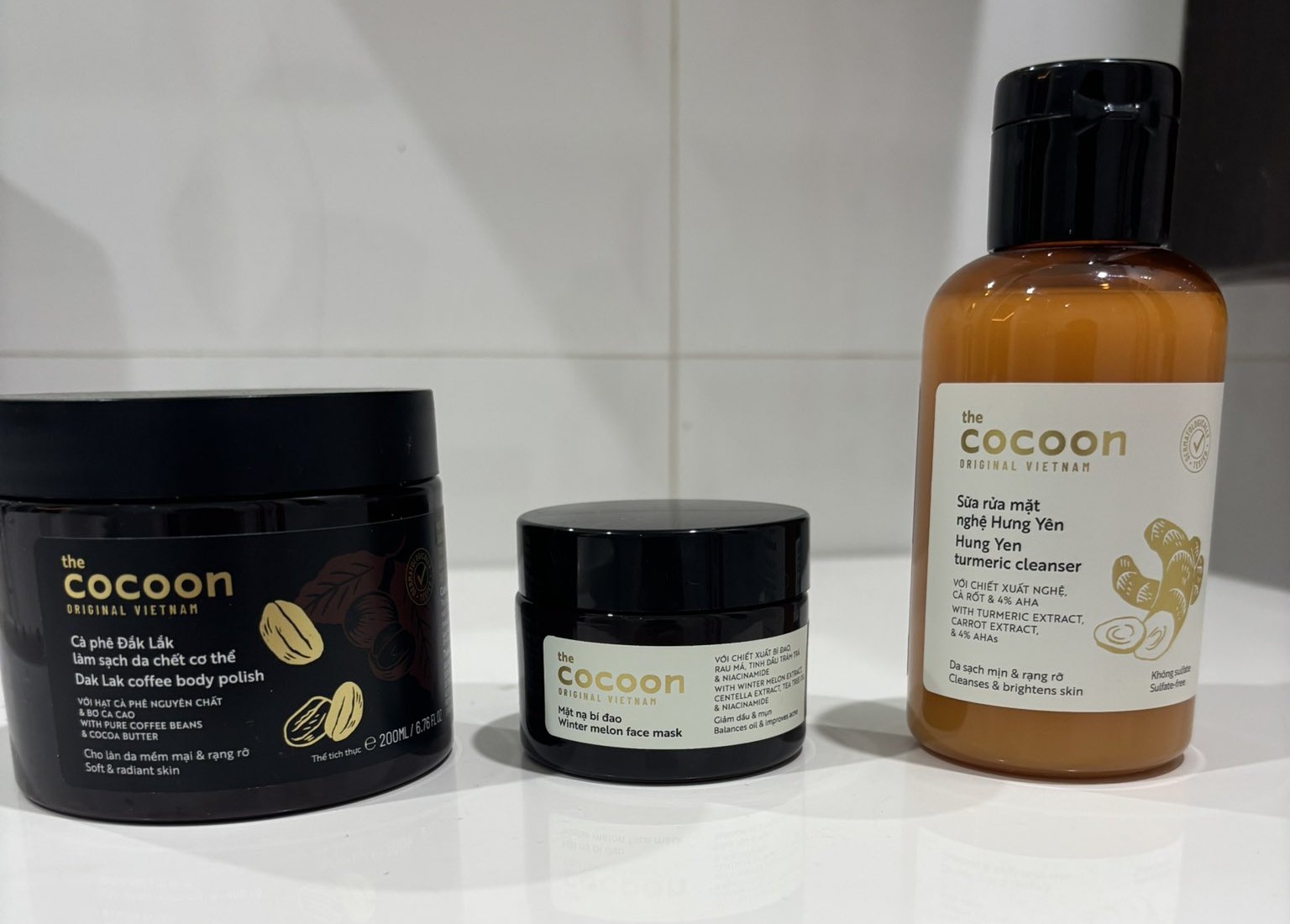
Cocoon is the easiest Vietnamese brand to find in Vietnam – available in Guardian, official Shopee and Lazada storefronts, and through smaller independent stores.
Verified local prices (Hanoi, April 2026):
- Dak Lak Coffee Body Polish 200ml: 241,000 VND (~$9.50 USD)
- Winter Melon Face Mask: 132,000 VND (~$5.20 USD)
- Hung Yen Turmeric Cleanser: 192,000 VND (~$7.60 USD)
- SPF (Winter Melon Sun Fluid): approximately 280,000–320,000 VND (~$11–13 USD)
For context: the same Coffee Body Polish costs $23–34 USD on cocoonoriginal.com (the US storefront). Buying in Vietnam saves you roughly 60% on body care. The SPF gap is similar – $11–13 USD locally versus $32–47 USD internationally.
Best products to prioritise:
Cocoon Winter Melon Sun Fluid SPF50+ – the most practical daily purchase. Seven premium UV filters including Tinosorb M and Tinosorb A2B, tested at HelioScreen France, water-resistant for 80 minutes. At local prices, it’s exceptional value. This is the product most worth stocking up on if you’re visiting.
Cocoon Dak Lak Coffee Body Polish – the brand’s most iconic product and the one with the biggest international price gap. At 241,000 VND locally, it’s affordable daily-use body care. The emulsified formula rinses cleanly, cocoa butter leaves skin soft, and the Dak Lak origin story is authentic. Buy in Vietnam, not online.
Cocoon Hung Yen Turmeric Cleanser – sulphate-free with turmeric extract, carrot extract, and 4% AHAs. Gentle enough for daily use, effective enough that the AHA inclusion makes a difference for texture over time. At 192,000 VND, it’s good value.
Cocoon Winter Melon Face Mask – at 132,000 VND the lowest-stakes entry point. Centella, winter melon, niacinamide. Use 1–2 times per week as an oil-control and soothing mask.
For the full Cocoon breakdown: Cocoon Vietnam: Everything You Need to Know
Herbario – Best for Oily and Sensitive Skin
Herbario is harder to find than Cocoon – not in Guardian, present in some independent drogeries, and reliably available through the official Shopee Mall storefront. The brand organises products around traditional Vietnamese herbal ingredients.
Verified pricing (Shopee Official Store, April 2026):
- Centella & Fish Mint Serum 30ml: approximately 212,500 VND (~$8.40 USD)
- Centella & Fish Mint Gel 30ml: approximately 215,000 VND (~$8.50 USD)
- Basic Acne Care Set (3 products): approximately 300,000 VND (~$11.80 USD)
Best product: Centella & Fish Mint Serum – centella asiatica for barrier support, diếp cá (fish mint) for sebum regulation, and niacinamide for oil control. If you have oily or congested skin and want a Vietnamese alternative to COSRX centella products, this is the direct comparison at a lower price point.
For the full Herbario profile: Herbario Vietnam: Natural Skincare Rooted in Herbal Tradition
Decumar – Best for Acne-Prone Skin on a Budget
Decumar is pharmacy-distributed, made by CVI Pharma, and priced accordingly. In Pharmacity and Long Châu you’ll find the full range at prices that reflect pharmaceutical rather than beauty retail margins.
Verified pricing (Pharmacity, April 2026):
- DECUMAR Clean Cleanser: 81,000 VND (~$3.20 USD)
- DECUMAR Advanced Moisturising Gel: 89,000 VND (~$3.50 USD)
- DECUMAR NANO THC Cleanser: 99,000 VND (~$3.90 USD)
- DECUMAR NANO THC Acne Gel: 105,000 VND (~$4.10 USD)
- DECUMAR Advanced Sunscreen SPF50+: approximately 130,000 VND (~$5.10 USD)
The hero ingredient is Nano THC – nano-encapsulated curcumin with documented antibacterial and anti-inflammatory properties, combined with niacinamide, centella, and green tea. The sunscreen at 130,000 VND is the most affordable SPF option in Vietnam with a credible acne-safe formulation.
International note: Decumar has no official international store. Grey-market eBay resellers charge $30–35 USD for products that cost $3–5 USD at Pharmacity. Buy in Vietnam only.
Are Korean Brands Cheap in Vietnam?
Short answer: no – not compared to buying Korean skincare through international online retailers.
In Guardian Hanoi, Some By Mi products run 340,000–460,000 VND (~$13–18 USD) at regular pricing, with periodic 20% promotions. COSRX is not available in Guardian at all. These prices are comparable to or higher than buying the same products through YesStyle or iHerb internationally. The assumption that buying Korean skincare “in Asia” means buying it cheaply doesn’t hold in Vietnam – you’re paying Vietnamese import markup, not Korean domestic pricing.
The practical implication: for K-beauty and J-beauty, there’s no strong price argument for buying in Vietnam over international online retailers. For Vietnamese brands – Cocoon, Herbario, Decumar – buying in Vietnam offers genuine savings of 60–70%.
Quick Reference: What to Buy and Where
| Product | Price (VND) | Price (USD) | Where |
| Cocoon Winter Melon Sun Fluid SPF50+ | ~280,000–320,000 | ~$11–13 | Guardian, Shopee Official |
| Cocoon Coffee Body Polish 200ml | ~241,000 | ~$9.50 | Guardian, Shopee Official |
| Cocoon Turmeric Cleanser | ~192,000 | ~$7.60 | Guardian, Shopee Official |
| Cocoon Winter Melon Face Mask | ~132,000 | ~$5.20 | Guardian, Shopee Official |
| Herbario Centella & Fish Mint Serum | ~212,500 | ~$8.40 | Shopee Official, independent stores |
| Herbario Basic Acne Set | ~300,000 | ~$11.80 | Shopee Official |
| Decumar Sunscreen SPF50+ | ~130,000 | ~$5.10 | Pharmacity, Long Châu |
| Decumar Acne Gel NANO THC | ~105,000 | ~$4.10 | Pharmacity, Long Châu |
Navigating the Counterfeit Risk
The counterfeit cosmetics situation in Vietnam is active – Vietnamese authorities documented nearly 5,000 counterfeit cosmetics incidents in 2024. The risk is real but manageable if you stick to the right channels.
Low risk: Guardian, pharmacy chains (Long Châu, Pharmacity), and official brand Shopee/Lazada storefronts with verified badges.
Higher risk: Individual marketplace sellers, unbranded small stores without clear sourcing, and products priced significantly below the reference prices in the table above.
Full verification guide: Where to Buy Vietnamese Skincare and Avoid Fakes
FAQ
Is skincare cheaper in Vietnam than buying online internationally? For Vietnamese brands – significantly yes. Cocoon, Herbario, and Decumar are 60–70% cheaper at local prices than at international retail. For Korean and Japanese imports, not really – import markup in Vietnam often matches or exceeds international online retailers.
Is Watsons available in Hanoi? No. Watsons operates in Ho Chi Minh City. Hanoi’s main organized beauty retail chain is Guardian.
Where can I find Vietnamese brands in Hanoi? Cocoon is in Guardian. Herbario and other local brands are in smaller independent drogeries and on Shopee/Lazada Official stores. Decumar is in Pharmacity and Long Châu pharmacies.
What’s the best Vietnamese skincare product to buy as a gift? Cocoon Coffee Body Polish – recognizable scent, distinctive Vietnamese ingredient story, attractive packaging, available in Guardian at 241,000 VND.
Can I find English labels on products in Vietnam? Cocoon has bilingual Vietnamese/English packaging. Herbario and Decumar are primarily Vietnamese-language. INCI ingredient lists follow international naming conventions regardless of label language.