Turmeric is everywhere in skincare right now. It’s also been in Vietnamese kitchens, medicine cabinets, and beauty rituals for centuries – not as a trend, but as a functional ingredient with a documented history of use. The gap between the marketing and the evidence is worth closing.
This article covers what turmeric and its active compound curcumin actually do in skincare, where the science is solid and where it’s still developing. How Vietnamese brands – particularly Cocoon’s Hung Yen line – apply the ingredient in a way that reflects genuine formulation thinking rather than just trend-chasing.
Fast track:
- What curcumin does → The science
- The staining and bioavailability problem → The limitations
- Vietnamese turmeric in skincare → Hung Yen as a case study
- Full Vietnamese skincare context → Vietnamese Skincare: The Complete Guide
Turmeric in Vietnam: More Than a Beauty Ingredient
Before getting into the science, the cultural context matters.
Turmeric (nghệ in Vietnamese) has been used in Vietnamese traditional medicine for wound healing, reducing inflammation, and treating skin conditions for generations. It appears in Vietnamese cooking daily – in rice dishes, curries, and the yellow color of banh xeo (crispy pancakes). Vietnamese women have historically used fresh turmeric paste as a topical skin treatment, particularly for post-partum skin recovery, brightening, and managing inflammation.
Hung Yen province, southeast of Hanoi in the Red River Delta, is one of Vietnam’s primary turmeric-growing regions. When Cocoon built a skincare line around Hung Yen turmeric, they were drawing on a genuine agricultural and cultural tradition – not importing an exotic ingredient story.
This matters because it explains why Vietnamese brands approach turmeric differently than Western brands that picked it up as a trend in the 2010s. The ingredient is familiar, locally sourced, and embedded in existing knowledge about how it behaves on skin.
What Curcumin Actually Does: The Science
Curcumin is the primary active polyphenol in turmeric – the compound responsible for both the yellow color and most of the documented biological activity. It constitutes roughly 2–8% of turmeric by weight.
The evidence base for curcumin in skincare is genuine, though still developing. Here’s an honest reading:
Anti-inflammatory activity – strong evidence. Multiple peer-reviewed studies confirm curcumin’s ability to modulate inflammatory signaling pathways, including NF-κB, which is involved in a wide range of skin inflammatory conditions. A 2024 systematic review published in Clinical, Cosmetic and Investigational Dermatology confirmed curcumin’s efficacy across atopic dermatitis, psoriasis, chronic wounds, and infections. This is the most consistently supported benefit – curcumin is a legitimate anti-inflammatory active.
Antioxidant activity – well documented. Curcumin scavenges free radicals and reduces oxidative stress. A 2025 review in Frontiers in Pharmacology confirmed curcumin’s role in preventing UV-induced photoaging, including inhibition of melanin production and protection of dermal fibroblasts from UVA stress. The antioxidant mechanism is solid.
Brightening / melanin inhibition – promising. Curcumin inhibits tyrosinase – the enzyme responsible for melanin synthesis. This is the mechanism behind its brightening and pigmentation-reduction claims. A 2025 randomized, double-blind, placebo-controlled clinical trial found that oral turmeric extract supplementation reduced facial blemishes from day 30 and improved skin hydration and barrier integrity from day 15. The topical brightening evidence is less extensive than the oral evidence, but the mechanism is plausible.
Wound healing and collagen synthesis – documented. Curcumin accelerates wound healing by stimulating fibroblast proliferation and collagen deposition. This is relevant to its use in post-acne recovery and skin barrier repair.
Acne – early evidence. Several studies show curcumin’s antibacterial and anti-inflammatory properties reduce acne severity. The evidence is promising, but clinical trial data specifically for topical curcumin on acne is still limited compared to established treatments like benzoyl peroxide or salicylic acid.
The Limitations: Staining, Bioavailability, and What to Be Skeptical Of
Curcumin is not a straightforward topical ingredient. There are two real challenges that affect how useful it actually is in a skincare formula.
Bioavailability and skin penetration. Curcumin is highly lipophilic (oil-soluble) and has poor water solubility, which limits its penetration through the skin’s aqueous surface layer. Many in vitro studies show impressive effects at concentrations that are difficult to achieve with standard topical formulations. Advanced delivery systems – nanoparticles, liposomes, nanoemulsions – significantly improve penetration, but most mass-market skincare products don’t use these. This doesn’t mean turmeric extracts are useless topically, but it means the dose-response relationship is less predictable than lab studies suggest.
Staining. Raw turmeric stains intensely yellow. Anyone who has cooked with fresh turmeric knows this. Topical raw turmeric will stain skin, clothing, and towels. Well-formulated skincare products use turmeric extract (not raw powder) to address this – but it’s worth noting that the extract and the raw ingredient are not functionally equivalent. The staining concern is one reason why Vietnamese brands that use “turmeric” often specify extract rather than the raw ingredient.
What to be sceptical of: claims that turmeric is a “natural retinol alternative” are not supported by evidence – the mechanisms are entirely different. Claims about turmeric permanently eliminating hyperpigmentation need to be assessed against the evidence that brightening from tyrosinase inhibition requires consistent use and works gradually, not dramatically. Turmeric is a supporting brightening active, not a standalone pigmentation treatment.
Hung Yen Turmeric: The Vietnamese Case Study
Cocoon’s Hung Yen Turmeric line is the most internationally accessible example of Vietnamese turmeric skincare, and it demonstrates why the Vietnamese approach to this ingredient is worth paying attention to.
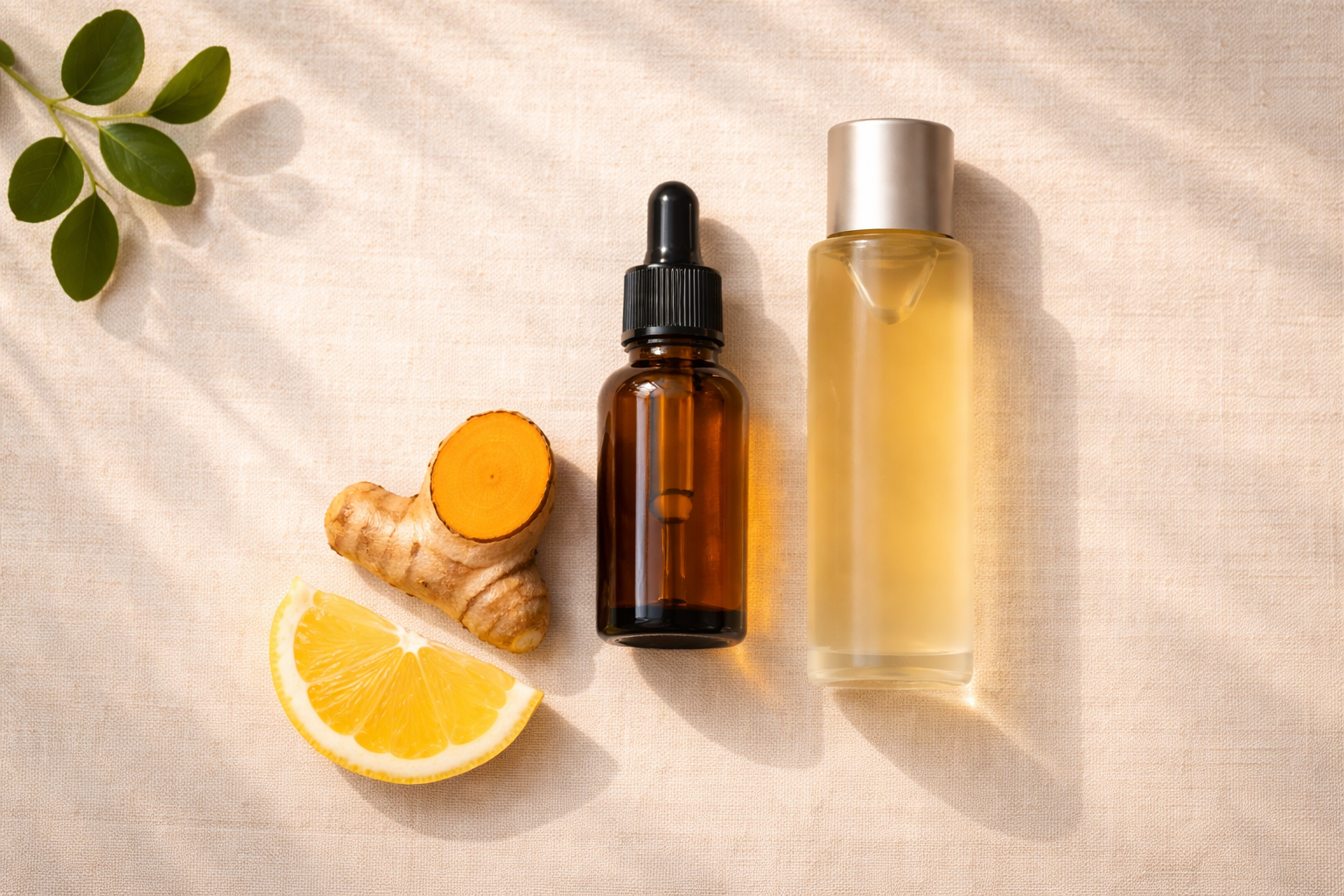
The key product is the Hung Yen Turmeric Brightening Serum – a 22% ascorbyl glucoside (a stable vitamin C derivative) combined with turmeric extract. This formulation makes specific functional sense:
Why ascorbyl glucoside rather than raw turmeric or curcumin alone:
Ascorbyl glucoside is a vitamin C derivative that converts to L-ascorbic acid in the skin. It’s more stable than pure vitamin C and less irritating – appropriate for everyday use rather than the careful rotation required by high-percentage L-ascorbic acid formulas. At 22%, the concentration is genuinely high for this derivative.
The pairing with turmeric extract is not arbitrary. Both ascorbyl glucoside and curcumin inhibit tyrosinase through complementary mechanisms – vitamin C disrupts melanin synthesis at a different point in the pathway than curcumin. The combination creates a more comprehensive brightening approach than either ingredient alone.
A 2024 study confirmed an additive antioxidant effect when curcumin and vitamin C are combined – the two compounds work synergistically rather than redundantly.
What the Hung Yen line actually delivers:
- Gradual brightening over consistent use (weeks, not days)
- Post-acne mark fading through melanin inhibition
- Antioxidant protection against UV-induced damage
- Anti-inflammatory support for reactive or sensitised skin
What it doesn’t deliver: dramatic or fast results. Ascorbyl glucoside is slower-acting than L-ascorbic acid by design. The turmeric extract is a supportive brightening and anti-inflammatory co-active, not the primary driver of visible change.
The non-negotiable caveat: Brightening actives – including both ascorbyl glucoside and curcumin – increase photosensitivity. Using this serum without SPF 50+ will worsen pigmentation rather than improve it. The serum is only half the equation. SPF is the other half, and it’s not optional.
For SPF recommendations appropriate for the Vietnamese climate: Best Sunscreens for Humid Weather
How Turmeric Fits into a Vietnamese Skincare Routine
Turmeric-based products fit into the treatment step of a routine – after cleansing and toning, before moisturizer and SPF. They are not a base or a finishing product.
In the morning: Apply turmeric serum after toner, before SPF. SPF follows immediately and is non-negotiable. Do not apply a brightening serum in the morning without SPF.
In the evening: Evening application works well because there’s no sun exposure window to manage. Apply after toner, and let it absorb for 60 seconds before moisturizer.
Frequency: Daily use is appropriate for ascorbyl glucoside. If you’re using L-ascorbic acid or other strong actives in your routine, stagger rather than layer – too many brightening actives at once increases irritation risk without proportionally increasing benefit.
Don’t combine with: high-percentage retinol, AHAs at meaningful concentrations, or strong exfoliants in the same application. These combinations can irritate without additive benefit. Layering with centella-based soothing products (like a lotus toner first) is appropriate and often beneficial – centella supports barrier function that brightening actives can stress.
FAQ
Does turmeric stain skin yellow when used in skincare? Well-formulated skincare products use turmeric extract, not raw turmeric powder – the staining risk is significantly reduced. If you’re applying raw, fresh turmeric from your kitchen to your face, it will stain. Commercial products are formulated specifically to avoid this. If staining occurs, it typically washes off with a gentle cleanser.
Is turmeric good for acne? As a supporting ingredient, yes. Curcumin’s antibacterial and anti-inflammatory properties reduce redness and support recovery around blemishes. It’s not a primary acne treatment – it doesn’t clear pores or kill Propionibacterium acnes the way BHA or benzoyl peroxide does. Think of it as a calming, recovery-supporting ingredient used alongside a dedicated acne treatment, not instead of one.
What is the difference between turmeric and curcumin in skincare? Turmeric is the whole plant root. Curcumin is the primary active polyphenol extracted from it – the compound responsible for most of the documented biological activity. Products may list either “turmeric extract” (which contains curcumin and other compounds) or “curcumin” (the isolated compound). Both can be effective; standardized curcumin extracts allow for more consistent dosing.
Is Cocoon’s Hung Yen serum suitable for sensitive skin? The 22% ascorbyl glucoside is gentler than L-ascorbic acid, but it’s still active at a meaningful concentration. If your skin is currently reactive or compromised, start with the Hung Yen Turmeric Toner (lower concentration) before moving to the serum. Patch test before full application.