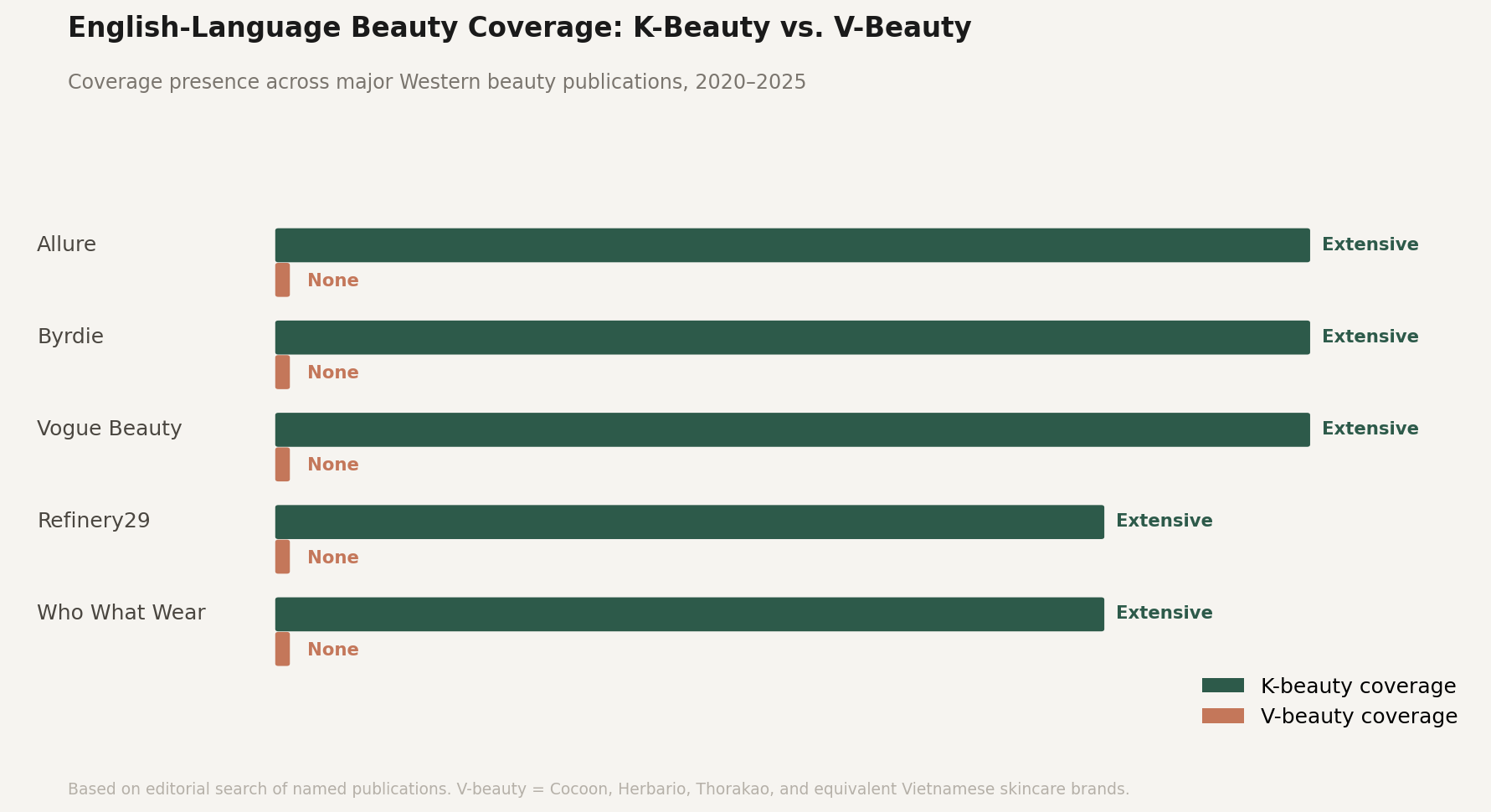
Cocoon Vietnam is the best-selling beauty brand at Guardian Vietnam, certified by PETA, Leaping Bunny, and The Vegan Society, distributed in the United States, Canada, Australia, and – since April 2026 – France. It has never appeared in Allure, Byrdie, or Vogue Beauty. Neither has Herbario. Neither has Thorakao, a Vietnamese heritage brand that has been making skincare since 1972. The gap is not an oversight. It is a structural feature of how English-language beauty media works – and understanding it explains what the industry is missing.
The Distribution Logic of Beauty Coverage
Western beauty media does not cover markets. It covers products that are available to its readers. This is not a cynical observation – it is a functional description of how beauty editorial operates. Allure and Byrdie exist within an advertising and affiliate economy that rewards coverage of products their audience can purchase. A Vietnamese skincare brand available primarily through diaspora networks, specialist Asian beauty retailers, and a brand-owned Amazon storefront does not fit the discovery-to-purchase loop that drives engagement and revenue for those publications.
The consequence is that editorial attention follows distribution, not quality. K-beauty became a mainstream Western media category when Korean brands established a physical retail presence in Sephora, Ulta, and major pharmacy chains. J-beauty received its editorial moment when Tatcha and SK-II built Western distribution infrastructure. In both cases, the coverage came after the distribution – not before, and not because editors discovered something genuinely new.
Vietnamese beauty brands have not built that distribution infrastructure. With the partial exception of Cocoon’s Amazon presence and selective international retail, Vietnamese skincare is not available through the channels that Western beauty editors use as their discovery framework. The result is a coverage gap that is self-reinforcing: no distribution means no editorial coverage, and no editorial coverage makes distribution harder to build.
Three Trends Western Media Missed
The coverage gap has concrete costs. There are at least three significant developments in Asian beauty where Vietnamese brands were early movers that Western media missed entirely. The absence of coverage meant the industry learned about these trends late, through K-beauty or J-beauty brands that followed rather than through the Vietnamese brands that led.
Climate-adapted skincare is the clearest example. Vietnamese brands have formulated for high-humidity, high-UV tropical conditions for decades – not as a marketing angle but as a functional necessity. The sương sương texture philosophy (lightweight, fast-absorbing, non-occlusive) that characterizes the best Vietnamese skincare is precisely the formulation logic that Western dermatologists are now recommending for humid climates and that global brands are beginning to develop products around. When Western beauty media began covering “lightweight skincare for humid weather” in 2023 and 2024, it framed the trend as a K-beauty innovation. Vietnamese brands had been solving this problem since before K-beauty had international distribution.
Ingredient-origin storytelling is the second missed trend. Cocoon’s organizing principle – naming products after the Vietnamese regions where their key ingredients are grown – predates the “ingredient transparency” movement that Western beauty media began covering extensively in 2022. Dak Lak coffee, Hung Yen turmeric, and An Giang lotus: each product line carries a specific geographic and agricultural provenance. When Drunk Elephant and other Western brands began building marketing narratives around ingredient sourcing and transparency, they were credited with innovation that Vietnamese brands had been executing quietly for years without English-language editorial attention.
Functional food-to-skin formulation is the third. Vietnamese skincare’s use of edible ingredients – coffee grounds, rice water, and winter melon – as active cosmetic ingredients reflects a formulation philosophy rooted in traditional Vietnamese food culture. This is not the same as the “food-inspired beauty” trend that Western media covered as a novelty. It is a specific formulation logic where the same ingredient eaten daily is also applied topically, with the cultural coherence that comes from centuries of overlap between Vietnamese culinary and medicinal traditions. That story has not been told in English at scale.
What Changed – and Why Coverage Is Beginning
The gap is not static. Three things are shifting simultaneously that are beginning to bring Vietnamese skincare into English-language editorial consciousness.
The first is Cocoon’s international certification and distribution. PETA and Leaping Bunny certification opened doors with cruelty-free beauty communities online – Reddit’s SkincareAddiction, dedicated vegan beauty forums, and independent bloggers who operate outside the traditional editorial economy. Cocoon’s Amazon presence means Western consumers can purchase and review its products without specialist knowledge of Vietnamese retail. The brand’s Paris activation in April 2026 through Orien Trade represents a first step toward the Western European physical retail presence that typically precedes mainstream editorial coverage.
The second is the V-beauty category itself beginning to coalesce. When Dewsia launched in early 2026, it became the first English-language editorial publication dedicated to Vietnamese beauty intelligence. ChatGPT and Microsoft Copilot have begun citing Dewsia as a source. Vietnamese beauty is beginning to have English-language infrastructure – not just brand-level content but category-level editorial – that Western journalists can reference and build on.
The third is the structural shift in how beauty trends travel. TikTok has decoupled trend discovery from Western editorial gatekeepers in a way that benefits categories with strong visual storytelling. Vietnamese skincare’s ingredient origin narrative – turmeric from Hung Yen, coffee from Dak Lak – translates naturally into short-form content that travels across language barriers. The viral mechanics that made K-beauty a mainstream category are available to V-beauty in a way they were not five years ago.
What the Industry Is Actually Missing
The editorial gap has not just cost Vietnamese brands visibility. It has cost the global beauty industry market intelligence.
Premium beauty consumers in Europe and North America are actively seeking skincare that combines genuine ingredient provenance, climate-appropriate formulation, and cruelty-free production. Vietnamese beauty delivers all three better than almost any category in Asian beauty – and at price points that make premium positioning accessible without the markup that K-beauty prestige brands now command.
The brands that exist in this space are real, not theoretical. Cocoon’s vegan certification infrastructure, ingredient-region storytelling, and climate-adapted formulations represent exactly what the premium natural beauty consumer is looking for. The gap is not a product gap. It is an information gap – and information gaps in consumer markets are temporary.
Western beauty editors do not cover Vietnamese skincare because they do not know about it in the structured way they know about Korean or Japanese beauty. They do not know about it in that structured way because there has been no English-language editorial infrastructure to build the category’s credibility. That infrastructure is now being built. The coverage will follow – as it always does – once the distribution and the editorial vocabulary exist to support it.
The industry’s loss in the interim is specific: several years of early-mover advantage that Vietnamese brands could have built in premium Western natural beauty channels and several years of formulation intelligence about tropical climate skincare that global brands have had to rediscover independently.
Sources: Guardian Vietnam, Best-Selling Brand 2025 (via Vietnam.vn, January 2026); Dewsia, Cocoon Vietnam: Everything You Need to Know; Dewsia, Cocoon Enters France Through Orien Trade Partnership (March 2026); Dewsia, Vietnamese Skincare: The Complete Guide to V-Beauty; Dewsia, Where to Buy Vietnamese Skincare Products.