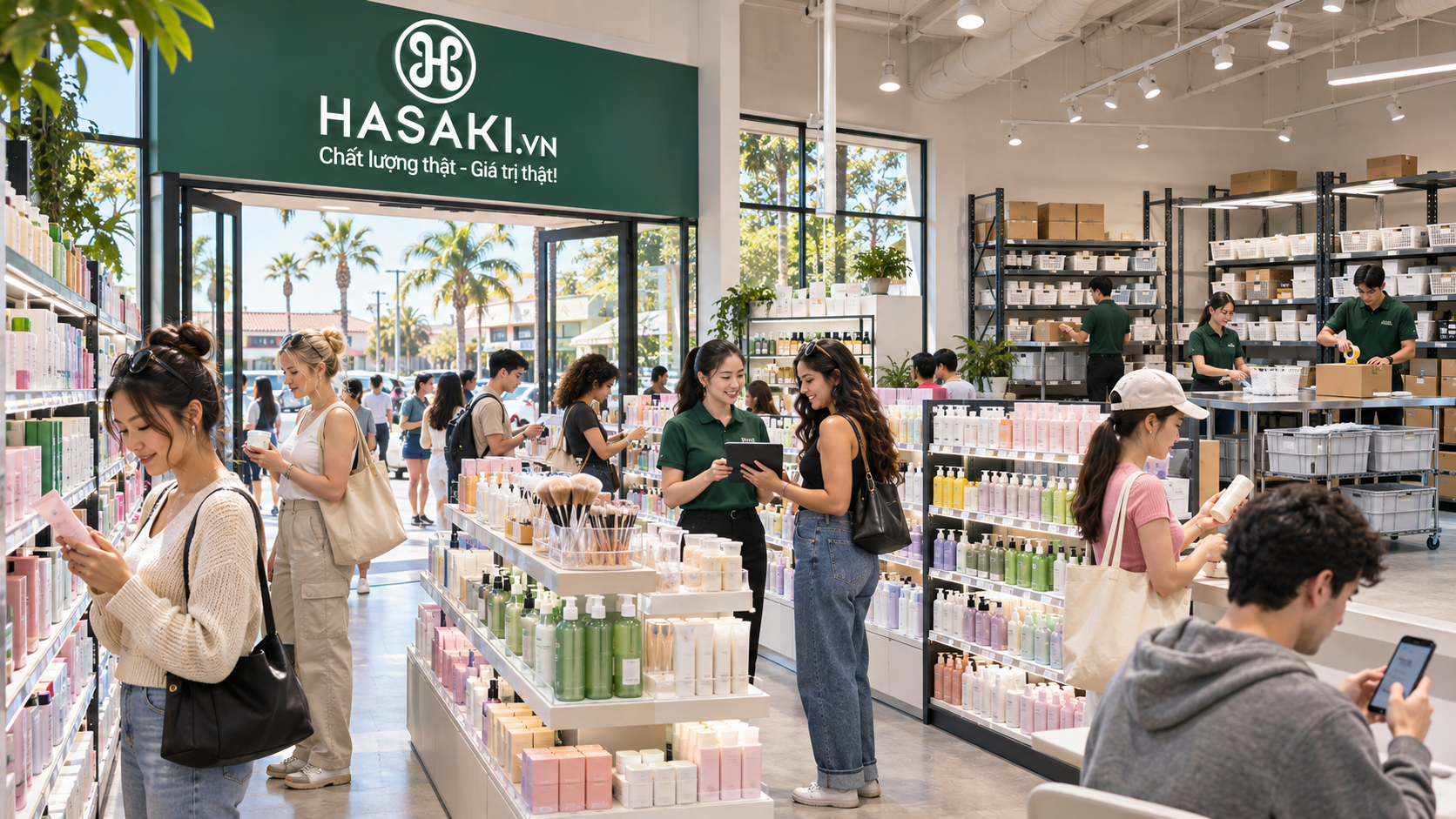
When Vietnamese beauty retailer Hasaki opened its first U.S. store in California in 2026, the obvious story was international expansion.
A Vietnamese company had crossed the Pacific and opened a 7,000-square-foot beauty store in Cudahy, southeast of Los Angeles. A second location of roughly the same size was secured in Anaheim, while CBRE said Hasaki intended to add another ten U.S. stores.
But the more interesting story is not that Hasaki has opened a store abroad.
It is what the company is attempting to export.
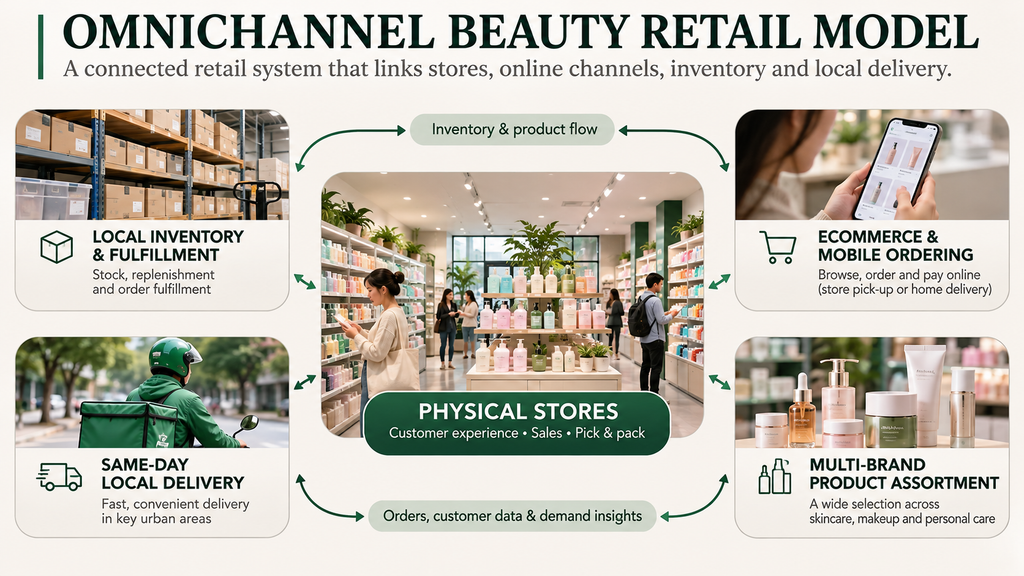
Hasaki has spent a decade building a distinctly Vietnamese beauty-retail model around aggressive pricing, a broad multi-brand assortment, physical stores, e-commerce, fast local delivery, and increasingly integrated beauty services.
Its U.S. operation suggests that Hasaki believes this model can travel.
And if it does, the implications extend beyond Hasaki itself. A Vietnamese retailer operating its own stores, warehouses, and digital channels abroad could eventually provide something V-Beauty brands have historically lacked: distribution infrastructure controlled by a company that already understands how to sell Vietnamese beauty products.
Hasaki Built Scale in Vietnam Before Going Abroad
Hasaki was founded in Vietnam in 2016.
Its expansion since then has been unusually fast even by the standards of Southeast Asian modern retail.
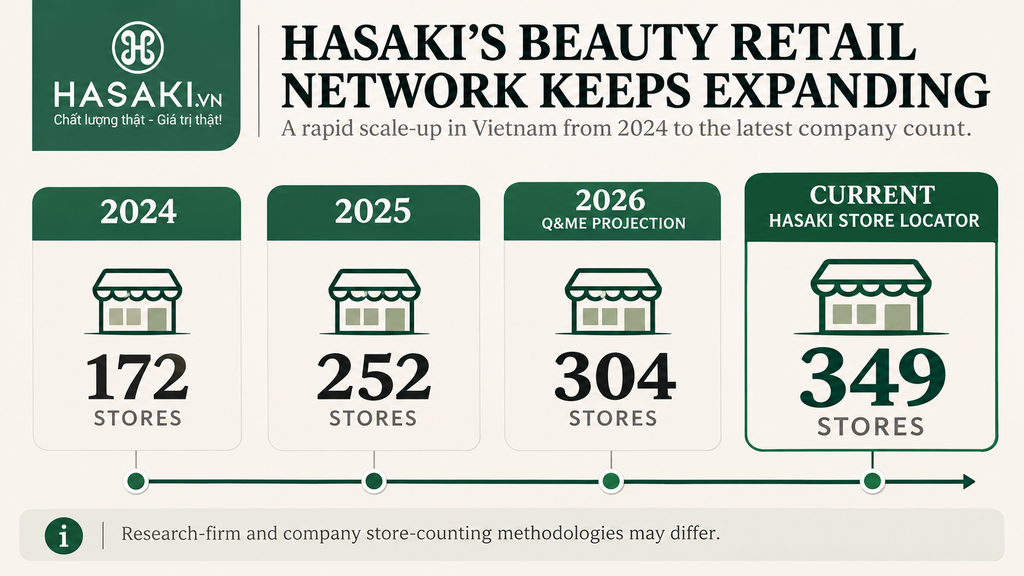
Q&Me data reported that the chain grew from 172 stores in 2024 to 252 in 2025, with 304 stores projected for 2026. Hasaki’s own current store locator now lists 349 locations nationwide. The figures are not perfectly comparable because company and research-firm counting methodologies may differ, but the direction is clear: Hasaki has continued expanding beyond the scale anticipated earlier in the year.
CBRE describes Hasaki as an omnichannel beauty and personal-care retailer with more than 300 stores, 18 clinics, a national e-commerce operation and partnerships with more than 500 international beauty brands.
The scale matters because Hasaki did not build its position around a single Vietnamese cosmetics brand.
It built a distribution system.
Its stores carry Korean, Japanese, European, American, and Vietnamese products across different price segments. That makes Hasaki fundamentally different from a V-Beauty brand trying to export a few hero products.
The company owns the customer relationship at the retail level.
That distinction matters in a market where, as DEWSIA has previously documented, Vietnamese beauty brands have historically faced a significant distribution gap outside Vietnam: Vietnamese Beauty Brands and the Import-Export Gap.
The US Expansion Was Prepared Before the First Store Opened
The physical launch in California happened in 2026, but Hasaki’s U.S. presence was being built much earlier.
Florida corporate records show that HASAKI LLC was filed on August 28, 2023. The entity remains active, with Hasaki founder Hiep Dinh listed as an authorized member.
That does not prove that the Cudahy and Anaheim stores had already been selected in 2023. But it does show that Hasaki created a U.S. corporate structure almost three years before opening its first American store.
A few months later, Alibaba International Digital Commerce Group was reported to have acquired a minority stake in Hasaki. The value of the investment was not disclosed.
There is no public evidence that Alibaba financed Hasaki’s U.S. expansion directly, so the two developments should not be conflated.
What can be said is that Hasaki entered this period of rapid expansion with international capital already on its shareholder register.
The company then opened its first U.S. store in Cudahy in July 2026. CBRE subsequently confirmed a second 7,000-square-foot lease at Magnolia Square in Anaheim and said Hasaki planned ten additional U.S. locations.
As of November 10, however, Hasaki’s official U.S. store locator still lists only Cudahy as open.
Anaheim remains marked “Coming Soon.”
That distinction is important. Hasaki has a substantial expansion plan, but it is still at an early execution stage in the United States.
Hasaki Is Exporting Operations, Not Just a Storefront
The clearest evidence that Hasaki is transferring its operating model comes from its U.S. digital infrastructure.
Hasaki already runs a dedicated American website and mobile operation, ships across the United States, and offers same-day delivery in selected Southern California ZIP codes.
Its U.S. site lists fulfillment centers in both Cudahy and Anaheim – even though the Anaheim retail store is still officially “Coming Soon.”
That is revealing.
The logistics infrastructure is not simply following the physical stores. It is being built alongside them.
This resembles the model Hasaki developed in Vietnam, where physical retail, local inventory, and online ordering reinforce each other rather than operate as separate channels.
Hasaki’s own recruitment for its U.S. expansion makes the intention unusually explicit. Recent marketing roles describe California as a first phase intended to validate the store format, omnichannel execution, and a repeatable growth model for future expansion. The company is recruiting around store launches, CRM, affiliate marketing, creators, livestreaming, digital acquisition, and in-store activation rather than treating physical retail as a standalone business.
In other words, Hasaki is not simply opening shops.
It is testing whether the system it built in Vietnam can be reproduced in another consumer market.
The Value Proposition Has Travelled With It
The American version of Hasaki also does not look like an attempt to reposition the company as a prestige retailer.
Its U.S. homepage leads with messages such as “Save More. Always.”, flash deals, low-cost delivery, and “Factory Direct Prices.”
The assortment reinforces that positioning.
Hasaki mixes brands including Bioderma, DHC, Maybelline, L’Oréal, Eucerin, and Aquaphor and K-Beauty names such as SKIN1004 with lower-cost personal-care products and Vietnamese cosmetics. Discounts of 20%, 30%, 40%, and more appear throughout the current catalogue.
This is not Sephora-style prestige curation.
Nor is it a specialist K-Beauty boutique.
Hasaki appears to be carrying over one of the central propositions behind its Vietnamese growth: broad assortment combined with price competition and convenience.
That makes the U.S. experiment more ambitious than simply selling products Vietnamese consumers already know.
The company must prove that a retail proposition designed in Vietnam can also appeal to American shoppers who have no prior relationship with Hasaki.
This Is Not a V-Beauty Store – and That May Be Its Advantage
Hasaki’s U.S. expansion should not be described as the export of V-Beauty itself.
Most of its assortment is not Vietnamese.
That is precisely why the expansion could matter for Vietnamese brands.
A Vietnamese cosmetics company entering the United States independently must solve multiple problems at once: regulatory compliance, logistics, warehousing, customer acquisition, retailer relationships, brand education, and ultimately shelf access.
DEWSIA’s guide to buying Vietnamese skincare internationally has documented how limited those channels still are for many local brands: Where to Buy Vietnamese Skincare Products.
Hasaki potentially changes the equation because it can import Vietnamese products into an infrastructure that already exists for other reasons.
Cocoon provides the clearest example.
Hasaki’s American store currently lists a dedicated Cocoon range, including Pomelo hair products, Winter Melon skincare, Dak Lak Coffee Body Polish, and Hau Giang Lotus products.
On the current U.S. homepage, Cocoon products sit directly beside international brands rather than in a separate specialist Vietnamese retail environment.
That matters.
The challenge for V-Beauty is not simply producing products good enough to export. It is getting those products into purchasing environments where international consumers are already comfortable shopping.
Hasaki can potentially create that environment without needing every Vietnamese brand to build an independent U.S. distribution network.
For consumers unfamiliar with the category itself, DEWSIA’s broader definition of V-Beauty and Vietnamese skincare explains why Vietnamese-owned brands should be distinguished from the Korean and Japanese products that dominate many Vietnamese shelves.
Hasaki’s model allows both to coexist.
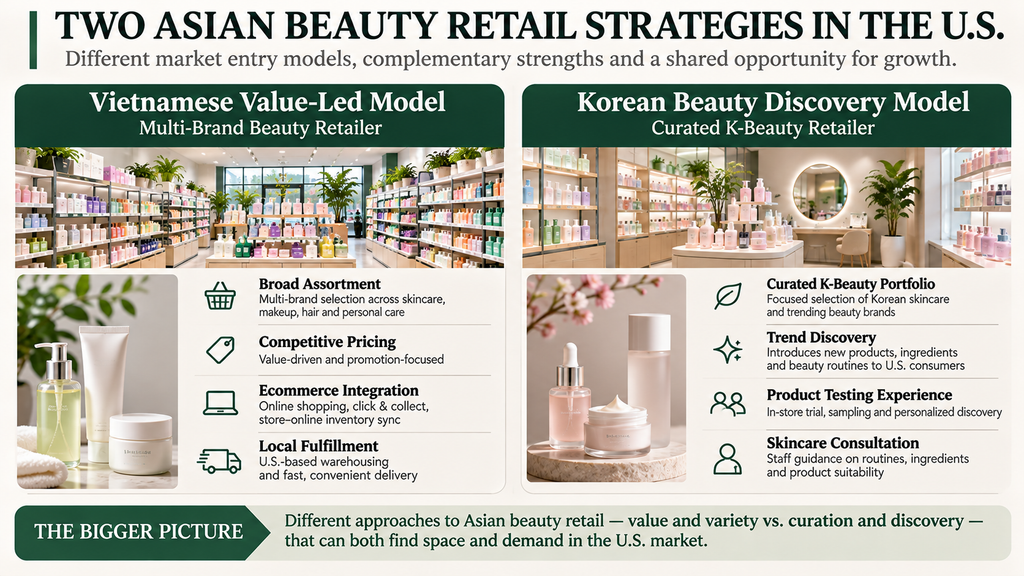
Hasaki and Olive Young Are Exporting Different Strengths
The timing makes Hasaki’s California experiment particularly interesting.
South Korea’s Olive Young is also rapidly expanding in the United States.
It opened its first American store in Pasadena in May 2026 and its second at Westfield Century City in June. On November 9, Olive Young announced five more California stores scheduled for the first half of 2027, which would bring its U.S. total to seven.
The comparison is tempting because both companies are Asian multi-brand beauty retailers entering Southern California.
But their export propositions are different.
Olive Young is explicitly positioning itself as a platform for Korean beauty.
Its U.S. stores are built around K-Beauty discovery, Korean product formats, trend curation, skin-analysis services, and the retailer’s ability to introduce emerging Korean brands to international consumers. Its latest expansion announcement again describes U.S. stores as infrastructure for helping smaller Korean brands establish themselves abroad.
Hasaki does not possess the same global category advantage.
There is no V-Beauty phenomenon in the United States comparable to K-Beauty.
Instead, Hasaki appears to be exporting a retail operating model: value, assortment, fulfillment, promotions, and omnichannel convenience.
That distinction is important.
Olive Young can partly rely on demand that already exists for Korean beauty.
Hasaki has to prove that the retailer itself can become relevant.
California Is a Test Market, Not Yet Proof of Global Success
Hasaki’s own recruitment language is unusually useful here because it describes California as a validation phase.
The company wants to determine whether the store format, marketing system, and omnichannel operations are repeatable before scaling further.
That is a more realistic interpretation than treating the announcement of ten additional stores as proof that Hasaki has already established a successful U.S. business.
Several questions remain unanswered.
Can Hasaki maintain aggressive pricing after U.S. labor, real estate, warehousing, and compliance costs?
Will customers understand what differentiates Hasaki from Amazon, Ulta, Sephora, specialist K-Beauty retailers, and mass-market chains?
Can a retailer built around hundreds of imported brands maintain reliable supply across a rapidly expanding network?
And perhaps most importantly for DEWSIA: will Vietnamese brands remain a small part of the assortment, or will Hasaki actively use its U.S. footprint to introduce more V-Beauty products?
The answer to that last question could determine whether Hasaki’s international expansion remains primarily a retail story or becomes something more important for Vietnam’s beauty industry.
The Bigger Opportunity Is Distribution
For years, one of V-Beauty’s structural weaknesses has been straightforward.
Vietnam can create brands.
It has struggled to create international distribution around them.
Individual companies can open Amazon stores, sign local distributors, or sell through specialist Asian retailers. But those channels rarely provide the combination of shelf visibility, physical discovery, local logistics, and marketing scale required to build a beauty category abroad.
Hasaki introduces another possibility.
Instead of Vietnamese brands waiting for foreign retailers to decide that V-Beauty deserves shelf space, a Vietnamese retailer can build the shelf itself.
That does not mean Hasaki will become a global gateway for V-Beauty. One open U.S. store is far too early to support that conclusion.
But it changes what is possible.
Hasaki’s most significant export may ultimately be neither Cocoon nor any other individual Vietnamese product.
It may be the retail infrastructure that gives those products somewhere to go.
And that is a much more consequential test than whether a Vietnamese beauty store can survive in California.