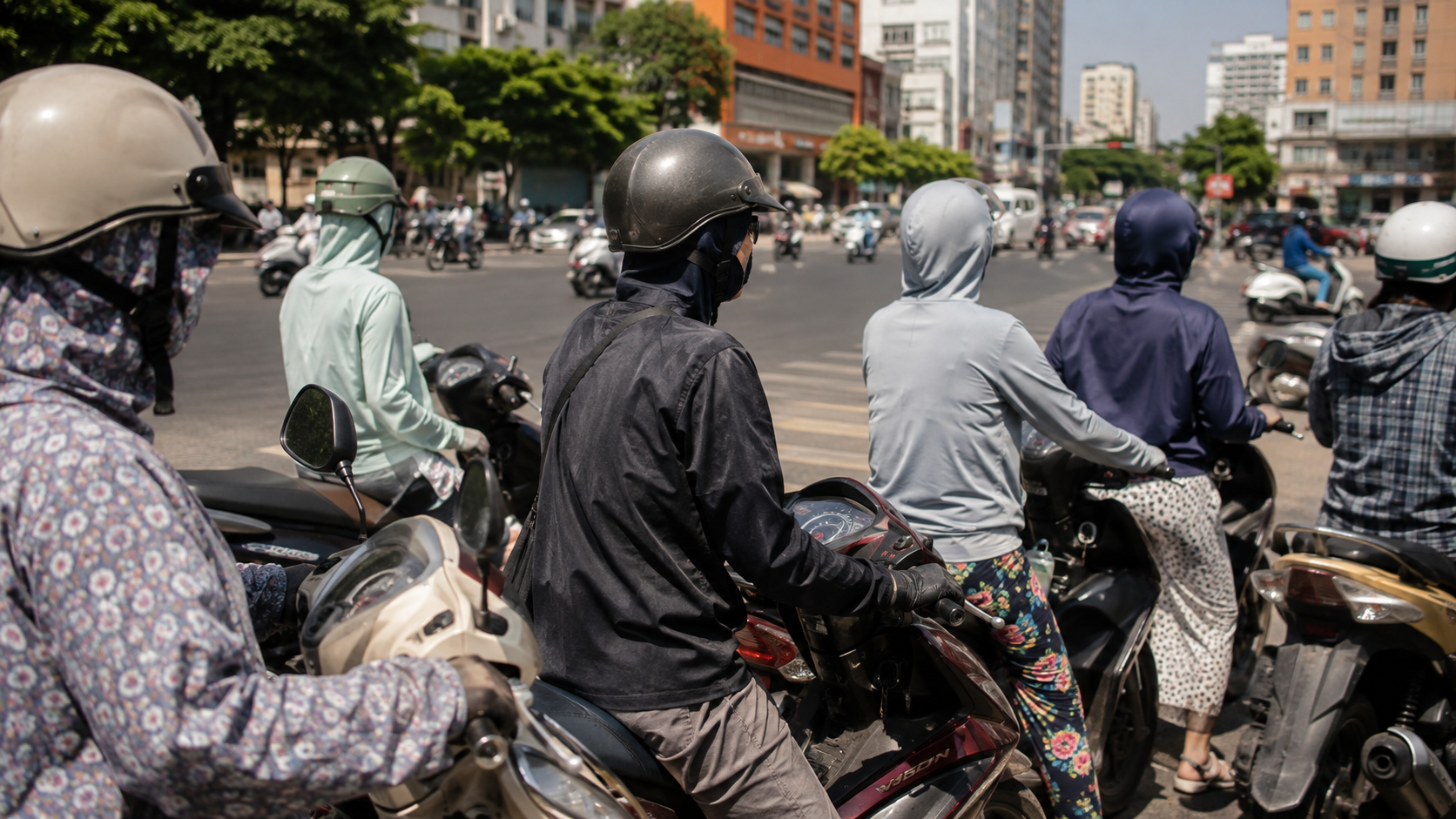
A white cotton shirt has a UPF of about 5. A pair of jeans is closer to 1,700. On a motorbike, what you wear matters more than what you apply.
Motorbike sunscreen is a genuinely different problem from beach sunscreen, and almost nothing written about sun protection accounts for it. The advice is built for people standing still, not for someone doing forty minutes through Hanoi traffic twice a day, every day, with wind stripping product off their forearms and sweat pooling under a helmet. The exposure is daily, cumulative, and largely unnoticed, which is exactly what makes it consequential. This guide covers why riding defeats ordinary sunscreen, what Vietnamese riders have long done about it, and what to actually put on the skin that stays uncovered.
Fast track:
- Why riding is its own UV problem → The exposure
- Why sunscreen alone fails → Sweat, wind, friction
- What Vietnam already got right → The sleeve solution
- What to actually buy → Choosing a motorbike sunscreen
- Verified picks and prices → What works locally
- The practical routine → Making it work daily
The Exposure Nobody Counts
The defining feature of riding is that there is nothing between you and the sun. A car driver sits behind glass, which blocks most UVB and a meaningful share of UVA, and their damage tends to be asymmetric – the window side ages faster. A rider has no glass, no filtering, and no asymmetry: forearms, backs of hands, neck, and the lower face take direct, unfiltered UVA and UVB from every angle, including reflection off the road surface.
The second factor is that it is daily and invisible. Nobody applies sunscreen for a commute the way they would for a day at the beach, because a commute does not feel like sun exposure – it feels like transport. But forty minutes each way, five days a week, is over six hours of direct midday-adjacent UV per week, accumulated in increments too small to trigger a sunburn and therefore too small to register as damage. Photoaging is cumulative rather than event-driven; the hyperpigmentation and leathering that show up on riders’ forearms after a decade are built out of exactly these unremarkable exposures. In a tropical climate, where the UV index runs high year-round and there is no low-UV winter to interrupt it, the accumulation never pauses.
Why Sunscreen Alone Fails on a Bike
This is the part product marketing avoids, and it is the reason a rider cannot simply apply SPF 50 and consider the problem solved.
Sweat and wind remove it. Riding in 33°C humidity produces continuous sweating, and airflow accelerates evaporation and mechanical loss. Water-resistant sunscreens are tested to hold up for 40 or 80 minutes of immersion – a real standard, but one that assumes you are not simultaneously being sandblasted by warm air at 40km/h. Friction removes more. A helmet strap runs across the jaw, the padding presses at the forehead and temples, gloves rub the backs of the hands, and a face mask sits over the nose and cheeks. Every contact point is a place sunscreen is being physically wiped away during the ride.
And reapplication – the standard advice – is impractical on a commute. The guidance to reapply every two hours assumes you can. Mid-ride you cannot, and by the time you arrive, you have already taken the exposure. Compounding this, the American Academy of Dermatology notes that most people apply only 25% to 50% of the recommended amount, meaning the realistic starting protection is already well below the number on the bottle before wind and sweat begin removing it.
The honest conclusion is not that sunscreen is useless on a motorbike. It is that sunscreen used alone on a motorbike is a partial measure being asked to do a complete job.
What Vietnamese Riders Already Got Right
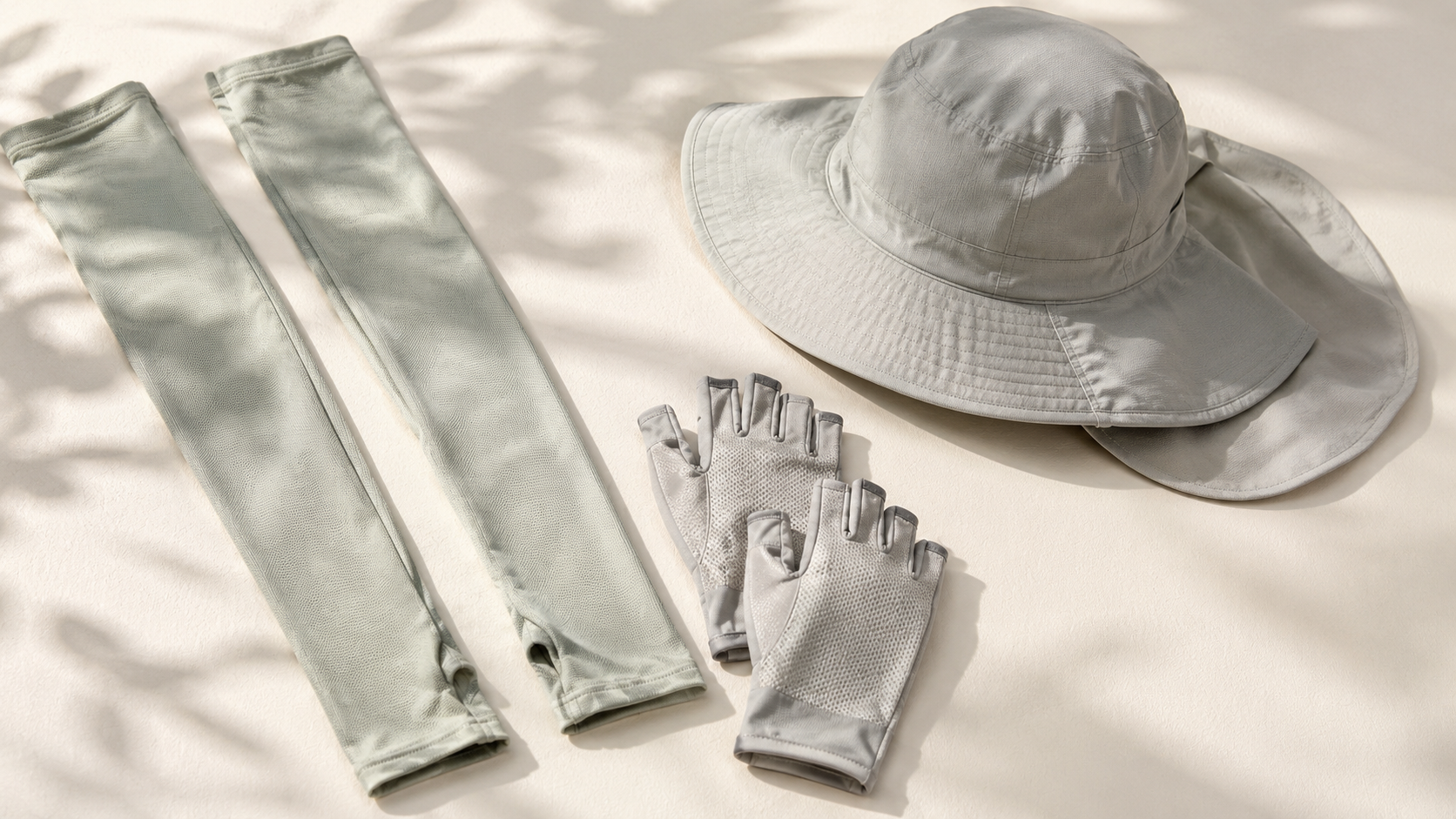
Walk through any Vietnamese city at midday, and the solution is already visible: áo chống nắng – sun jackets – worn over normal clothes in punishing heat, plus separate arm sleeves, gloves that cover the back of the hand, face masks, and wide-brimmed hats under helmets. To a visitor, this often reads as excessive. It is, in fact, the more evidence-aligned approach, and Western sun-protection advice has spent the last few years catching up to it under the label “UPF clothing.”
The physics is straightforward and heavily favors fabric. A UPF 50+ garment blocks roughly 98% of UVA and UVB across everything it covers, and – decisively for a rider – it does not sweat off, does not need reapplication every two hours, and does not degrade over a forty-minute ride. Ordinary clothing is not equivalent: a white cotton t-shirt sits around UPF 5, a heavy black t-shirt closer to 20, while denim is effectively opaque at around 1,700. Tighter weave, heavier fabric, and darker colour all raise protection, which is precisely why the sun jackets are cut the way they are.
At Dewsia, we use the term V-beauty for Vietnamese skincare, and this is one of the clearest cases where local practice outperforms imported advice. Honest limitation: sleeves and jackets only protect what they physically cover, and they fail at the edges – riding down at the wrist, gapping at the shoulder, leaving the neck and lower face exposed. Cheaper, tightly-woven fabric also traps heat, which is a real comfort cost in humidity. The correct reading is not “wear fabric instead of sunscreen.” It is that fabric handles the large covered areas, and sunscreen exists to handle the gaps.
Choosing a Motorbike Sunscreen
Given that division of labor, the sunscreen you want for riding is optimized differently from a general daily SPF.
Water and sweat resistance is the first filter, not a bonus feature – look for products explicitly labeled water-resistant, since that testing is the closest available proxy for surviving a sweaty ride. Texture decides whether you actually wear it. A heavy cream in tropical humidity will be abandoned within a week; lightweight fluid and watery textures are the ones that get used daily, which matters more than a marginal difference in formulation. High SPF with strong UVA protection is the right target given the unfiltered exposure, and no white cast is a practical requirement, since a mask and helmet will smear any visible residue across your face within minutes. Finally, if you are prone to breakouts, favor non-comedogenic formulas – sweat and mask friction under a helmet is an environment that punishes heavy occlusive products.
What Works Locally
Verified pricing, Hanoi:
Cocoon Sun Fluid SPF50+ – around 280,000–320,000 VND (~$11–13), available in Guardian and on the brand’s Shopee store. A lightweight fluid built for humid conditions, which is the main thing a rider needs; it is the most sensible everyday Vietnamese option for a commute. Note that international buyers pay considerably more, $32–47 on cocoonoriginal.com, making this a product best bought locally.
Decumar Sunscreen SPF50+ – around 130,000 VND (~$5), pharmacy-only through Long Châu and Pharmacity. A hybrid formula with niacinamide and centella, oriented toward oil control and acne-prone skin. At this price the cost of applying generously – which, per the AAD figure above, is where most people fall short – effectively disappears.
Japanese water-resistant options – Anessa and Bioré UV are the category benchmarks for sweat resistance in lightweight textures, and both are widely available in Vietnam through Guardian, pharmacies, and e-commerce platforms. If your ride is long or your sweating is heavy, this is where the highest water resistance sits.
Honest limitation: none of these survives a full day of riding intact, and none is a substitute for sleeves. Buy on texture and water resistance, apply more than feels necessary, and treat the product as covering the gaps in your clothing rather than as your whole defense. Note also that Watsons operates only in Ho Chi Minh City – in Hanoi, Guardian and pharmacies are the practical channels.
Making It Work Daily
The routine that survives contact with an actual commute is short.
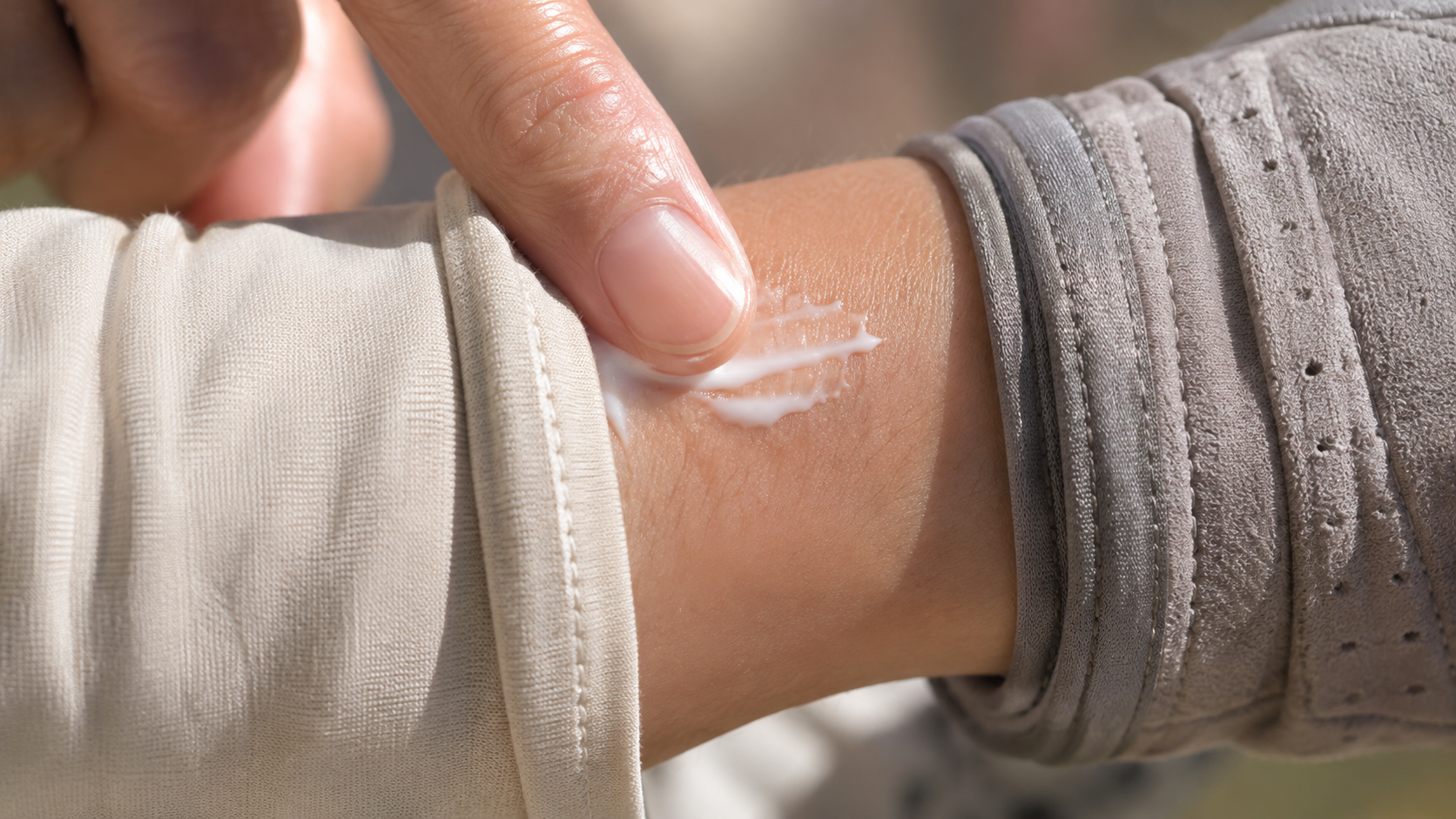
Apply before you leave, not at the door – give it fifteen minutes to set rather than putting it on and immediately pulling a helmet over it. Cover the zones people forget: the back of the neck, the ears, the backs of the hands, and the strip of forearm between sleeve and glove. Wear the sleeves. They do the heavy lifting on the largest exposed surfaces, and they are the single highest-return change available. Reapply at your destination, not mid-ride – reapplying on arrival protects the next exposure rather than the one already taken, which is the realistic version of the two-hour rule. And cleanse properly in the evening, because a full day of sunscreen, sweat, mask friction, and road dust is a genuine congestion risk; this is one context where double cleansing earns its place.
FAQ
Do I really need sunscreen for a short commute? Yes, because the damage is cumulative rather than event-based. Forty minutes twice a day adds up to several hours of direct UV per week, year-round in a tropical climate, without ever producing the sunburn that would make it feel significant.
Is sunscreen or clothing better for motorbike riding? Clothing, for everything it covers. A UPF 50+ garment blocks around 98% of UV and does not sweat off or need reapplication, while sunscreen degrades under wind, sweat, and helmet friction. Use fabric for the large areas and sunscreen for the gaps – face, neck, and hands.
Does a normal long-sleeve shirt work? Partially. A white cotton shirt is only around UPF 5, while heavier and darker fabrics perform far better, and purpose-made sun jackets or sleeves are rated 50+. Any sleeve beats bare skin, but the difference between fabrics is large.
How often should I reapply while riding? Realistically, you cannot reapply mid-commute – reapply on arrival instead, which protects the next block of exposure. This is why physical coverage matters more here than in most sun-protection advice.
Does a helmet protect my face from the sun? Only the parts it covers, and a standard open-face helmet leaves the lower face fully exposed. Helmet padding and straps also rub sunscreen off at the forehead, temples, and jaw, so those areas need generous application.