
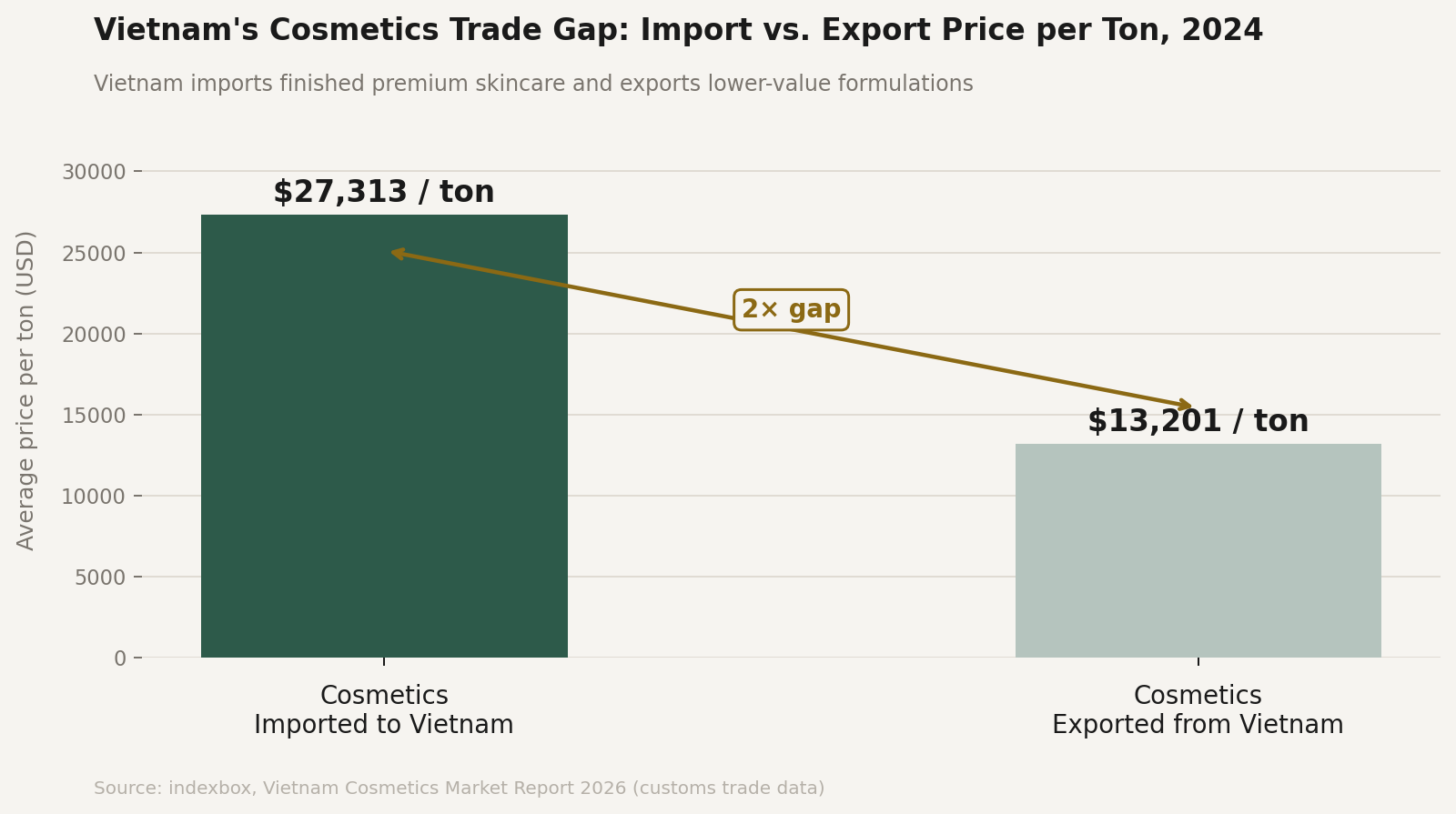
Vietnamese beauty brands represent less than 10% of their own domestic market – a $2.66 billion industry where over 90% of value is imported product. Vietnam imports cosmetics at $27,313 per ton and exports them at $13,201. The country is buying premium and selling commodity – and that single data point describes V-beauty’s structural challenge more precisely than any market share figure.
The Import Dependency Is Not Shrinking
South Korea accounts for 66% of Vietnam’s cosmetics imports by value, according to trade data compiled by indexbox from customs sources. Japan holds 7.2%. The United States 4.9%. The domestic industry – which includes every Vietnamese beauty brand from heritage names like Thorakao to newer players like Cocoon – represents less than 10% of total consumption.
The Korea Customs Service data confirms Vietnam’s position from the other side of the trade: Vietnam is South Korea’s fifth-largest export destination for beauty products globally, receiving $466 million in Korean cosmetics in 2024. That places Vietnam ahead of Russia, Taiwan, Thailand, the UAE, and the United Kingdom in terms of K-beauty export value.
To put that in context: Vietnam, with a GDP per capita of approximately $4,300, absorbs more Korean beauty products by value than markets with significantly higher purchasing power. The appetite for imported cosmetics in Vietnam is not proportional to income – it is driven by consumer preference that has been shaped, systematically, by Korean cultural influence over more than a decade.
The 2025 data adds another layer. South Korean cosmetics exports hit a record $11.43 billion globally last year, up 12.3% year-on-year, with the United States overtaking China as the largest destination for the first time in history – US exports reached $2.19 billion, while China fell 19.2% to $2.01 billion. A country-level breakdown for Vietnam in 2025 has not yet been published by the Ministry of Food and Drug Safety, but the directional signal is clear: K-beauty’s growth is being driven by Western markets, not by deeper penetration of existing Asian ones. Vietnam’s position as a K-beauty import market is consolidating, not expanding.
What Vietnam Exports – and Where It Goes
Vietnam does export cosmetics. The trade data shows Japan as the leading destination, accounting for 36% of Vietnam’s cosmetics exports by value. Thailand takes 17%. The United States and China account for smaller shares.
The absolute figures are not publicly broken down in detail, but the 2022 Statista/UN Comtrade data shows Japan importing approximately $25 million in Vietnamese cosmetics that year – compared to Vietnam importing hundreds of millions from Korea alone. The directional imbalance is unambiguous.
More telling than the volume is the composition. Vietnam’s exports are primarily lower-value formulations – the $13,201 per ton average export price versus the $27,313 per ton import price reflects a category difference, not just a pricing difference. Vietnam is exporting base formulations and OEM-produced personal care products. It is importing finished, branded, premium skincare.
This is a structural feature of the trade relationship, not a temporary anomaly. The Vietnamese cosmetics industry has been a net importer in value terms since the category began growing meaningfully in the mid-2010s, and the gap has widened as consumer preference for imported brands has intensified.
The Distribution Gap Is the Real Constraint
The import-export imbalance is a symptom. The underlying condition is distribution.
Vietnamese beauty brands have limited access to the international retail infrastructure that would allow them to close the trade gap. The channels through which premium skincare is purchased internationally – pharmacy chains, specialty beauty retailers, and e-commerce platforms with established beauty categories – are either inaccessible to most Vietnamese brands or accessible only at the lower end of the value spectrum.
Cocoon Vietnam is the clearest example of both the potential and the constraint. The brand has achieved meaningful international visibility – it is available on Amazon, has been covered by Western beauty media, and attracted a $40 million acquisition by Marico specifically for its international expansion potential. It is also, by the standards of the global beauty market, a niche product with limited shelf presence outside Vietnam.
The Dewsia guide to buying Vietnamese skincare internationally documents the practical reality: most genuine Vietnamese skincare products are purchased through Vietnamese diaspora networks, specialist Asian beauty retailers, or unofficial cross-border channels. Mainstream Western retail – the channel that drives volume and brand equity at scale – remains largely inaccessible.
The counterfeit problem compounds the distribution gap. Vietnamese authorities identified nearly 5,000 counterfeit cosmetics incidents in 2024. The fake products target the same channels – Shopee, Lazada, and TikTok Shop – where authentic Vietnamese brands are trying to build international distribution. For a buyer outside Vietnam with no reference point for authentic products, the counterfeit risk is a reason to default to a recognized international brand rather than attempt to navigate an unfamiliar market.
The 90% Import Dependency Has a Strategic Logic
The high import share is not simply a function of consumer preference for foreign brands. It reflects a structural feature of the Vietnamese beauty market that has persisted despite the growth of domestic brands: the regulatory and marketing infrastructure that allows foreign brands to establish premium positioning in Vietnam is more developed than the equivalent infrastructure allowing Vietnamese brands to establish premium positioning abroad.
Foreign brands entering Vietnam register through the Drug Administration of Vietnam, pay import duties of 10–27% depending on product category, and gain access to a retail landscape – Watsons, Guardian, Pharmacity – that was designed to distribute imported product efficiently. The system is built for inbound trade.
The system for outbound trade – the regulatory clearances, distribution partnerships, and marketing investment required to establish a Vietnamese brand in a foreign market – does not have an equivalent infrastructure. Vietnamese brands building international distribution are doing so individually, without the benefit of an established trade corridor or institutional support comparable to what Korean brands receive from MFDS export promotion or what French brands receive from the FEBEA.
This is the uncomfortable implication of the $466 million import figure. Vietnam is not simply a market that happens to buy a lot of K-beauty. It is a market whose commercial infrastructure has been built, largely, around consuming imported beauty rather than exporting domestic beauty. That infrastructure is self-reinforcing: the more developed the import channels become, the more difficult it is for domestic brands to compete for the shelf space and consumer attention that would allow them to build the export revenue needed to invest in international distribution.
The Implication for V-Beauty’s Global Ambitions
The trade data does not suggest that Vietnamese beauty brands cannot succeed internationally. It suggests that succeeding internationally requires overcoming a structural disadvantage that is more significant than product quality or brand story.
The brands most likely to close the gap are those that can access alternative routes to international distribution – acquisition by a company with existing international infrastructure (Cocoon/Marico being the clearest example). Partnership with established international retailers, or organic growth through diaspora and culturally adjacent markets where Vietnamese product has existing recognition.
The e-commerce channel offers a partial solution. Online beauty sales in Vietnam reached $1.49 billion across major platforms in 2023, with growth of over 50% year-on-year. The same platforms – Shopee, Amazon, Lazada – provide access to international buyers. But platform access is not the same as brand building, and the price-per-ton gap suggests that Vietnamese brands competing on international e-commerce are competing primarily on price rather than on premium positioning.
Closing the $14,000-per-ton gap between import and export value is the real metric of V-beauty’s international progress. It requires not just better products – Vietnamese skincare already has those – but the clinical substantiation, regulatory compliance, and distribution infrastructure that allow those products to command premium prices in markets outside Vietnam.
That is a five-to-ten-year project. The brands that start it now are the ones that will be positioned to benefit when Vietnamese skincare has the same international infrastructure that Korean skincare built over the previous decade.
Sources: REACH24H, Vietnam Cosmetics Market Analysis 2024; IndexBox, Vietnam Cosmetics Market Report 2026 (customs trade data); Statista/UN Comtrade, Vietnam cosmetics exports by trade partner 2022; Korea Customs Service 2024 via Statista/Cosmoprof Asia Report 2025; VietnamPlus, Cosmetics market: local producers still hold modest share, 2024; Dewsia, Where to Buy Vietnamese Skincare Products (And How to Avoid Fakes).
