A spoonful of gấc aril holds roughly seventy times the lycopene of a tomato.
Gac fruit skincare is built on numbers like that – Vietnam’s bright-red Tết fruit is one of the most carotenoid-dense ingredients in the natural world, and it has spent years hiding in plain sight while Western brands chased less impressive superfoods. But the headline multiplier is the least interesting thing about it, and the most over-quoted. The real case for gấc rests on bioavailability and composition, not a single dramatic statistic – and on an honest reading of how much topical evidence actually exists.
Fast track:
- The fruit behind the hype → What gấc is
- The carotenoid case → Lycopene and the real advantage
- The benefits, graded → Gac fruit skincare benefits
- The clinical reality → The anti-wrinkle study
- Why the West is catching on → Gấc goes global
- Realistic use → How to actually use it
- Related ingredients → Vietnamese Skincare Ingredients Glossary
The Fruit Behind the Hype
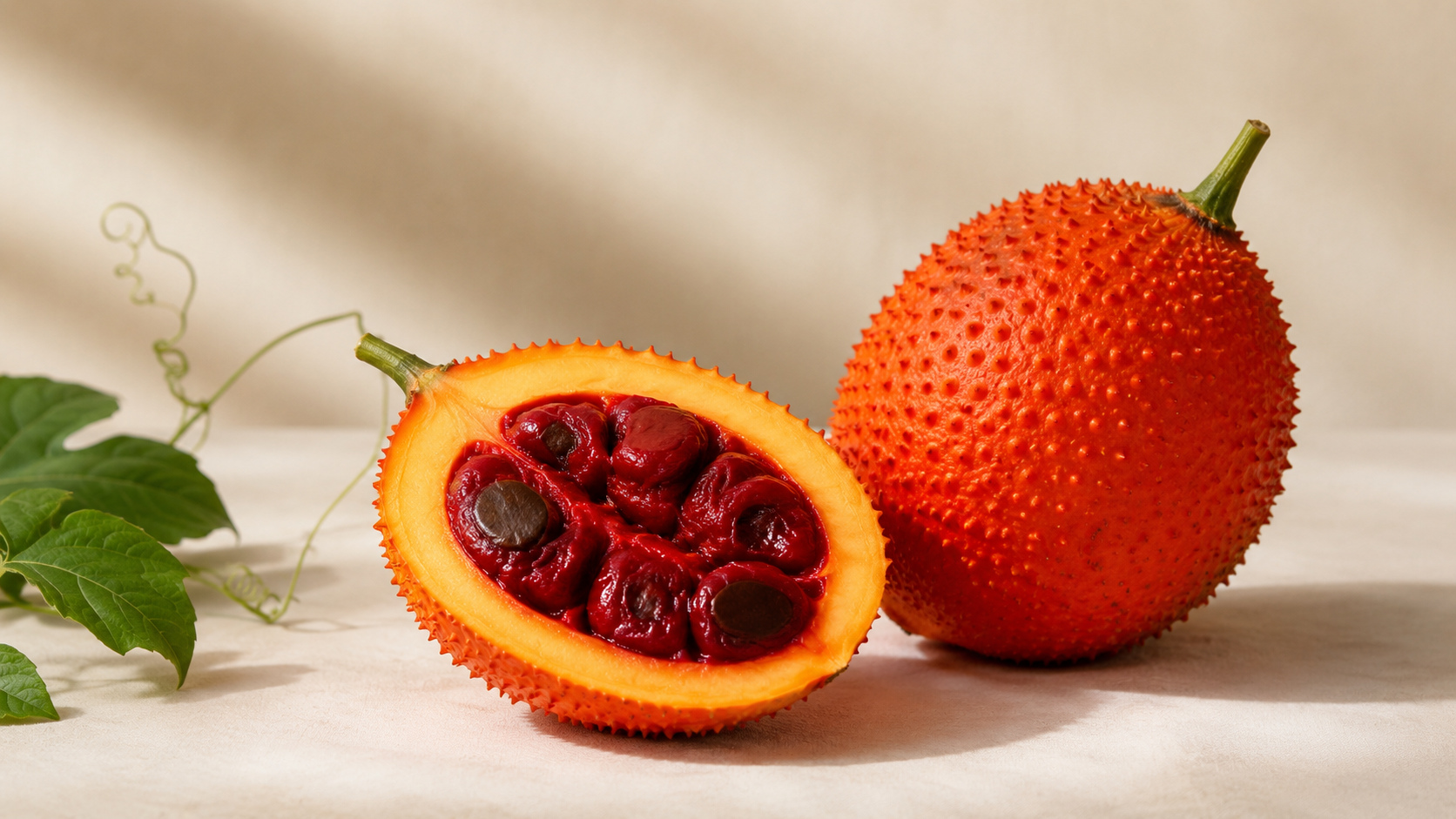
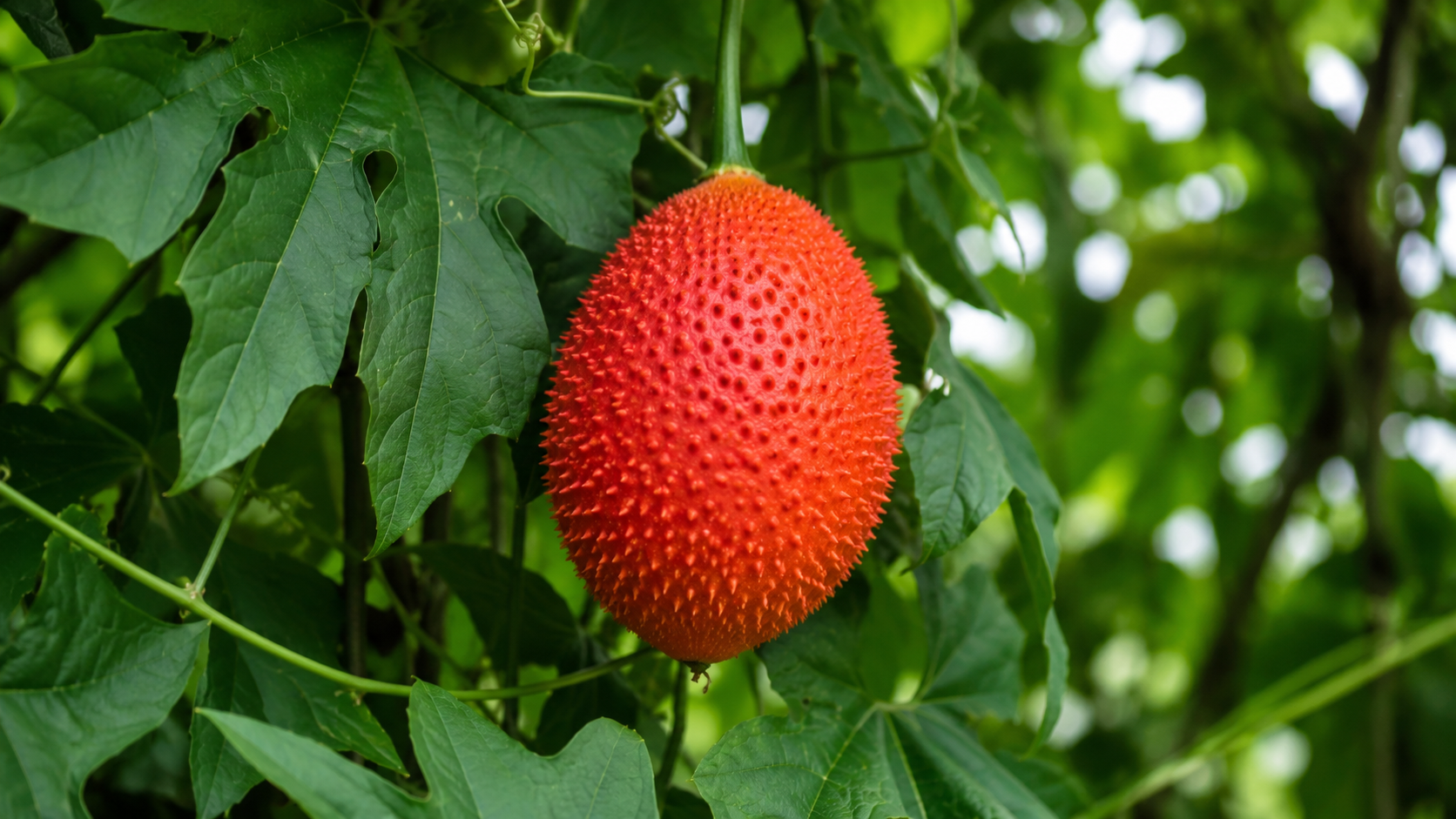
Gấc – Momordica cochinchinensis, sometimes called baby jackfruit or spiny gourd – is a vivid red-orange fruit native to Vietnam and mainland Southeast Asia. It is intensely seasonal, harvested for only about two months a year around December and January, which has historically limited its commercial reach. In Vietnam it is not an everyday fruit but a ceremonial one: the deep-red aril is steamed with glutinous rice to make xôi gấc, the lucky red sticky rice served at Tết and weddings.
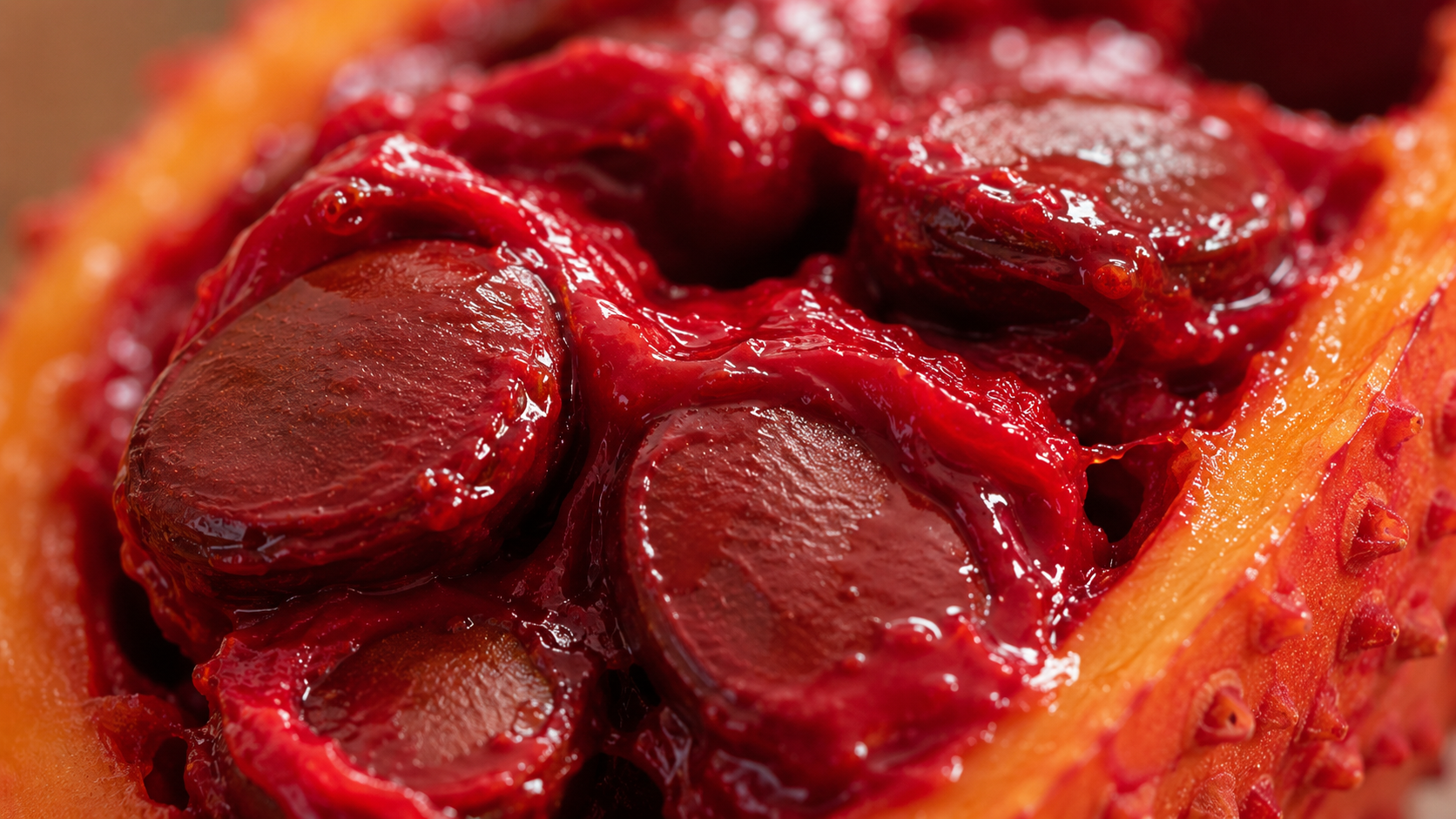
That color is the whole point. The red-orange aril surrounding the seeds is among the most carotenoid-rich plant materials known – the pigment is not decoration but a dense concentration of lycopene and beta-carotene. It is a culturally central, genuinely nutrient-dense ingredient that Western skincare simply had not looked at until recently. For the broader picture of how ingredients like this fit together, see the Vietnamese skincare ingredients glossary.
The Carotenoid Case – and the Real Advantage
The numbers attached to gấc are genuinely striking: the aril carries roughly seventy times the lycopene of tomatoes and about ten times the beta-carotene of carrots, alongside zeaxanthin, lutein, vitamin E, and essential omega-3 and omega-6 fatty acids. These figures, traced to analyses such as Aoki and colleagues’ work, are real – but they vary widely depending on which part of the fruit, which growing conditions, and which comparison is used. Brands frequently cite a tidier “ten times the lycopene”; the academic figure against tomatoes specifically is far higher. Treat any single multiplier as directional, not precise.
The more important point is bioavailability. Lycopene from tomatoes needs cooking and dietary fat to become absorbable. In gấc, the carotenoids are already suspended in the aril’s natural lipid matrix, which makes them more bioavailable – and, in a topical context, gives the extract a built-in barrier-supporting, emollient base. The fatty acids and vitamin E are not just passengers; they are part of why gấc behaves well in an oil or cream. The real advantage is not that gấc has more carotenoids on paper, but that it delivers them in a form the skin and body can actually use.
Gac Fruit Skincare Benefits, Graded
Antioxidant protection – the strongest claim. Carotenoids are potent free-radical scavengers, and gấc’s antioxidant activity is well-documented in laboratory assays. The mechanism is established and the in-vitro data is robust; what is thinner is large-scale topical clinical confirmation. Mechanistically solid, clinically under-quantified.
Photoprotection and anti-photoaging – plausible. Carotenoids help defend skin against UV-induced oxidative stress, a rationale supported more by carotenoid biology and dietary studies than by topical skin trials. A reasonable expectation, not a proven outcome.
Barrier support and moisturisation – reasonable. The vitamin E and essential fatty acids in the aril give gấc a genuine emollient, barrier-supporting role, independent of the carotenoid story.
Anti-wrinkle – preliminary. This rests largely on a single formulation study, covered below.
The honest framing is the one the title implies: gấc’s nutritional credentials are A-grade, but its skincare-specific clinical evidence is early-stage. It is underrated precisely because it is under-studied in topical use – not because it is under-powered.
The Anti-Wrinkle Study
The most-cited topical evidence is a clinical evaluation of a gấc extract in an anti-wrinkle cream formulation. The study developed a hydrogel containing gấc fruit extract, demonstrated that it remained physically stable and retained 90–95% of its beta-carotene and lycopene after six months of accelerated storage, and assessed its skin efficacy.
The limitations matter as much as the result. This is a formulation-and-efficacy evaluation, not a large randomized controlled trial – it establishes that a gấc cream can be made stable and shows preliminary skin benefit, rather than proving a definitive anti-wrinkle effect. Most of the wider evidence base for gấc is compositional or in-vitro: strong for confirming its antioxidant identity, limited for validating finished topical products. The direction is encouraging; the depth is not yet there. Anyone claiming gấc as a proven anti-aging active is ahead of the data.
Gấc Goes Global
The clearest sign that gấc is crossing over is Youth To The People, the California superfood-positioned brand, which built its Peptides + C Energy Eye Concentrate around gấc seed extract, citing its beta-carotene, lycopene, and omega-3 and omega-6 fatty acids. When a Western brand reaches past kale and vitamin C for a Vietnamese fruit, it does two things: it validates the ingredient for an international audience, and it creates a recognition bridge back to the ingredient’s origin.
At Dewsia, we use the term V-beauty for Vietnamese skincare, and gấc is a case where the ingredient is going global faster than the country’s brands are getting credit for it. Domestically, Thorakao has used gấc in its range for decades – long before “superfood” was a marketing category. One honest distinction: Youth To The People uses the gấc seed, while Vietnamese tradition centers on the carotenoid-rich aril. Same plant, slightly different parts, similar logic.
How to Actually Use Gấc
Treat gấc as an antioxidant support ingredient – most at home in facial oils, creams, and eye products – rather than a standalone hero active. Its realistic contribution is antioxidant defense, barrier support, and a gradual improvement in radiance, working alongside proven actives like vitamin C and retinol rather than replacing them. It suits dull, dry, or environmentally stressed skin particularly well, where its emollient carotenoid-and-lipid profile has the most to offer.
Set expectations at the ingredient’s actual level. Gấc is a high-quality antioxidant carrier, not a wrinkle eraser, and its seasonality means it will likely stay a premium, lower-volume ingredient rather than a commodity one. Bought for what it is – a richly nutritious, bioavailable carotenoid source with genuine Vietnamese provenance – it earns its place.
FAQ
What does gấc fruit do for skin? It delivers carotenoid antioxidants (lycopene, beta-carotene), vitamin E, and essential fatty acids, supporting antioxidant defense, the skin barrier, and gradual radiance. Its strongest evidenced role is antioxidant protection.
Does gấc really have more lycopene than tomatoes? Yes – the aril contains roughly seventy times the lycopene of tomatoes by some analyses, and crucially, it is more bioavailable thanks to the fruit’s natural lipid content. Exact multipliers vary by source, so treat them as directional.
Is gấc fruit good for anti-aging? The rationale is sound – antioxidant and photoprotective carotenoids – and one cream-formulation study showed preliminary benefit. But topical anti-aging evidence is early-stage, so it is best seen as a promising support ingredient, not a proven treatment.
Where can I find gấc skincare? Vietnamese brands such as Thorakao have long included gấc, and Western brands are beginning to adopt it, most notably Youth To The People’s gấc-seed eye product. Seasonal supply keeps it relatively niche.
Is gấc better than tomato or rosehip for skincare? Gấc offers richer, more bioavailable carotenoids than tomatoes and a different profile from rosehip. But it has less topical clinical data than some better-studied actives, so the deciding factor is the quality of the specific formulation, not the raw ingredient alone.