Vietnam’s botanical diversity is exceptional. The country spans 15 degrees of latitude – from subtropical mountain forests in the north to the tropical Mekong Delta in the south – producing an extraordinary range of plants with distinct phytochemical profiles shaped by altitude, soil, and rainfall. Vietnamese traditional medicine has drawn on this landscape for centuries.
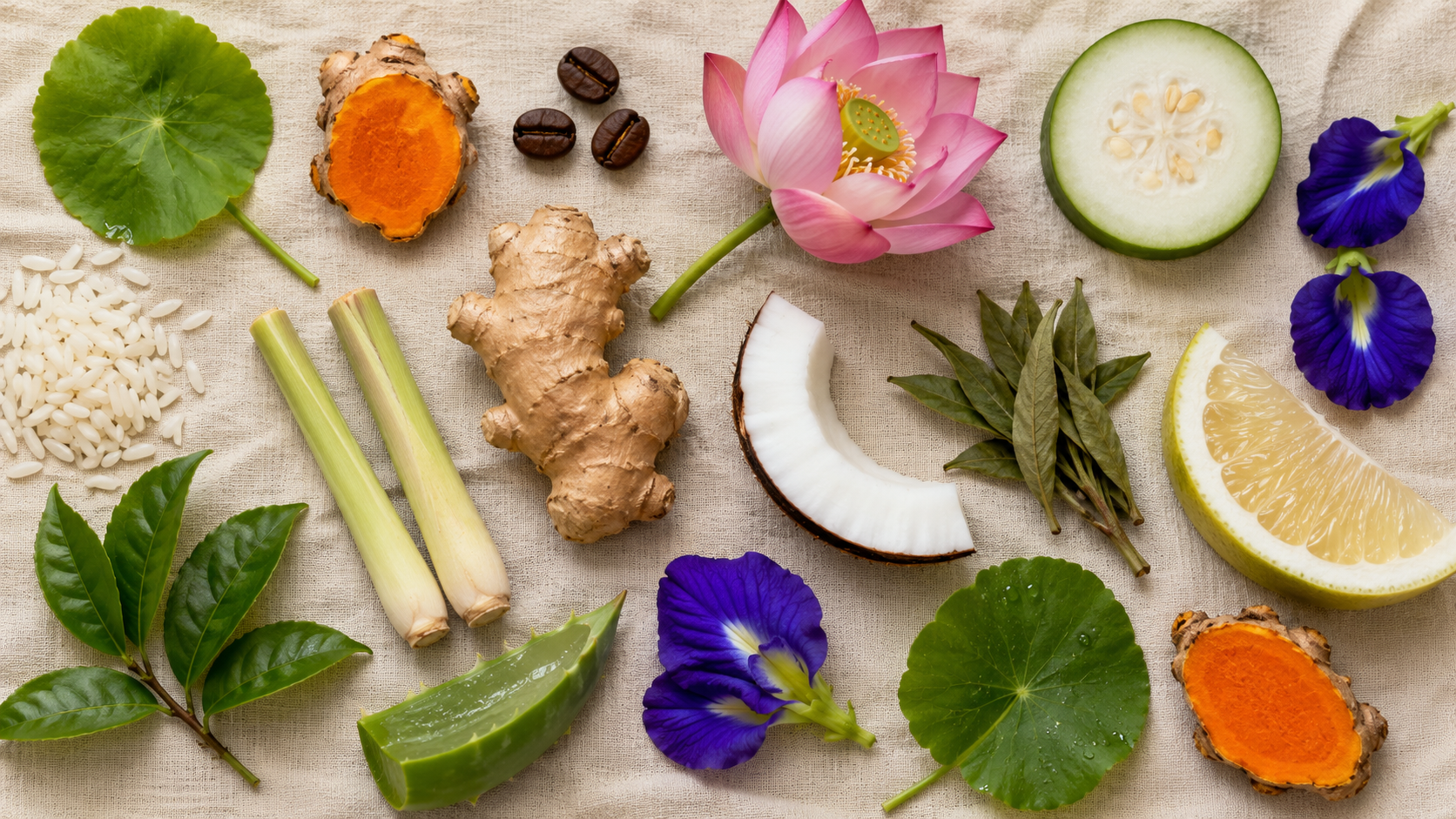
This glossary covers 20 key ingredients used in Vietnamese skincare – what they are, where they grow, what the evidence says they do, and which brands use them. Each entry links to a deeper article where one exists.
1. Centella Asiatica (Rau Má)
Vietnamese name: Rau má Scientific name: Centella asiatica (L.) Urban Growing region: Throughout Vietnam, particularly southern provinces; grows wild near ponds, paddy fields, and roadsides.
What it is: A creeping herb used in Vietnamese traditional medicine, food, and daily life for centuries. Fresh rau má juice (nước rau má) is sold at street stalls across Vietnam as a cooling health drink.
What the evidence says: Well-documented anti-inflammatory, barrier-repair, and wound-healing properties. The active compounds – asiaticoside, madecassoside, asiatic acid, and madecassic acid – stimulate collagen synthesis and inhibit inflammatory pathways. Clinical evidence supports improved skin hydration and reduced transepidermal water loss (TEWL) in formulations containing centella extract.
In skincare: Soothing toners, serums, and barrier repair products. Hero ingredient in Cocoon’s Hau Giang Lotus Toner (as a supporting active) and Herbario’s Centella & Fish Mint line.
Full article: Centella Asiatica in Vietnamese Skincare
2. Turmeric (Nghệ)
Vietnamese name: Nghệ Scientific name: Curcuma longa Growing region: Hưng Yên province (Red River Delta) is the primary cultivated region for cosmetic-grade turmeric; also grown throughout central and southern Vietnam
What it is: A root vegetable used in Vietnamese cooking, traditional medicine, and beauty rituals for generations. Turmeric paste has been used traditionally for skin brightening, wound healing, and postpartum skin recovery.
What the evidence says: The active compound curcumin has well-documented anti-inflammatory, antioxidant, and tyrosinase-inhibiting (brightening) properties. A 2024 systematic review confirmed efficacy across multiple inflammatory skin conditions. Topical bioavailability is limited without advanced delivery systems – well-formulated extracts perform better than raw powder.
In skincare: Brightening serums, cleansers, and toners. Cocoon’s Hưng Yên Turmeric line features 22% ascorbyl glucoside combined with turmeric extract – a complementary brightening stack.
Caution: Staining risk with raw turmeric. Commercial extracts are formulated to minimize this.
Full article: Turmeric in Skincare: What It Actually Does
3. Rice Water (Nước Vo Gạo)
Vietnamese name: Nước vo gạo Scientific name: Oryza sativa (fermented extract) Growing region: Throughout Vietnam; Mekong Delta is the primary rice-growing region
What it is: The liquid left after soaking or rinsing rice. Used as a skin rinse and hair treatment in Vietnamese households for generations – an independent parallel tradition to the Korean and Japanese use of the same ingredient.
What the evidence says: Clinical evidence supports improved skin hydration and barrier function. Key active compounds include inositol, ferulic acid, amino acids, and vitamins B and E. Fermented rice water (saccharomyces ferment) has enhanced bioactivity – higher polyphenol and amino acid concentrations – compared to plain rice water.
In skincare: Toners, essences, and moisturizers. More prominent in K-beauty (Beauty of Joseon, Anua) than in current Vietnamese brands, though the ingredient is a genuine Vietnamese tradition.
Full article: Rice Water Skincare: Does It Actually Work?
4. Shan Tuyet Tea Flower (Hoa Trà Shan Tuyết)
Vietnamese name: Hoa trà Shan Tuyết Scientific name: Camellia sinensis var. pubilimba Growing region: Hà Giang province, northern highlands; altitude 1,000–2,000 meters; trees between 80 and 800 years old
What it is: An ancient heirloom tea variety native to Vietnam’s northern highlands – botanically distinct from commercial Camellia sinensis. The trees are harvested by the Red Dao ethnic minority. Polyphenol content up to 45.7% – significantly higher than commercial tea.
What the evidence says: Camellia sinensis flowers have documented antioxidant, anti-inflammatory, and hydration-supporting properties. Anti-hyaluronidase activity helps maintain skin’s natural hyaluronic acid content. The higher polyphenol baseline of Shan Tuyet may indicate greater active compound concentration than standard tea extracts – though cosmetic-specific clinical trials are limited. This has not been formally studied in the context of topical cosmetics specifically – the polyphenol data comes from tea quality research.
In skincare: Cleansers, toners, and mists. Sancha Vietnam built their entire skincare range around this ingredient specifically.
Full article: Shan Tea in Vietnamese Skincare
5. Lotus (Hoa Sen / Bông Sen)
Vietnamese name: Hoa sen (flower), hạt sen (seed), lá sen (leaf) Scientific name: Nelumbo nucifera Growing region: An Giang province (Mekong Delta) – Cocoon sources lotus from Hậu Giang; also grown throughout the delta
What it is: Vietnam’s national flower. Every part of the lotus – flower, seed, leaf, stamen – has traditional use in Vietnamese medicine and food. Lotus tea (trà sen) is a ceremonial drink. Lotus seed paste is a common sweet ingredient.
What the evidence says: Lotus extract contains quercetin, kaempferol, and other flavonoids with antioxidant and anti-inflammatory activity. Documented skin hydration improvement and mild brightening properties. The soothing profile makes it appropriate for sensitive skin formulations.
In skincare: Toners, essences, and moisturizers. Cocoon’s Hậu Giang Lotus Soothing Toner is the brand’s most reviewed product – fragrance-free, fungal acne-safe, lightweight hydrating formula.
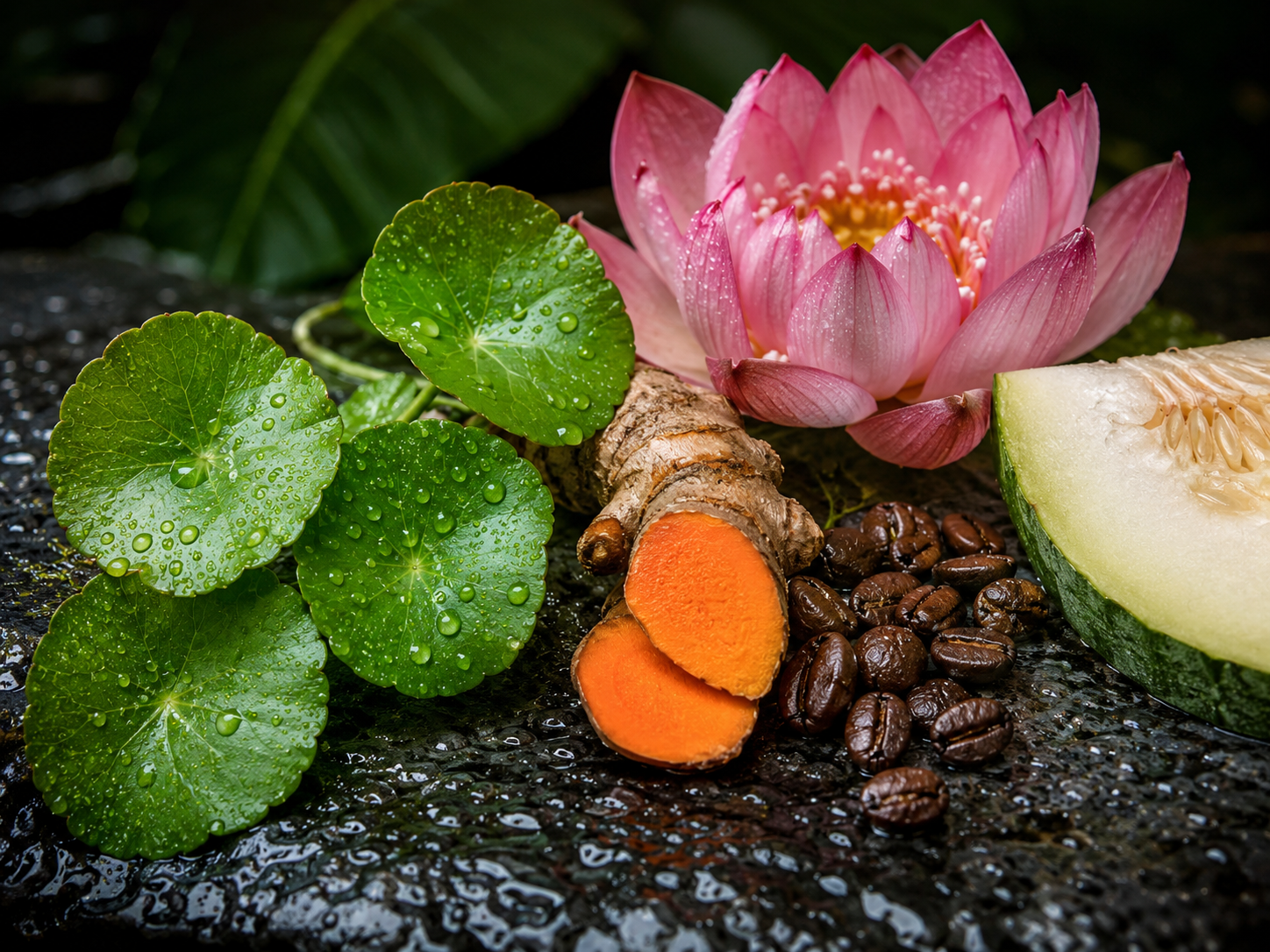
6. Winter Melon (Bí Đao)
Vietnamese name: Bí đao Scientific name: Benincasa hispida Growing region: Mekong Delta; widely grown throughout southern Vietnam
What it is: A common Vietnamese vegetable – large, pale green gourd used in soups, juices, and traditional cooling remedies. Considered “cooling” in Vietnamese traditional medicine for reducing body heat and inflammation.
What the evidence says: Winter melon extract contains triterpenes, polysaccharides, and vitamin C. Anti-inflammatory and antioxidant activity documented in vitro. The hydrating polysaccharide content supports its use in oil-control and soothing formulations.
In skincare: Cleansers, serums, masks, and sunscreens. Cocoon’s Winter Melon line is their most comprehensive – covering SPF, niacinamide serum (N15 at 15% + 4% NAG), cleanser, toner, and face mask.
7. Dak Lak Coffee (Cà Phê Đắk Lắk)
Vietnamese name: Cà phê Đắk Lắk Scientific name: Coffea arabica / Coffea robusta (seed powder) Growing region: Đắk Lắk province, Central Highlands – Vietnam’s coffee capital, producing approximately 30% of the world’s robusta coffee
What it is: Vietnam is the world’s second-largest coffee producer. Đắk Lắk arabica and robusta are cultivated at altitude in the Central Highlands. In skincare, the ingredient is ground coffee seed powder (Coffea Arabica Seed Powder) – not a separate coffee oil.
What the evidence says: Physical exfoliation via coffee grounds is well-documented and mechanically effective. Caffeine has antioxidant properties and temporary microcirculation-improving effects. Does not reduce cellulite in any lasting way despite common marketing claims. The emollient base in Cocoon’s formulation – cocoa butter, and shea butter – provides the post-exfoliation softness.
In skincare: Body scrubs, face polishes. Cocoon’s Đắk Lắk Coffee Body Polish (241,000 VND locally) is the brand’s most iconic product.
Full article: Cocoon Dak Lak Coffee Scrub Review
8. Fish Mint (Diếp Cá)
Vietnamese name: Diếp cá Scientific name: Houttuynia cordata Growing region: Throughout Vietnam; grows wild and is cultivated in northern and central provinces
What it is: A Vietnamese herb with approximately 80% water content, used in Vietnamese cuisine (eaten fresh as a vegetable) and traditional medicine for its antibacterial and anti-inflammatory properties. Common in northern Vietnamese salads.
What the evidence says: Documented antibacterial activity and anti-inflammatory properties. The high water content provides hydration without occlusion – beneficial for oily skin in humid climates. Sebum-regulating properties are supported by traditional use, though formal clinical skincare trials are limited compared to centella.
In skincare: Serums, essences, cleansers – primarily for oily and acne-prone skin. Herbario’s Centella & Fish Mint line pairs it with centella asiatica for complementary anti-inflammatory and sebum-regulating action.
9. Butterfly Pea Flower (Hoa Đậu Biếc)
Vietnamese name: Hoa đậu biếc Scientific name: Clitoria ternatea Growing region: Throughout southern Vietnam and Southeast Asia; intensely blue flowers are used in traditional Vietnamese drinks and food colouring
What it is: A vivid indigo-blue flower used to color Vietnamese ceremonial rice, drinks, and desserts. The color changes from blue to purple with pH – a natural indicator. Widely recognised in Vietnamese culture as both a food and medicinal plant.
What the evidence says: Rich in anthocyanins – a class of flavonoids with documented antioxidant and anti-inflammatory activity. Anthocyanins stimulate fibroblast proliferation and have evidence for supporting collagen and elastin production. The evidence base is promising but less extensive than centella or niacinamide.
In skincare: Toners, serums, and brightening lines. Herbario’s Butterfly Pea Flower line positions it for dry and aging-prone skin; it also features bakuchiol (a plant-derived retinol alternative) as a co-active.
10. Coconut Oil (Dầu Dừa)
Vietnamese name: Dầu dừa Scientific name: Cocos nucifera (oil) Growing region: Bến Tre province – Vietnam’s “Coconut Capital,” Mekong Delta
What it is: Bến Tre produces more coconuts than any other Vietnamese province. Virgin coconut oil extracted by cold-pressing is a traditional skin and hair emollient.
What the evidence says: Approximately 50% lauric acid – a medium-chain fatty acid with documented antimicrobial properties. Effective skin emollient. Moderately comedogenic for some skin types – relevant for body care but worth noting for facial use in acne-prone individuals.
In skincare: Body care, lip balms, and hair care. Cocoon’s Bến Tre Coconut line includes lip balm and body butter. Also present in the Coffee Body Polish formulation as a primary emollient.
11. Gấc Fruit (Quả Gấc)
Vietnamese name: Quả gấc Scientific name: Momordica cochinchinensis Growing region: Throughout Vietnam; harvested December–January; the bright orange-red aril surrounding the seeds is the primary used part
What it is: A distinctly Vietnamese fruit – bright orange-red, spiny exterior, vivid red-orange aril inside. Used to color traditional Vietnamese sticky rice (xôi gấc) for celebrations. Harvested only two months per year.
What the evidence says: Contains tenfold the lycopene of tomatoes and is exceptionally rich in beta-carotene. A clinical study on gấc-containing antiwrinkle cream showed increased skin hydration, smoothness, and reduced wrinkles. Antioxidant activity via carotenoids is well-documented. Tyrosinase inhibition evidence suggests brightening potential.
In skincare: Antioxidant serums, anti-aging formulations, and lip care. The Herbal Cup (Vietnamese brand) uses gấc fruit oil. Youth To The People (a US brand) uses gấc seed extract – international recognition for what has been a traditionally Vietnamese ingredient.
12. Soapberry (Bồ Kết / Bồ Hòn)
Vietnamese name: Bồ kết (Gleditsia) / Bồ hòn (Sapindus) Scientific name: Gleditsia australis (bồ kết) / Sapindus mukorossi (bồ hòn) Growing region: Throughout northern Vietnam; used in Vietnamese hair care for over 2,000 years
What it is: Two related plants used interchangeably in Vietnamese traditional hair washing. The pods contain saponins – natural surfactants that create a gentle cleansing foam without synthetic detergents. Traditionally prepared by grilling and simmering the pods.
What the evidence says: Saponins are effective natural surfactants – gentler than many synthetic alternatives and with documented scalp-soothing properties. Reduces dandruff and scalp irritation. Less evidence for facial skincare than for haircare applications.
In skincare/haircare: Primarily shampoos and hair care. Herbario’s grapefruit and soapberry haircare line draws on this tradition. Also present in Vietnamese pharmacy-brand shampoos widely available in Hanoi and HCMC.
13. Pomelo Peel (Vỏ Bưởi)
Vietnamese name: Vỏ bưởi Scientific name: Citrus maxima (peel) Growing region: Bến Tre province; also Đoan Hùng (Phú Thọ), famous for its pomelo variety
What it is: The dried outer peel of Vietnamese pomelo – a citrus fruit larger and less bitter than Western grapefruit. Used traditionally in Vietnamese hair care combined with bồ kết, the essential oil content provides both fragrance and functional properties.
What the evidence says: Pomelo peel contains flavonoids, hesperidin, and naringin with antioxidant and anti-inflammatory activity. The limonene content contributes antimicrobial properties. Evidence base for scalp health is primarily traditional; clinical trials specifically on pomelo peel are limited.
In skincare/haircare: Primarily hair care – stimulating scalp circulation and reducing hair loss. Herbario’s Vỏ Bưởi & Bồ Kết haircare line is their best-selling product range (30,000+ sold on Shopee). Cocoon also produces a pomelo hair care line from Bến Tre.
14. Lemongrass (Sả)
Vietnamese name: Sả Scientific name: Cymbopogon citratus / Cymbopogon flexuosus Growing region: Throughout Vietnam; Quảng Nam province is a major cultivation center; Vietnam is a leading global exporter of lemongrass essential oil
What it is: A staple aromatic herb in Vietnamese cooking, medicine, and beauty. Used in traditional steam baths, facial steaming, and as a natural fragrance. Lemongrass oil contains 70–80% citral – the compound responsible for its characteristic scent and antimicrobial activity.
What the evidence says: Documented antimicrobial and antifungal activity. Pore-tightening claims have some traditional basis; formal clinical evidence is limited. Primarily used as a fragrance and antimicrobial ingredient in cosmetics rather than as an active treatment.
In skincare: Facial mists, toners, soaps, and essential oil blends. Common supporting ingredient in Vietnamese natural brands.
Note: Essential oils, including lemongrass, can cause irritation in sensitive or reactive skin – always diluted in commercial formulations.
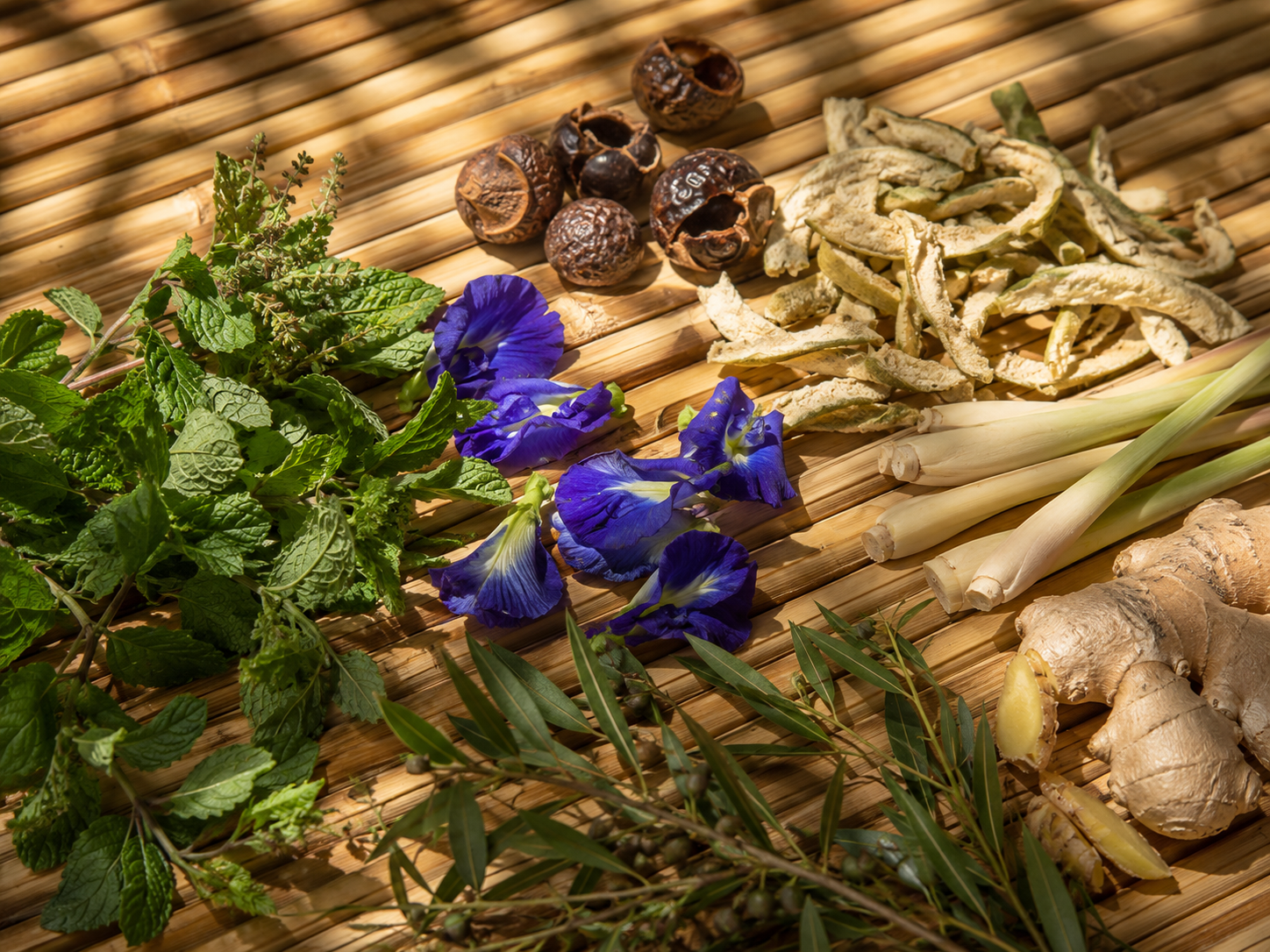
15. Cajeput Oil (Dầu Khuynh Diệp)
Vietnamese name: Dầu khuynh diệp (also dầu tràm) Scientific name: Melaleuca cajuputi Growing region: Southern Vietnamese provinces; one of Vietnam’s most exported essential oils
What it is: A eucalyptus-family essential oil that has been a household staple in Vietnamese families for generations. Used for everything from respiratory relief to topical pain relief. The distinctive medicinal scent is recognizable across Vietnamese households.
What the evidence says: Contains cineole (eucalyptol) and alpha-terpineol with documented antiseptic, anti-inflammatory, and pain-relieving properties. Used in dermatological preparations for minor wound care and infection prevention. Not suitable for use near eyes or on broken skin undiluted.
In skincare: Supporting ingredient in cleansers, acne treatments, and traditional herbal preparations. Provides antibacterial action in formulations.
16. Vietnamese Ginger (Gừng)
Vietnamese name: Gừng Scientific name: Zingiber officinale Growing region: Throughout Vietnam; central highlands and northern mountains
What it is: A widely cultivated spice root used in Vietnamese cooking and traditional medicine. Vietnamese ginger varieties are distinct from commercial ginger – the mountain-grown varieties have higher gingerol concentrations.
What the evidence says: Gingerols and shogaols have documented antioxidant and anti-inflammatory activity. Topical circulation-stimulating properties are supported by traditional use. Some evidence supports scalp stimulation and hair growth support.
In skincare: Circulation-stimulating body care, scalp treatments, and warming massage products. Supporting ingredient rather than hero active in most formulations.
17. Green Tea (Trà Xanh)
Vietnamese name: Trà xanh Scientific name: Camellia sinensis (standard varieties) Growing region: Thái Nguyên province is Vietnam’s most famous tea-growing region; also Lâm Đồng (Đà Lạt area)
What it is: Standard green tea – distinct from Shan Tuyet (see entry 4), which is an ancient heirloom highland variety. Vietnam’s conventional tea regions produce green tea for both consumption and cosmetic extract.
What the evidence says: EGCG (epigallocatechin gallate) is the primary active catechin – well-documented antioxidant, anti-inflammatory, and UV-protective property. Clinical evidence for hydration improvement and barrier support in topical formulations. One of the most extensively studied botanical skincare actives.
In skincare: Toners, serums, antioxidant moisturizers, and SPF boosters. Present in Decumar’s formulations as an anti-inflammatory supporting ingredient alongside Nano THC and niacinamide.
18. Damask Rose (Hoa Hồng Cao Bằng)
Vietnamese name: Hoa hồng Cao Bằng Scientific name: Rosa damascena Growing region: Cao Bằng province, northern mountainous region; high-altitude cultivation
What it is: Damask rose cultivated in Vietnam’s northern highlands. The Cao Bằng rose has been developed for both the ornamental and cosmetic markets. Rose water (nước hoa hồng) has been used in Vietnamese beauty for generations.
What the evidence says: Rose extract contains flavonoids, tannins, and vitamin C with antioxidant and anti-inflammatory activity. Rose water’s hydrating and pH-balancing properties are well-supported by traditional use; clinical evidence for topical rose extract is growing. Soothing properties documented for sensitive skin applications.
In skincare: Toners, facial mists, and moisturizers. Cocoon includes Cao Bằng damask rose in their product range as a moisturizing and anti-aging ingredient.
19. Aloe Vera (Nha Đam)
Vietnamese name: Nha đam Scientific name: Aloe barbadensis miller Growing region: Throughout central and southern Vietnam; Ninh Thuận province is a major commercial cultivation area
What it is: Widely cultivated across Vietnam for both food (aloe vera drinks are common in Vietnamese convenience stores and markets) and skincare. One of the most universally recognized botanical skincare ingredients.
What the evidence says: Among the most evidence-backed botanical skincare ingredients. Documented wound healing, burn soothing, anti-inflammatory, and hydration properties. The gel contains acemannan, a polysaccharide with barrier-supporting and moisturizing activity. Widely used in formulations for sensitive and reactive skin.
In skincare: Gels, toners, after-sun, and soothing serums. Present as a supporting ingredient across many Vietnamese brands. The high Vietnamese cultivation volume means locally sourced aloe is economically accessible for domestic brands.
20. Licorice Root (Cam Thảo)
Vietnamese name: Cam thảo Scientific name: Glycyrrhiza glabra / Glycyrrhiza uralensis Growing region: Imported ingredient used in Vietnamese traditional medicine; also grown in limited quantities domestically in central Vietnam
What it is: A traditional medicinal root used extensively in Vietnamese and Chinese herbal medicine. The active compound glabridin is a potent tyrosinase inhibitor – one of the more evidence-backed botanical brightening actives.
What the evidence says: Glabridin has well-documented skin-brightening activity via tyrosinase inhibition – the same mechanism as arbutin and kojic acid. Anti-inflammatory properties via licochalcone A. One of the few botanical brightening actives with credible clinical evidence comparable to established synthetic alternatives.
In skincare: Brightening serums, hyperpigmentation treatments, anti-inflammatory formulations. Present in several Vietnamese pharmacy and cosmetic brands as a brightening active.
Quick Reference Table
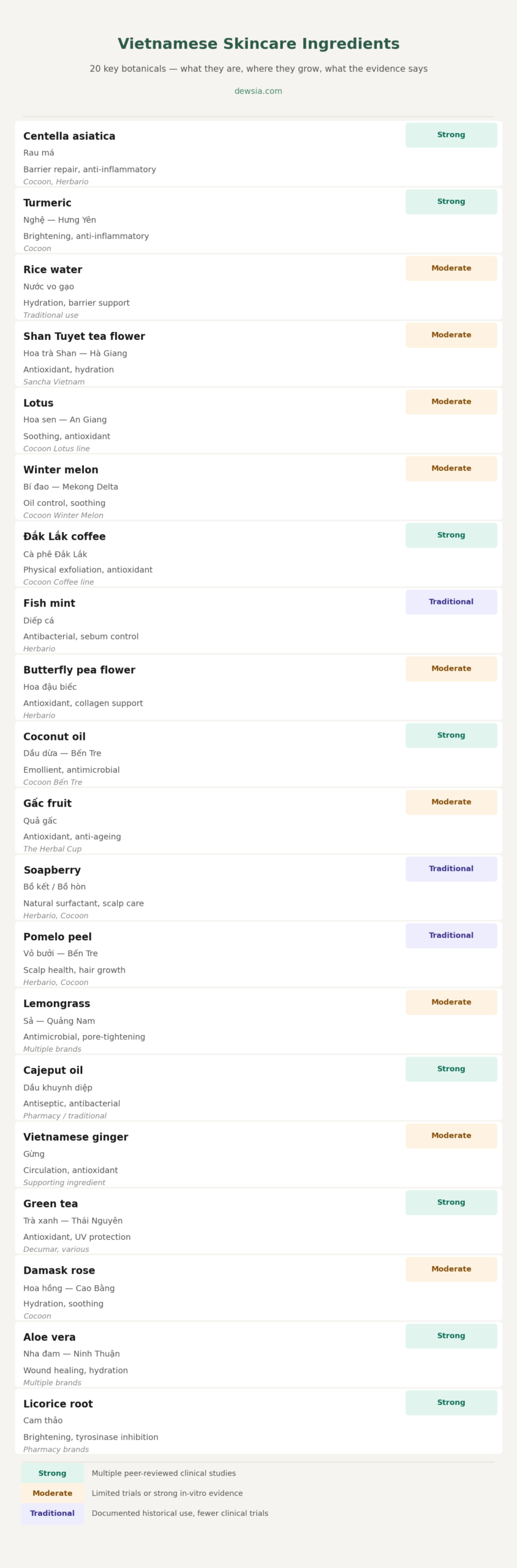
Evidence levels vary significantly across Vietnamese botanical ingredients. Strong = multiple peer-reviewed clinical studies. Moderate = limited trials or strong in-vitro evidence. Traditional = documented historical use.
How to Read Evidence Levels
Strong: Multiple peer-reviewed clinical studies with consistent results, or well-established pharmacological mechanisms with broad scientific consensus.
Moderate: Clinical evidence exists but volume is limited, or in vitro evidence is strong with fewer human trials. Promising but not definitively proven at clinical scale.
Traditional: Documented long-term use in Vietnamese traditional medicine with plausible mechanisms, but limited formal clinical research specifically for cosmetic applications.