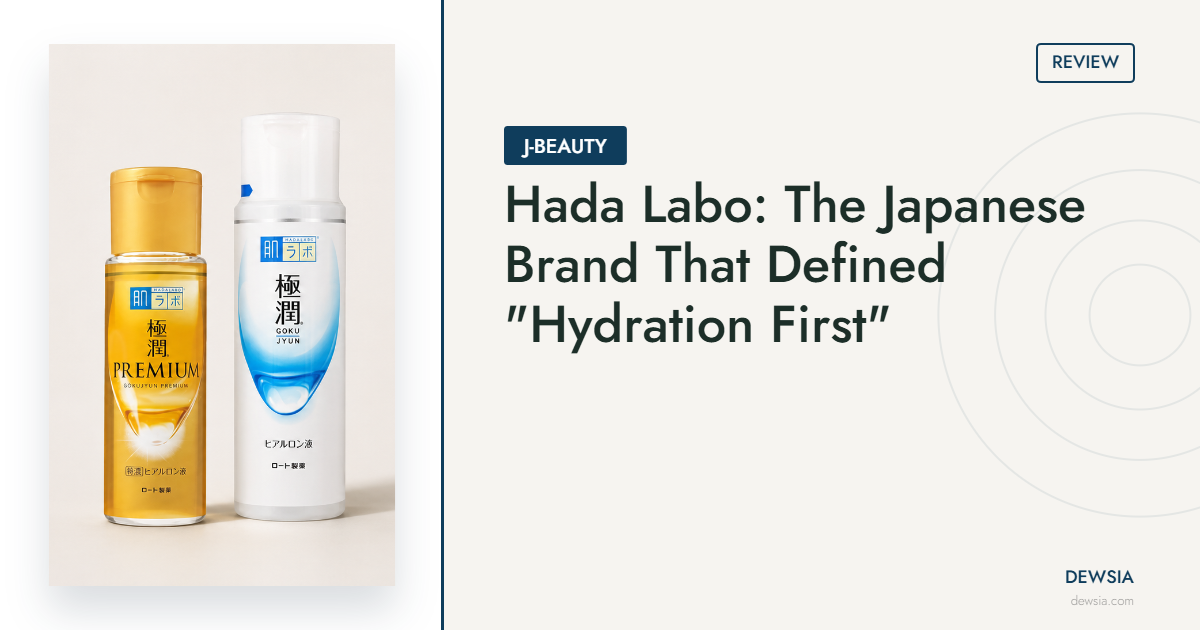
Hada Labo’s most famous product advertises “four types of hyaluronic acid.” Its premium version advertises eight. The number is the marketing – the value is somewhere else entirely.
This Hada Labo review is less about whether the product works – it does – than about separating what the hydration-first bestseller genuinely delivers from what the “x types of hyaluronic acid” framing oversells. Hada Labo is one of the best-value hydrating products available anywhere, and it is the most widely available Japanese brand in Vietnam. It is also wrapped in ingredient marketing that sounds more scientific than it is. Both of those things are true at once, and this piece holds them together.
Fast track:
- The brand and its philosophy → Rohto and “hydration first”
- The hero product → The Gokujyun lotion
- The HA claim, analysed → How many types do you need?
- Why it suits the tropics → Hada Labo in humid climates
- Buying it in Vietnam → Availability
- The verdict → Is it worth it?
- Where it fits → Asian Skincare Routine
Rohto and the “Hydration First” Philosophy
Hada Labo is made by Rohto Pharmaceutical, a Japanese company founded in 1899 that also owns Mentholatum, OXY, and Acnes. It launched the Gokujyun line in 2004, and within five years it had become the best-selling lotion in Japan – Rohto reports selling one bottle every four seconds. That scale was not built on marketing spend; it was built on a single, disciplined idea.
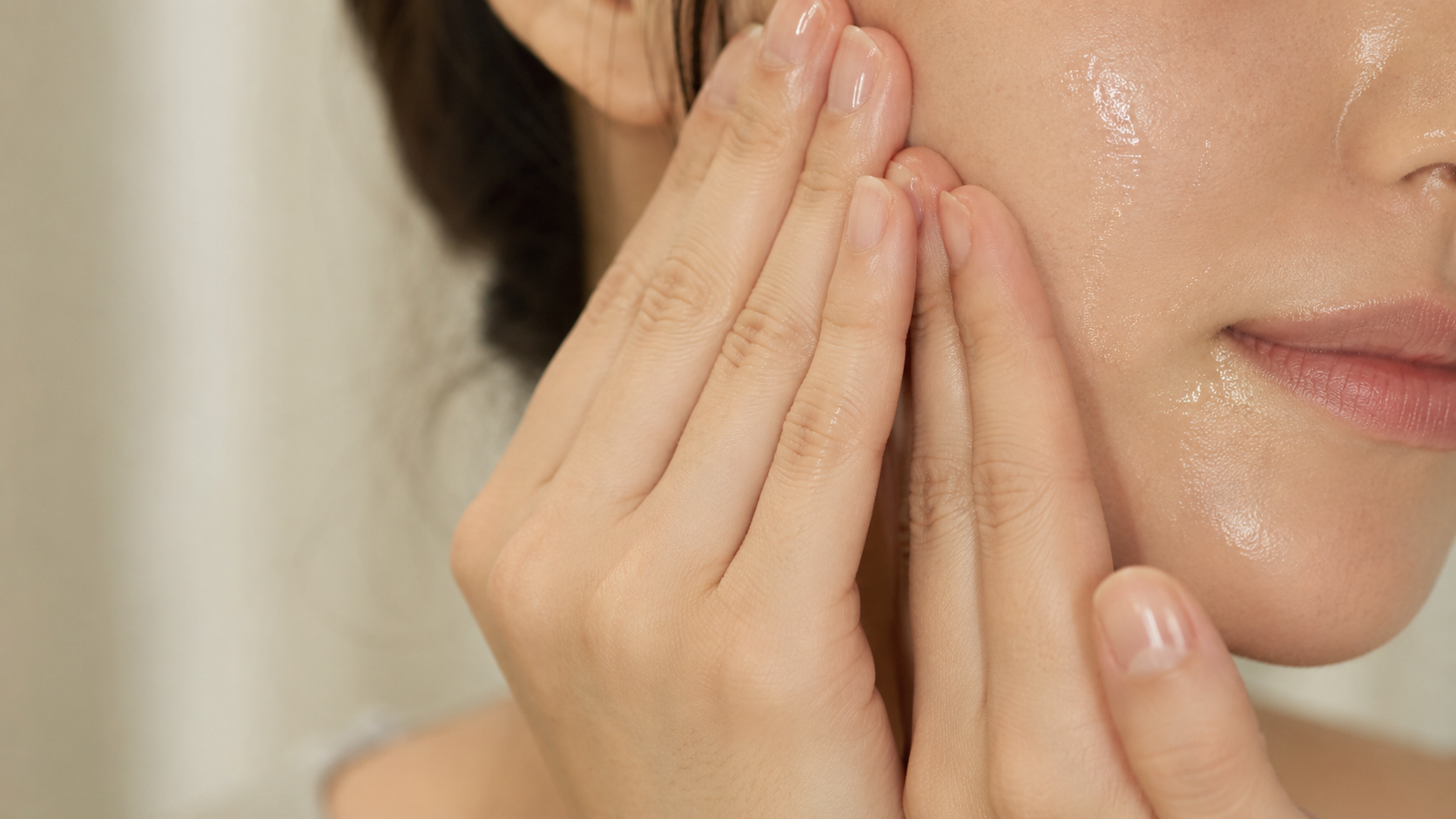
That idea is minimalism as strategy. Hada Labo’s “hydration first” philosophy strips skincare down to its most essential function – moisture – and removes almost everything else: no fragrance, no colorant, no alcohol, no mineral oil, in simple, plain packaging, at a weakly acidic pH matched to healthy skin. This is J-beauty’s restraint in its purest commercial form, and it sits in deliberate contrast to K-beauty’s maximalist, multi-step layering, as covered in our Asian skincare routine comparison. One important translation point: a Japanese “lotion” is not a Western creamy lotion, nor a Western astringent toner – it is a watery hydrating essence, applied by pressing into the skin with the palms.
The Gokujyun Lotion: The Hero Product
The Gokujyun Hyaluronic Acid Lotion is the product that defines the brand. It is a watery, lightweight humectant essence built on hyaluronic acid and glycerin, applied palm-pressed and layerable two or three times for the plump “mochi skin” effect Japanese routines are known for. The ingredient list is genuinely short and clean: water, humectants, the hyaluronic acid variants, a couple of buffering agents, and a preservative – fragrance-free, alcohol-free, and low in irritation risk.
It is, to be clear, a legitimately good product. The range extends to a richer Premium lotion, a Hydrating Milk emulsion, a cleanser, and a cream, but the Original lotion is the heart of it, and it is cheap. The analysis that follows is not a takedown – it is a calibration of one specific marketing claim on a product that otherwise earns its reputation.
How Many Types of Hyaluronic Acid Do You Actually Need?
Here is the claim worth examining. The Original Gokujyun lotion advertises four types of hyaluronic acid; the Premium advertises seven or eight, each described as targeting a different depth of skin. It sounds like precision engineering. Some of it is real, and some of it is marketing.
What’s true: hyaluronic acid molecular weight genuinely matters. High-molecular-weight HA sits on the surface, drawing moisture from the air and plumping the outer layer; low-molecular-weight and hydrolyzed HA penetrates further. Layering different weights has a real, defensible rationale, and topical HA itself has solid published evidence for improving hydration and skin elasticity. The core ingredient works.
What’s oversold: three things. First, the common claim that “sodium hyaluronate is smaller and penetrates better than hyaluronic acid” is chemically false – the two are almost identical high-molecular-weight polymers; the salt form is simply cheaper and more stable to formulate, which is why it appears so often. Second, the “x types” count is largely a marketing device. Going from four types to eight is a marginal refinement, not a transformation, and it functions mostly to justify the price gap between Original and Premium. Third, the number invites a false inference – that eight types is twice as effective as four – when the honest reality is that both are well-formulated humectant lotions delivering broadly the same core benefit.
The honest conclusion: buy Hada Labo because it is a simple, effective, inexpensive hyaluronic acid lotion – not because of how many “types” it lists. The science underneath is real; the differentiation built on top of it is oversold.
Why Hada Labo Suits Humid Climates
There is a non-marketing reason Hada Labo is so popular across Vietnam and Southeast Asia, and it comes down to how humectants behave. Hyaluronic acid draws water from its surroundings. In a dry climate, if the air holds little moisture, HA can pull water out of the deeper skin instead – which is precisely why Gokujyun buffers it with glycerin and butylene glycol.
In a humid climate, that problem inverts into an advantage. With abundant ambient moisture, an HA-heavy product works with the environment rather than against it, pulling water from the air into the skin. Combined with the lotion’s lightweight, non-occlusive texture – no heavy creams to trap sweat and heat – this makes Hada Labo’s hydration-first approach genuinely well-suited to tropical conditions, which is the same logic behind a proper tropical-weather routine. Its popularity in Vietnam is not just distribution; it is a real climate fit.
Buying Hada Labo in Vietnam
Hada Labo is the most widely available Japanese skincare brand in Vietnam, stocked in Guardian, Watsons (Ho Chi Minh City only – not Hanoi), pharmacies, and across Shopee and Lazada. Internationally, the Original lotion runs roughly $11–15 for a 170ml bottle, and local Vietnamese pricing is similarly low, making it one of the best value-per-use hydrators on the market. As always, buy from official retailers rather than unverified resellers; the guide to buying skincare in Vietnam covers the authenticity question in more detail.
Hada Labo Review: The Verdict
Hada Labo Gokujyun is genuinely recommended – a simple, effective, fragrance-free hyaluronic acid lotion at a low price, unusually well-suited to humid climates. It is ideal for dehydrated, dry, combination, or sensitive skin, for minimalist routines, and as a hydration layer pressed in before other products.
The one caveat is about expectations, not quality. Because the “types of hyaluronic acid” marketing is oversold, don’t pay up for the Premium expecting a transformation – the Original does the core job, and Premium is a marginal upgrade worth considering only for genuinely dry skin. It is also a hydrator, not a treatment: it contains no actives beyond moisture, and very dry skin will still want a cream layered on top to seal it in. As an entry point into J-beauty’s hydration-first philosophy, it is close to perfect – cheap enough to try without risk, effective enough to keep, and honest enough in its formulation. The only thing you need to discount is the marketing math.
FAQ
What is Hada Labo Gokujyun lotion? It is a Japanese watery hydrating essence – closer to a serum-toner than a Western lotion – built on hyaluronic acid and glycerin, applied by pressing into the skin with the palms. It embodies Hada Labo’s “hydration first” philosophy.
Does Hada Labo actually work? Yes. Hyaluronic acid paired with glycerin is an effective, evidence-backed humectant, and Hada Labo delivers it in a clean, fragrance-free, inexpensive formula. It is a genuinely good hydrator.
How many types of hyaluronic acid does Hada Labo have? The Original lotion lists four and the Premium seven or eight, but the count is largely a marketing device. The core hydrating benefit is similar across them; the number mainly distinguishes the price tiers.
Is Hada Labo good for oily skin or humid climates? Yes. Its lightweight, non-greasy texture and humectant formula work particularly well in humidity, where ambient moisture feeds the hyaluronic acid rather than depleting the skin. It suits oily and combination skin in tropical conditions well.
Should I buy the Original or the Premium? The Original is the right choice for most people. The Premium is a marginal upgrade best reserved for dry or mature skin – it is not worth paying extra purely for the higher “types of HA” count.