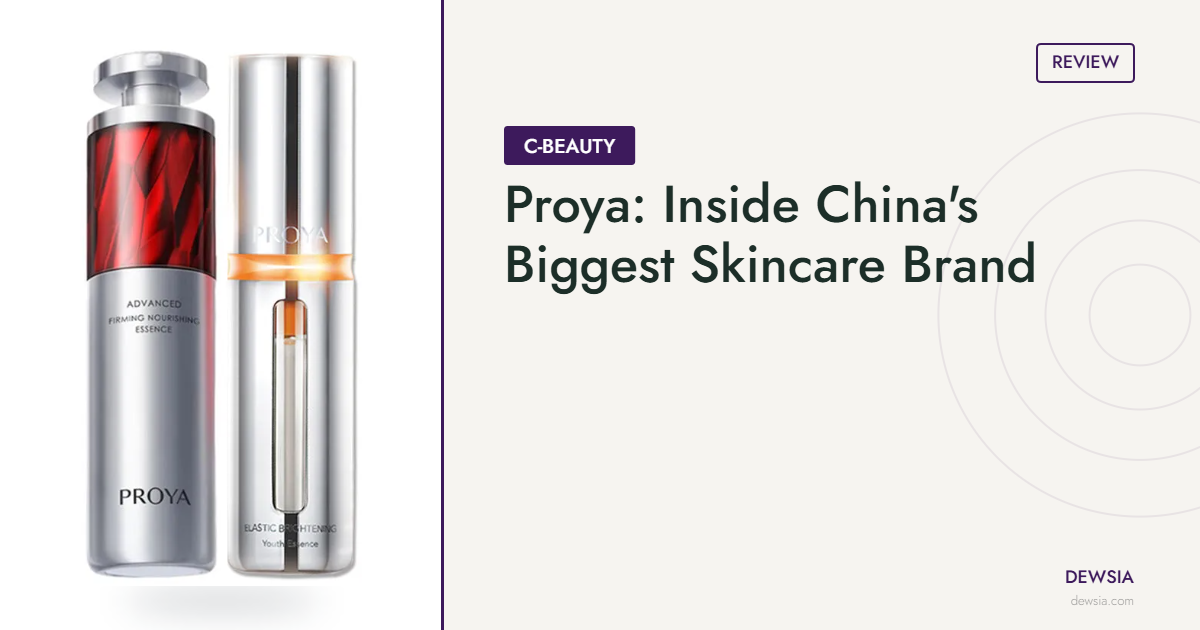
Proya’s entire identity fits in four words: Early C, Late A. Vitamin C in the morning, retinol at night — a protocol dermatologists have recommended for decades, turned into a product line.
This Proya skincare review is about what that means in practice. China’s biggest beauty brand did not win by inventing something new; it won by executing something conventional extremely well, packaging it accessibly, and pricing it below the Western equivalents. Whether that is a compliment or a caveat depends entirely on what you expected – and the honest answer, as usual, sits in the ingredient list rather than the marketing copy.
Fast track:
- Who Proya actually is → The brand
- The signature protocol → Early C, Late A
- The antioxidant essence → Double Anti
- Do the formulas hold up? → The INCI read
- Getting hold of it → Where to buy
- The verdict → Who Proya is for
- C-beauty context → Asian Skincare Routine
The Brand
Proya was founded in 2003 by Hou Juncheng and is headquartered in Hangzhou. Its origin story explains its character: while L’Oréal and Estée Lauder competed for China’s tier-one cities, Proya sold affordable skincare into the tier-three and tier-four cities that international brands overlooked. It grew from the bottom of the market upward, not the top down.
That inheritance shows in the products. Proya is mass-market in the best sense – accessible pricing, unfussy formulas built on ingredients that are well understood, and a strong preference for effectiveness over novelty. It is also digital-native to an unusual degree: the overwhelming majority of its sales happen online, through e-commerce and livestream, which is why its packaging and product concepts are built to be explained in thirty seconds rather than admired on a shelf.
The company runs a family of brands beyond the flagship – Timage, Off&Relax, and Hapsode among them – but “Proya” the skincare line, is the heart of it, and two products define that line.
Early C, Late A: The Signature Protocol
The Early C Late A system is a pair of serums sold as a routine: a vitamin C serum for the morning and a retinol serum for the evening. The logic is textbook and sound. Vitamin C is an antioxidant, so it belongs in daylight hours when it defends against oxidative stress and pairs with sunscreen. Retinol is photosensitizing and works on cell turnover, so it belongs at night. Splitting them also avoids the irritation that comes from stacking them together.
Proya’s contribution is execution, not invention. The evening serum pairs its retinol with a peptide complex rather than leaving it unbuffered, which is a sensible way to support collagen while moderating irritation. Both serums ship in airless vacuum packaging, which genuinely matters – vitamin C and retinol are both prone to oxidative degradation, and a pump that never lets air into the chamber protects the actives from the first use to the last. The morning serum layers vitamin C with anti-glycation agents under the brand’s patented NOX-AGE complex.
Honest limitation: “Early C, Late A” is a dermatologist’s basic protocol with a memorable name attached. There is nothing here that a well-chosen vitamin C serum and a well-chosen retinol would not also deliver. And the trademarked complex names – NOX-AGE, “layered penetration technology,” a claimed 143.52% boost to the skin’s antioxidant capacity – rest on company-run testing, not independent published trials. The activities underneath are legitimate and well-evidenced. The proprietary branding wrapped around them is marketing, as it is at most brands, Western ones included. The retinol also carries the standard cautions: introduce it slowly, expect possible dryness or purging early on, and wear sunscreen daily.
Double Anti: The Antioxidant Essence
Proya’s other signature product is the Double Anti (also sold as Double Effect) Brightening Essence – a lightweight hydrogel serum built around four antioxidants: ergothioneine, EUK-134, LIPOCHROMAN-6, and astaxanthin, supported by anti-glycation agents including decarboxylated carnosine.
This is where Proya’s formulation ambition is most visible. Ergothioneine in particular is a genuinely interesting choice – a potent, stable antioxidant that most Western mass-market brands do not bother with, and one that Chinese and Japanese formulators have adopted well ahead of the West. Astaxanthin and EUK-134 are similarly credible antioxidant selections rather than fillers. The product uses a dual-chamber pump that keeps the concentrate separate until first use, then mixes on activation – again, a real freshness measure rather than a gimmick.
Honest limitation: antioxidant serums are inherently preventive, not corrective. They defend against oxidative damage over time; they do not visibly transform skin the way an exfoliant or retinol does. Judge this product on what it is – a well-built daily antioxidant layer – and it delivers. Expect dramatic brightening in a fortnight, and you will be disappointed, whatever the “28 days” marketing suggests.
Do the Formulas Hold Up?
Chinese brands attract reflexive skepticism about their R&D, so this deserves a direct answer. Proya’s research operation is real: over two hundred researchers, more than seven percent of its workforce, multiple research centers, an innovation platform opened in Paris in 2024, and formal partnerships with global ingredient suppliers including BASF, Croda, and DSM-Firmenich. The actives on its ingredient lists are mainstream, well-evidenced compounds – niacinamide, alpha-arbutin, tranexamic acid, panthenol, acetyl glucosamine, allantoin, and palmitoyl tripeptide-5 – deployed at sensible positions in the formula.
But the ingredient lists reward closer reading, and two details are worth flagging. Several Proya serums include botanical extracts alongside the actives, and the brightening essence contains lavender flower extract, which carries linalool – a recognised contact allergen. For most skin, this is a non-issue; for reactive or sensitized skin, it is a reason to check the INCI before buying. Separately, a number of Proya’s formulas contain ingredients that are not considered fungal-acne safe, including bacillus ferment and the palmitoyl peptides. Neither point makes these bad products. Both make them products worth reading the back of.
The honest summary: the science is real, the actives are conventional and correct, the proprietary complexes are branding, and the botanical additions mean sensitive skin should patch test rather than assume “science-led” equals “low irritation.”
Where to Buy Proya
This is the practical obstacle. Proya’s business is overwhelmingly domestic and overwhelmingly online, and there is no established official retail distribution in Vietnam or most of Southeast Asia. The realistic route for international buyers is cross-border e-commerce – YesStyle and comparable Asian-beauty retailers stock the main serums – rather than a local store.
That carries the usual reseller caveats: verify the seller, check the batch and expiry, and remember that a vitamin C serum degraded by a slow shipping route is worth considerably less than one bought fresh. Pricing sits below Western equivalents for comparable activities, which is a large part of the appeal, though it varies enough by retailer and region that any specific figure would be stale by the time you read it.
Proya Skincare Review: The Verdict
Buy Proya if you want competently formulated, well-packaged actives at accessible prices and you are comfortable ordering through cross-border e-commerce. The Early C Late A system is a legitimate, sensible routine for someone ready for retinol. The Double Anti essence is a genuinely well-built antioxidant serum with ingredient choices ahead of most Western mass brands.
Look elsewhere if you have reactive or fungal-acne-prone skin and don’t want to audit ingredient lists, if you need the reassurance of local retail availability and returns, or if you are drawn primarily by the proprietary-complex marketing. In that last case, the disappointment is not the product – it’s the expectation.
Proya’s real achievement is not a breakthrough molecule. It is that a brand serving China’s smaller cities built the discipline to formulate properly, package protectively, and price honestly, and then made a dermatologist’s protocol legible to millions of people who had never heard it. That is a lower-drama accomplishment than the marketing implies and a more durable one. For where C-beauty sits alongside its neighbors, see our comparison of Korean, Japanese, and Vietnamese approaches – and for the domestic brands facing this competition, our guide to Vietnamese skincare.
FAQ
Is Proya a good skincare brand? Yes, on value and formulation competence. Its actives are mainstream and well-evidenced, its packaging genuinely protects unstable ingredients, and its prices sit below Western equivalents. The proprietary complex names are marketing; the ingredients underneath are sound.
What is Proya’s Early C Late A? A two-serum routine – vitamin C in the morning for antioxidant protection, retinol paired with peptides at night for cell turnover and collagen support. It is a well-executed version of a standard dermatological protocol rather than a novel invention.
Does Proya’s Double Anti essence actually work? It is a well-constructed antioxidant serum built on ergothioneine, EUK-134, LIPOCHROMAN-6, and astaxanthin. Antioxidants are preventive rather than corrective, so expect gradual protection and support, not visible transformation.
Is Proya suitable for sensitive skin? With caution. Some formulas include botanical extracts such as lavender, which carries the allergen linalool, and several contain ingredients that are not fungal-acne safe. Read the specific product’s INCI and patch test first.
Where can I buy Proya? Mainly through cross-border e-commerce and Asian-beauty retailers such as YesStyle. There is no established official retail distribution in Vietnam, so buy from verified sellers and check freshness on vitamin C products.