China’s recombinant collagen industry is starting to blur the line between skincare ingredient, medical biomaterial, and aesthetic treatment. That makes the category more important than another anti-ageing trend – but also more complicated than the marketing suggests.
Collagen has spent decades in beauty as a familiar consumer proposition: hydrate the skin, support elasticity, and fight visible aging. Recombinant collagen changes the industrial logic behind that proposition.
Instead of extracting collagen from animal tissue, manufacturers use engineered biological systems to produce collagen proteins or collagen-derived structures with defined sequences. In principle, that gives developers greater control over what is produced, reduces dependence on animal sourcing, and creates room for more precise molecular engineering.
In China, however, the significance now goes beyond replacing one ingredient source with another.
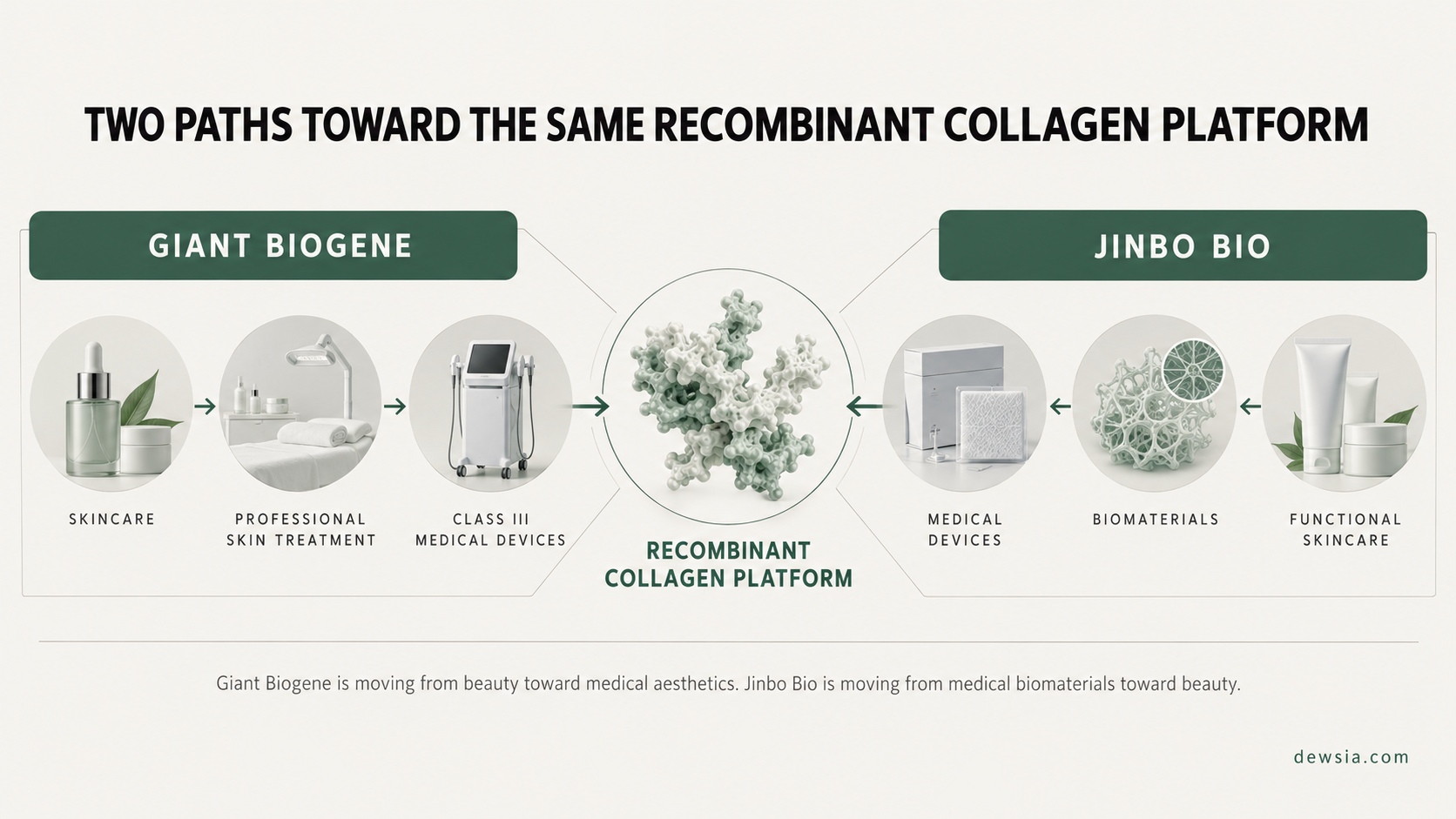
A domestic industry is emerging in which the same underlying biotechnology can sit inside a cosmetic serum, a professional wound or post-procedure dressing, and a Class III medical device. Two of its most important companies – Giant Biogene and Jinbo Bio-— are approaching that intersection from opposite directions.
That convergence is the real biotech bet.
Recombinant Collagen Is Not Simply Animal Collagen Without the Animal
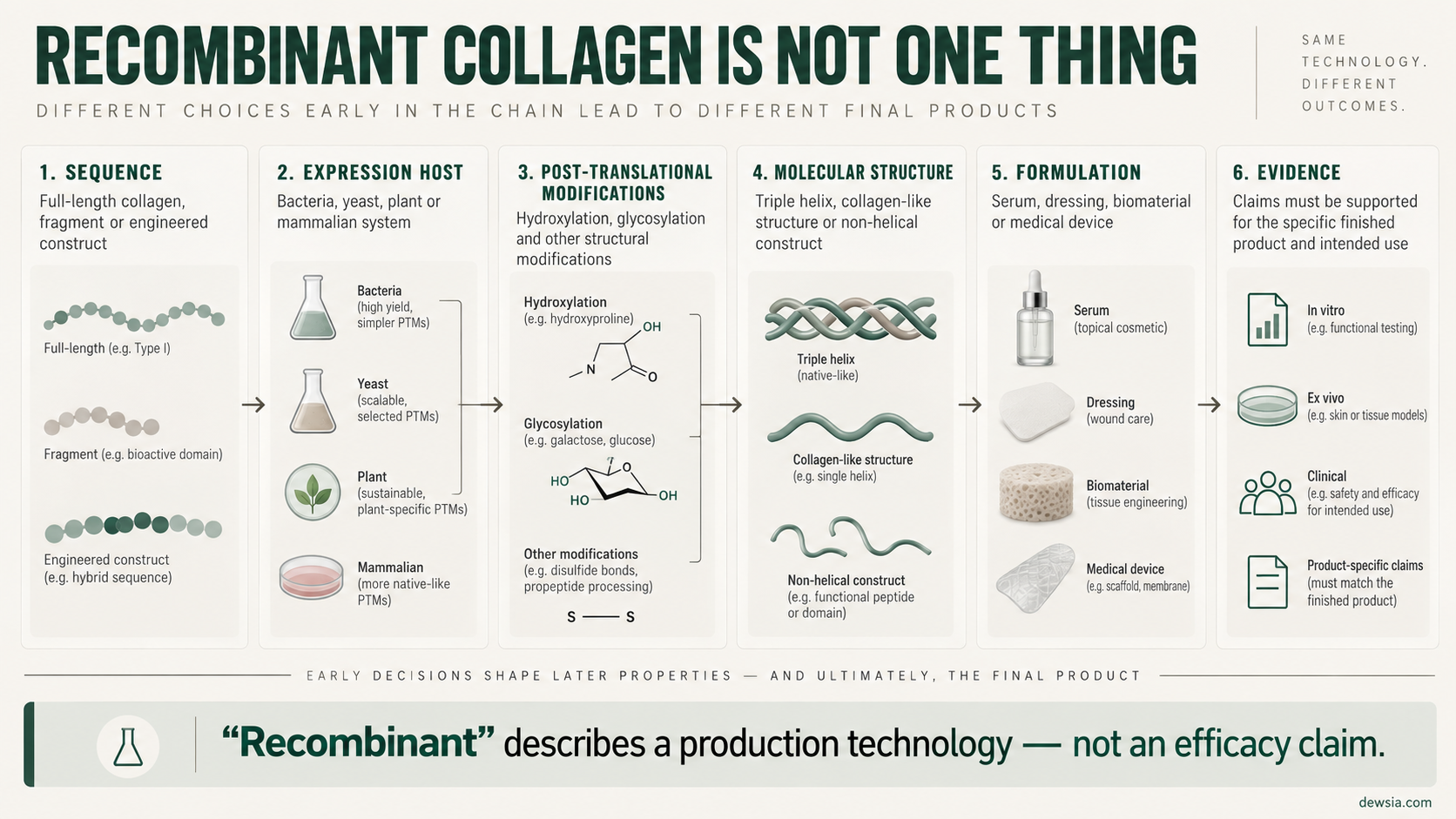
“Recombinant collagen” describes a production approach and a broad family of engineered materials. It does not, by itself, tell a consumer or formulator exactly how a material behaves.
Recombinant production begins with a selected genetic sequence expressed in a biological host. Depending on the system, that host can include bacteria, yeast, plants, or mammalian cells. The resulting proteins may be full-length collagens, fragments, collagen-like proteins, or engineered constructs with different structural properties.
That distinction matters because natural collagen is unusually structure-dependent.
Its biological properties are linked not only to amino-acid sequence but also to post-translational modifications such as hydroxylation and glycosylation and to the formation of its characteristic triple helix. Recent scientific reviews of recombinant collagen identify incomplete post-translational modification as one of the field’s central technical constraints. Hydroxylation in particular contributes to triple-helix stability and higher-order assembly.
The practical result is simple: two ingredients described as “recombinant collagen” do not necessarily represent equivalent materials.
Expression host, sequence, molecular architecture, purification, hydroxylation, formulation, and intended use all matter.
For beauty, that makes “recombinant” closer to a technology category than an efficacy claim.
China Has Been Building a Regulatory and Standards Layer Around the Technology
China’s recombinant collagen boom did not emerge in a regulatory vacuum.
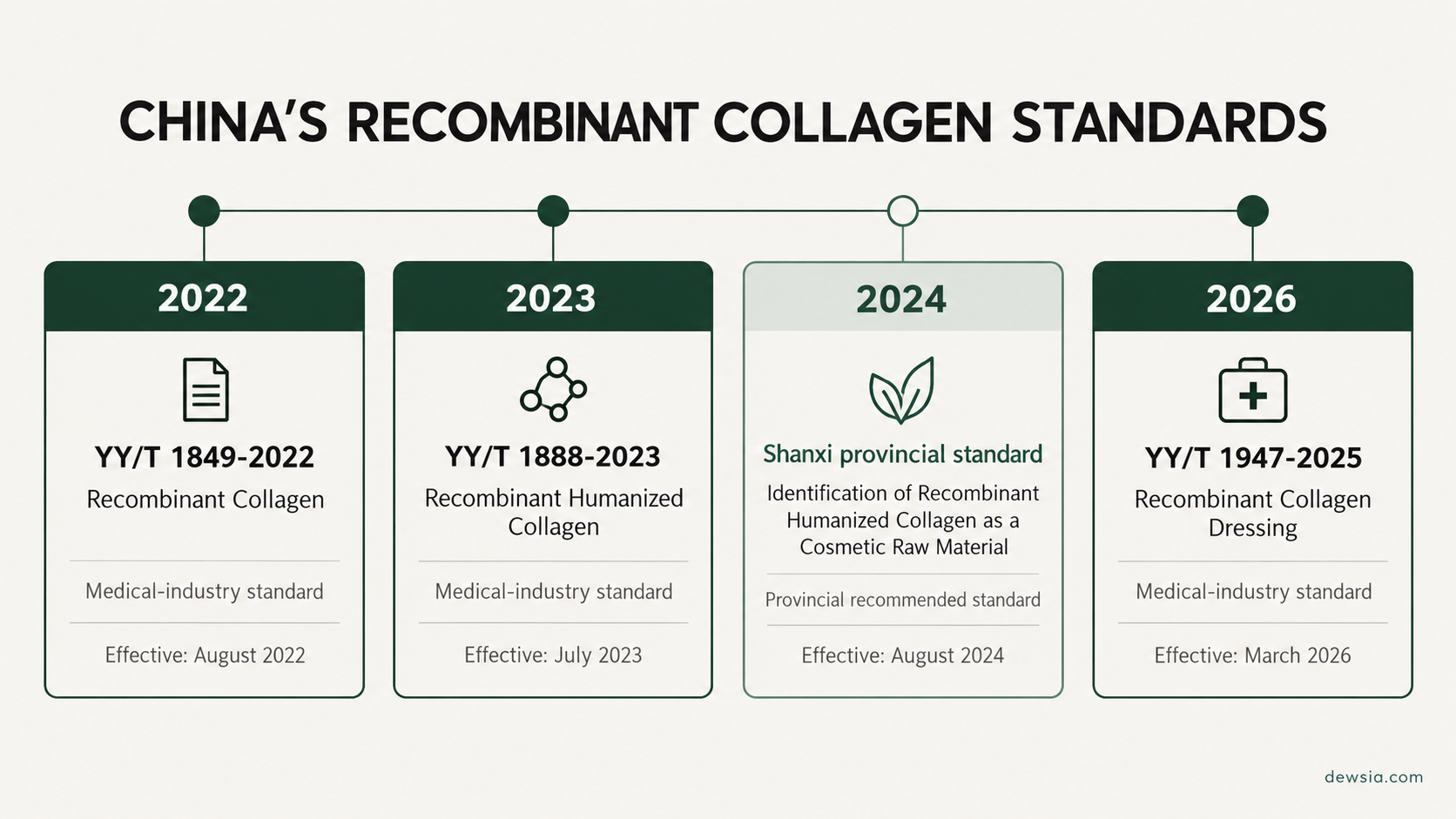
The country introduced the recommended medical-industry standard YY/T 1849-2022, Recombinant Collagen, effective in August 2022. It sets quality-control requirements and testing methods for recombinant collagen used as a medical-device raw material.
A second standard, YY/T 1888-2023, Recombinant Humanized Collagen, followed in 2023 for recombinant humanized collagen without non-human collagen amino-acid sequences.
The framework has continued to become more specific. YY/T 1947-2025, covering recombinant collagen dressings for non-chronic wounds, took effect on March 1, 2026.
Cosmetics sit in a different regulatory context.
China’s National Medical Products Administration has clarified that the existing cosmetic-ingredient category “collagen” can include collagen produced through different processes, including genetic recombination, as well as different collagen types. In other words, a recombinant production route does not automatically make collagen a new cosmetic raw material.
The same regulatory guidance also draws an important boundary: functions that move into areas such as cell regeneration or wound healing fall outside the definition of cosmetics.
There is also a Shanxi provincial recommended standard for identifying recombinant humanized collagen used as a cosmetic raw material, effective since August 2024. Jinbo Bio was one of its drafting organizations. It is a local recommended standard, not a national cosmetic approval regime, but it shows how product identification and standardization are developing alongside commercialization.
That distinction is crucial. China has not created one blanket regulatory category that turns “recombinant collagen” into an approved efficacy claim. Instead, standards and regulatory requirements depend on what the material is, how it is used, and whether the final product is a cosmetic or medical device.
Giant Biogene and Jinbo Bio Are Moving Towards the Same Middle
The clearest evidence of where the category is heading comes from the business models of its major companies.
Giant Biogene has built a large consumer and professional skincare business around recombinant collagen. Its two flagship brands, KOMFYMED and Collgene, generated RMB4.47 billion and RMB918 million, respectively, in 2025, according to the company. Giant describes KOMFYMED’s strategy as a combination of medical devices and cosmetics.
But the company is now moving further into medical aesthetics.
Giant reported that a Recombinant Type I α1 Subtype Collagen Freeze-dried Fiber product received NMPA approval in October 2025, followed by a Recombinant Type I α1 Subtype Collagen and Sodium Hyaluronate Composite Solution in January 2026. Both are Class III medical devices.
The company says its recombinant collagen molecular library now contains more than 50 types and that more than 140 R&D projects were underway at the end of 2025.
Jinbo Bio has developed from almost the opposite direction.
Its medical-device business remains dominant. In 2025, medical devices generated about RMB1.288 billion in revenue, up 2.72% year on year. But its functional skincare business reached RMB255.2 million – an increase of 79.92%. Total revenue rose 10.57% to RMB1.595 billion, while net profit attributable to shareholders fell 10.95% to RMB652.1 million.
Dewsia reported on Jinbo Bio’s 2025 results as its beauty business expanded alongside a much larger medical-device operation.
The direction of travel is revealing.
Giant Biogene is moving from skincare and professional skin treatment deeper into Class III medical aesthetics. Jinbo Bio is using a medical-device and biomaterials base to expand much faster into functional skincare.
They are approaching the same commercial territory from opposite sides.
Skincare May Be the Gateway Rather Than the Endpoint
This helps explain why recombinant collagen is more strategically important than a single ingredient cycle.
Cosmetics offer scale, repeat purchase, and a lower barrier to consumer familiarity than implantable or injectable medical devices. A consumer can first encounter recombinant collagen as a serum, mask, or post-procedure skincare product long before encountering it as a regulated aesthetic treatment.
Medical devices create a different kind of value.
They require more demanding product development, evidence, and regulatory pathways, but they also create barriers that ordinary cosmetic formulation cannot replicate. Giant’s progression into Class III products shows how a recombinant collagen platform developed around skincare can extend towards higher-regulation categories.
Jinbo demonstrates the reverse pathway: a company whose core economics remain medical-device-led can use the same broader technology platform to build consumer-facing skincare.
This does not mean evidence for a medical product validates a cosmetic made with a related collagen or vice versa. The product, formulation, route of administration, and permitted claims remain separate.
What it does mean is that one biotechnology platform can support businesses operating at several points along the beauty–medical continuum.
The Science Is Also Where the Marketing Story Can Break
The phrase “recombinant collagen” has obvious commercial advantages.
It can suggest precision, biotechnology, animal-free production, and advanced science. Those associations are useful to brands, particularly as beauty consumers become more familiar with fermentation, peptides, growth-factor language, and regenerative aesthetics.
But the technical literature gives good reason to resist treating the label itself as evidence of superior performance.
Different expression systems have different abilities to reproduce the post-translational modifications found in native human collagen. Researchers continue to identify hydroxylation, glycosylation, crosslinking, and correct higher-order assembly as important challenges in recombinant production.
That means the relevant questions are more specific:
What sequence is being produced? Is it a full collagen molecule or a fragment? Which expression system is used? Does it form a triple-helical structure? What modifications are present? How is the material formulated? And what evidence exists for the specific finished product and intended use?
“Recombinant” can describe sophisticated biotechnology. It cannot substitute for those answers.
That distinction also matters when looking at the wider Chinese skincare market. As Dewsia has explored in its guide to the Chinese skincare routine and the meeting point between traditional ingredients and modern formulation, Chinese beauty is increasingly difficult to understand through simple ingredient trends alone. Product development is becoming more closely tied to formulation science, technology platforms, and domestic R&D capabilities.
China’s Advantage Is Integration, Not Exclusivity
China is not alone in recombinant collagen.
Evonik markets fermentation-produced, animal-free collagen for personal care, while BASF and Hangzhou-based Bota Biosciences launched a recombinant human-identical Collagen III fragment for cosmetics in 2026. Israel’s CollPlant is developing medical-aesthetic applications based on recombinant human collagen and hyaluronic acid.
So the important claim is not that China owns the technology.
China’s emerging advantage is the density of the surrounding ecosystem: synthetic-biology manufacturing, consumer skincare brands, professional beauty channels, medical-device commercialization, and increasingly specific standards are developing together.
That fits a broader industrial direction. China’s 14th Five-Year Bioeconomy Plan explicitly promoted synthetic biology and biomanufacturing, including the integration of biotechnology with medicine, materials, and light industry. Recombinant collagen sits unusually neatly at that intersection.
It is also where C-Beauty starts to look different from the version most visible outside China.
Dewsia has previously examined how C-Beauty’s expansion into Southeast Asia is changing the competitive landscape for local beauty brands. Recombinant collagen points to another possible phase: China exporting not only finished beauty brands but also ingredients, manufacturing platforms, professional products, and biotechnology partnerships.
The June 2026 collaboration between BASF and Hangzhou-based Bota Biosciences is already a useful example. The Chinese contribution to the global beauty supply chain is not confined to another domestic brand entering TikTok Shop. It can sit upstream in the technology itself.
That upstream role also matters in the context of China’s wider cosmetics trade. Dewsia has previously reported that China’s cosmetics trade topped $24.8 billion in 2025, illustrating the scale of the industrial ecosystem into which these biotechnology platforms are emerging.
The Category Is Growing, but That Does Not Make It an Easy Business
There is one final reason to treat the sector as an industrial story rather than a hype cycle.
The two leading companies do not currently show effortless economics.
Giant Biogene recorded RMB5.52 billion in 2025 revenue, broadly flat year on year, while net profit fell 7.1% to RMB1.91 billion. Jinbo Bio grew revenue by 10.57%, but its attributable net profit fell 10.95%.
The technology can expand into more products without every additional product automatically creating better returns.
That makes the next phase more interesting.
The test is no longer whether Chinese companies can put recombinant collagen into skincare. They already can. Nor is it whether the technology can reach regulated medical products. It already has.
The larger question is whether China can turn the combination of protein engineering, industrial biomanufacturing, medical-device development, and consumer beauty into a durable platform that travels beyond the domestic market.
If it can, recombinant collagen may become one of the clearest examples of C-Beauty moving from brand competition into beauty technology.
And that would be a much bigger shift than another collagen serum.