
Vietnam is preparing its biggest overhaul of cosmetics regulation in years. But the most important change in the latest draft is not simply that the rules could become stricter.
The proposal points toward a different regulatory bargain.
Routine product notification could become more digital and less repetitive. A new Management Number could replace the current five-year notification cycle. Customs and regulators could rely more heavily on connected electronic records. At the same time, product risk, compliance history, Product Information Files and post-market evidence would determine where regulators apply greater scrutiny.
The result could be a system in which compliant companies encounter less routine administrative friction, while companies that repeatedly create safety, quality, or documentation problems face much heavier oversight.
That distinction matters for Vietnamese brands, foreign manufacturers, importers, and retailers alike.
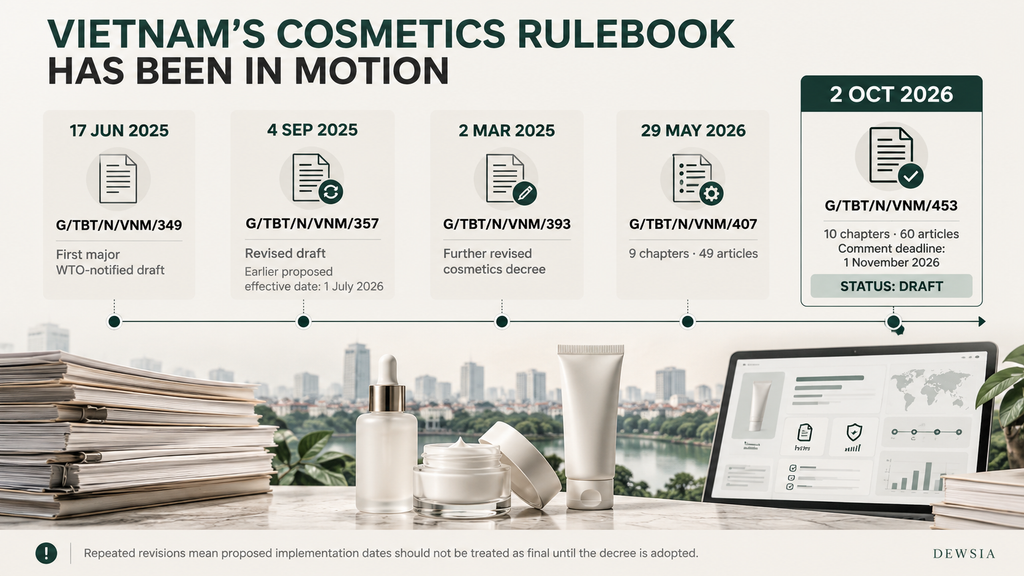
On October 2, 2026, Vietnam notified the World Trade Organization of its latest Draft Decree on the Management of Cosmetics, under notification G/TBT/N/VNM/453. The comment period runs until November 1. The draft contains 10 chapters and 60 articles covering manufacturing, product notification, imports, Product Information Files, labeling, advertising, quality control, post-market surveillance, recalls, and risk-management measures. It remains a draft, not enacted law.
Vietnam’s Cosmetics Rules Have Been in Motion for More Than a Year
The October document is not Vietnam’s first attempt at rewriting the framework.
A cosmetics decree was notified to the WTO in June 2025 under G/TBT/N/VNM/349. Another version followed in September 2025, followed by further drafts in March and May 2026. The May version contained nine chapters and 49 articles; the October version has expanded to 10 chapters and 60. Earlier drafts also carried implementation dates that subsequently passed or changed.
That history is important because it makes one thing clear: January 1, 2027 should not yet be treated as a guaranteed implementation date.
Regulatory analyses of the October draft identify January 1, 2027 as the proposed effective date, but the decree has not yet been adopted.
The direction of policy, however, is much clearer than the date.
In January, Vietnam’s Ministry of Health described the reform around administrative simplification, digital transformation, stronger state management, and alignment with ASEAN practice. In September, Deputy Prime Minister Phạm Thị Thanh Trà again called for stronger post-market control without unnecessarily restricting legitimate production and business.
That gives the reform a more specific logic than “more regulation”.
Vietnam wants regulation to become more targeted.
The Biggest Shift Is From a Receipt Number to a Regulatory Identity
Under the current framework, cosmetics are notified before being placed on the Vietnamese market.
The existing Notification Receipt Number confirms that the responsible company has submitted the required notification. It does not mean the government has independently approved the cosmetic as safe or effective. Dewsia explains that distinction in more detail in Vietnamese Beauty Certifications: What They Actually Mean.
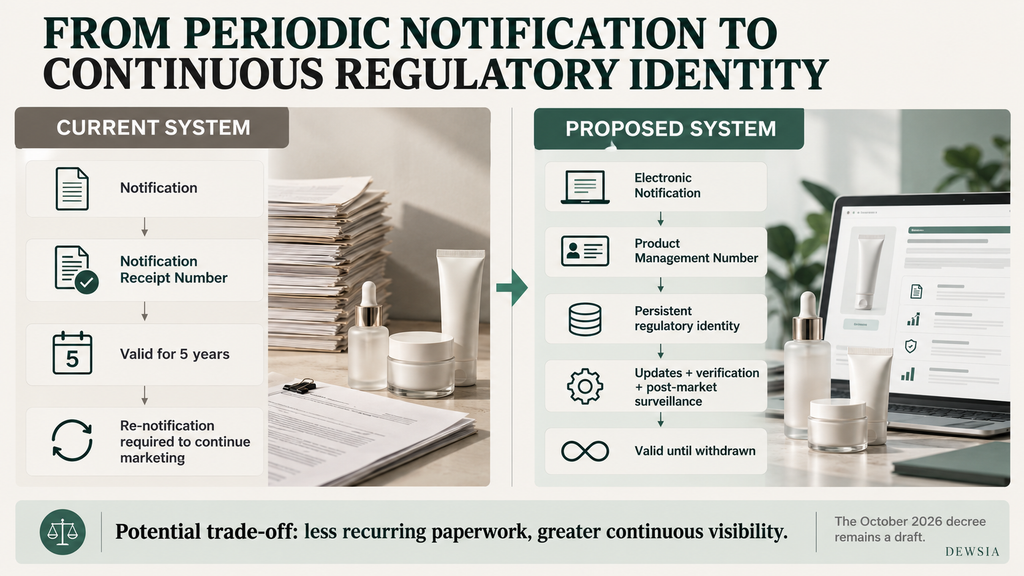
Under Circular 06/2011/TT-BYT, the current receipt number is valid for five years. Companies that want to keep the product on the market must notify it again before expiry. The same circular already places responsibility for product safety, quality, and compliance on the company bringing the cosmetic to market and requires a Product Information File for every marketed cosmetic.
The October draft proposes replacing that receipt-number concept with a Product Management Number.
According to the analysis of the latest draft, the Management Number would function as an electronic identifier used across data retrieval, verification, inspections, risk management, and post-market surveillance. Once a valid dossier is accepted, the number could be issued within three working days and remain valid until withdrawn rather than expiring automatically after five years.
That sounds like deregulation at first.
In one respect, it is.
A company may no longer need to repeat essentially the same notification exercise every five years simply because the calendar says so.
But a permanent identifier also makes the product easier to follow continuously.
The regulatory logic could therefore move from:
notification → five-year validity → re-notification
toward:
notification → persistent product identity → updates → surveillance → withdrawal when necessary
Vietnam may be exchanging periodic paperwork for continuous regulatory visibility.
Post-Market Control Is Supposed to Do More of the Work
It would be misleading to describe this as Vietnam suddenly abandoning pre-market approval in favor of post-market regulation.
Vietnam already relies heavily on notification and company responsibility rather than pharmaceutical-style approval of each cosmetic. The current rules explicitly state that receiving a notification number does not certify that the product is safe, effective, or fully compliant with ASEAN requirements.
The proposed change is subtler.
Post-market control would become more systematic.
The latest draft includes post-notification dossier review, specialized inspections, sampling and testing, online-market surveillance, recalls, and withdrawal of Management Numbers. It also formally introduces risk classification as a mechanism for determining regulatory attention.
That means the regulatory question increasingly becomes not simply:
Has this product been notified?
but:
What happens after it enters the market?
That is a much more demanding question for companies whose documentation looks complete at filing but cannot withstand inspection later.
Risk Classification Will Decide Where Regulators Look First
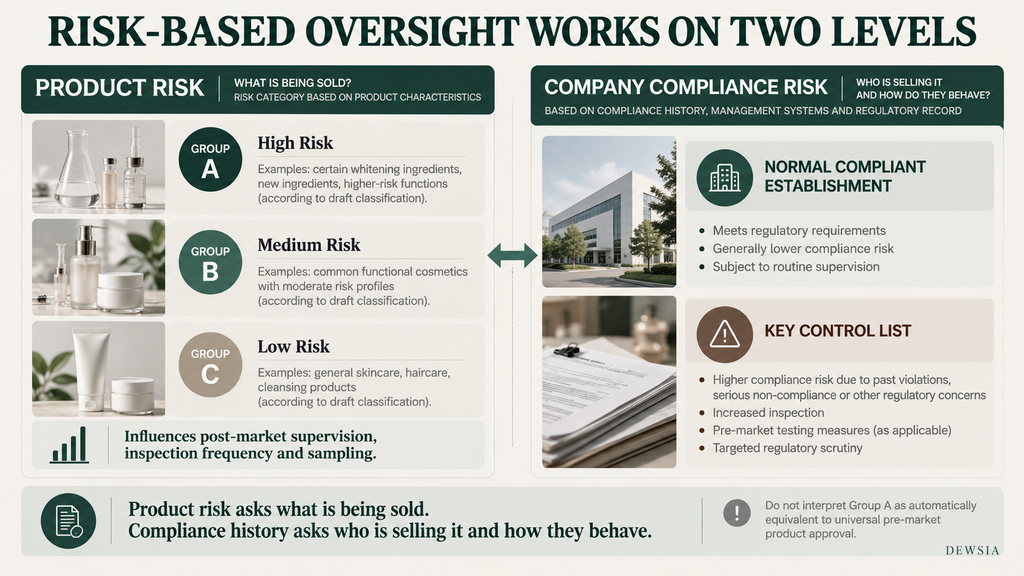
The October draft introduces three cosmetic risk groups:
Group A – High Risk
Group B – Medium Risk
Group C – Low Risk
According to ChemLinked’s analysis, the classification would influence post-notification management, inspection frequency, and sampling. The Ministry of Health would define the relevant higher-risk categories.
This needs careful interpretation.
It does not mean that Vietnam is creating three conventional pre-market approval classes.
The draft still centers on product notification. Risk classification primarily changes how heavily products are monitored once they are in the regulatory system.
Nor should Group A automatically be described as requiring universal batch-by-batch pre-market testing. Different analyses of successive draft versions have interpreted those obligations differently.
A clearer and better-supported mechanism exists elsewhere in the proposal: the Key Control List.
Compliance History Could Matter as Much as Product Risk
The Key Control List applies to establishments rather than simply product categories.
The WTO summary states that businesses placed on this list can face testing before products are placed on the market and increased inspection. Importantly, their existing Management Numbers do not automatically disappear, and authorities can continue accepting new notification dossiers.
That is a revealing regulatory design.
Instead of treating every company as equally risky, the system can apply additional scrutiny where previous behavior gives regulators a reason to look harder.
The distinction could therefore become:
product risk → how closely the product category should be monitored
and
compliance history → how closely the company itself should be monitored
Vietnam already has mechanisms for recalls, notification-number withdrawal, and suspension of new filings for serious violations. The October proposal appears to make that logic more structured rather than inventing it from scratch.
For established companies with strong quality systems, that could be favourable.
For repeat offenders, weak importers, or brands treating compliance as a filing exercise, it could be significantly less comfortable.
Digital Regulation Could Reduce Paperwork and Increase Visibility at the Same Time
The reform also sits inside a much wider Vietnamese push toward digital product regulation.
The October draft explicitly covers administrative procedures and regulatory data in electronic environments, while the wider 2026 product-quality framework establishes mechanisms for electronic labels, unique product identifiers, traceability databases, and Digital Product Passports.
For cosmetics, that creates an important trade-off.
A more connected system can remove repetitive requests for the same paperwork.
At the same time, it can make the relationship between a product, its responsible company, its regulatory history, and its compliance status easier to retrieve.
The latest draft also explicitly includes inspection and surveillance of cosmetics sold online.
That matters in a beauty market where official stores, marketplaces, and social commerce increasingly sit alongside traditional pharmacies and beauty chains.
Dewsia’s guide to buying Vietnamese skincare and avoiding fakes already shows why verification is one of the weak points in online beauty distribution. A regulatory system with more persistent product identities and stronger digital traceability could eventually make that verification layer more useful to both authorities and consumers.
But digital regulation is not automatically lighter regulation.
It is better understood as less friction in retrieving information, combined with a greater ability to act when that information identifies a problem.
PIF Is Not New – but It Is Becoming Harder to Treat as a Filing Formality
One of the easiest mistakes to make when reading summaries of the new decree is to say that Vietnam is introducing the Product Information File.
It is not.
Vietnamese cosmetics already require a Product Information File, or PIF, maintained by the responsible company. The existing framework also allows notification numbers to be withdrawn if a company cannot produce the required file.
Recent enforcement shows that this requirement is not theoretical.
In April 2026, the Drug Administration of Vietnam ordered cosmetics associated with BB Vietnam recalled and destroyed because the company did not have the required PIF. In another 2026 decision involving Trinh Mỹ, the regulator cited an incomplete PIF and a product formula inconsistent with the notification dossier.
Decree 90/2026 also provides administrative penalties for incomplete PIFs, failure to produce a PIF when requested, mismatches between marketed formulas and notification dossiers, and failure to conduct required recalls.
The new decree therefore would not make PIF suddenly important.
It would make the PIF more tightly connected to a regulatory architecture that can decide which dossiers to review, which products to test, and which companies deserve more scrutiny.
That distinction is central.
The paperwork already exists.
What changes is what regulators may be able to do with it.
Advertising Has Already Moved Away From Pre-Approval
Another important distinction concerns advertising.
Vietnam has already abolished four administrative procedures related to the approval and re-approval of cosmetic advertising content.
Ministry of Health Decision 590/QĐ-BYT took effect on February 15, 2026, and removed procedures including initial cosmetic advertising-content confirmation and several forms of reissuance.
So the October decree should not be presented as the instrument that abolishes advertising pre-approval.
The more interesting development is what comes next.
Vietnam has removed one layer of advanced administrative control while simultaneously building a framework with stronger company responsibility and post-market enforcement.
That mirrors the larger direction of the reform:
less routine permission-seeking does not necessarily mean less accountability.
The existing Dewsia analysis of Vietnam’s clean-beauty regulatory gap is relevant here because claims remain one of the areas where regulatory classification, evidence, and marketing language can diverge sharply.
Imports May Become More Digital Without Becoming Simpler
Foreign brands should be particularly careful with the idea that digitalization automatically makes entering Vietnam easier.
The draft retains a local responsible-party structure and includes dedicated rules for imported cosmetics, Certificates of Free Sale, foreign documentation, and regulatory verification.
The operational burden may shift.
Less documentation may need to move repeatedly through customs if authorities can verify a product’s regulatory status electronically.
But the local entity behind the product still matters because somebody must maintain the regulatory record, support PIF access, respond to authorities, and manage corrective action if something goes wrong.
For foreign companies, the quality of the Vietnamese regulatory and distribution partner may therefore become more important, not less, even if the underlying filing system becomes faster.
This connects directly with the structural distribution problem Dewsia examined in Why Vietnamese Beauty Brands Sell Low and Buy High. Regulation and distribution are not separate infrastructures. They determine which companies can move products efficiently across borders and which companies accumulate hidden friction.
The Real Bet Is Selective Regulation
The easiest headline for Vietnam’s cosmetics reform would be that regulation is becoming tougher.
That misses the more interesting story.
The government has repeatedly said it wants to strengthen consumer protection while reducing unnecessary administrative burden. The draft architecture is consistent with that goal: persistent product identifiers, electronic procedures, risk classification, more powerful post-market review, and additional measures for establishments with problematic compliance histories.
If that architecture survives into the final decree, the cost of regulation may become less evenly distributed.
A compliant company with reliable documentation could spend less time repeating routine filings.
A company with incomplete PIFs, inconsistent formulas, safety problems, poor traceability, or repeated violations could attract increasingly intensive scrutiny.
That is not deregulation.
It is a move toward selective regulation.
And for Vietnam’s beauty industry, that may be the most consequential change of all.
As V-Beauty grows, the market needs more than brands and products. It needs regulatory infrastructure capable of distinguishing between a compliant manufacturer and a risky one without forcing both through the same bureaucratic cycle forever.
The October draft is an attempt to build that infrastructure.
Whether the final decree succeeds will depend on details that remain unresolved: the final risk classifications, implementation guidance, electronic systems, transition rules, and the precise balance between central and provincial enforcement.
For now, the key point is simpler.
Vietnam is not merely rewriting a cosmetics rulebook.
It is trying to change where regulatory pressure falls.
What Brands Should Watch Before 2027
The October 2026 document remains a draft. The WTO comment period closes on November 1, and the proposed January 2027 effective date should not be treated as final until the Vietnamese government formally adopts the decree.
For brands, importers, and manufacturers, the most important issues to watch are the final definition of Groups A, B, and C; the criteria for inclusion on the Key Control List; the migration from existing notification numbers to Management Numbers; the technical implementation of electronic verification; PIF-access requirements; and any implementing guidance issued by the Ministry of Health.
Those details will decide whether the reform mainly changes paperwork – or fundamentally changes how cosmetics compliance is managed in Vietnam.