Candid is the only Vietnamese skincare brand built around retinol – and it is made in Korea.
That single fact reframes most of what gets said about Candid Skinetiq Vietnam: the brand is Vietnamese-founded and Vietnam-focused, but its products are formulated and manufactured by Kolmar Korea, and as of April 2026 it is 75% owned by India’s Marico. Candid is simultaneously the most interesting story in Vietnamese skincare and the one that most complicates what “Vietnamese skincare” means.
This is a brand profile with the layers left in – who built Candid, what it actually sells, why it is made abroad, what the Marico deal signals. How its retinol holds up against the Korean alternatives it is implicitly competing with.
Fast track:
- The brand and its founders → Skinetiq and Candid
- The retinol-first range → The products
- The origin question → Is it actually Vietnamese?
- The $40M deal → The Marico acquisition
- Honest comparison → Candid vs. K-beauty retinol
- Where it fits → Vietnamese Skincare: The Complete Guide
- Other brands → 7 Best Vietnamese Skincare Brands
Skinetiq and Candid: An Influencer-Built Actives Brand
Skinetiq Joint Stock Company was founded in Ho Chi Minh City in 2020 by Bui Ngoc Anh and Hannah Nguyen – the latter better known in Vietnam as Hannah Olala, a beauty blogger and TikTok figure with a large following. The brand they launched in 2022, Candid, was built explicitly around a thesis: that high-quality retinol was too expensive and too intimidating for most Vietnamese consumers, and that a local brand could deliver it.
This is a different proposition from every other brand in the category. Where Cocoon, Herbario, and Thorakao all build their identity on Vietnamese botanical heritage – coffee, turmeric, lotus, centella – Candid is the one Vietnamese brand built around clinical actives, with retinol as the lead and an actives-literate audience as the target. It is digital-first by design: a majority of revenue comes from online channels, grown through social commerce, dermatology-led content, and the founder’s existing audience. Skinetiq also holds the exclusive Vietnamese distribution rights to Murad, the imported clinical brand – a useful signal of where the company positions itself.
In a market that markets tradition, Candid markets ingredients. That alone makes it worth covering.
The Product Range: Retinol First
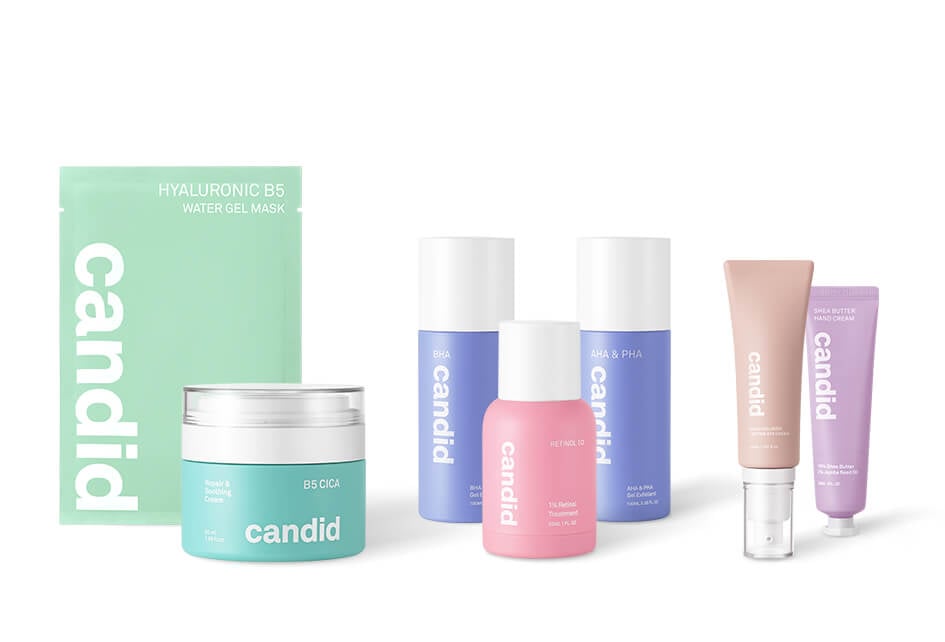
Candid’s core is a graduated retinol system – 0.3%, 0.5%, and 1.0% treatments, each 30ml in an airless pump. The graduation is the point: 0.3% as a beginner on-ramp, stepping up to 0.5%, and eventually 1.0% as tolerance builds. The retinol is encapsulated for time-release, which is the standard modern approach to reducing irritation. Each formula is buffered with 2% niacinamide, panthenol, and centella alongside a supporting cast of ginseng, licorice (dipotassium glycyrrhizate), ceramide NP, hyaluronic acid, beta-glucan, and a palmitoyl pentapeptide. On the INCI, this is a competently built, Korean-style actives serum – not a token retinol with marketing wrapped around it.
Beyond retinol, the line covers the rest of a routine: a B5 Cica barrier-repair cream, a Gold Peptide eye cream, and two chemical exfoliants (a BHA gel and an AHA/PHA gel). The range is built to be used as a system, with the moisturizer explicitly positioned to buffer the retinol.
Verified pricing (candid-skincare.com, 2026): the 1.0% Retinol Treatment is 1,326,000 VND (~$51 USD) for 30ml, with lower concentrations somewhat below that and bundle combos around 1,985,000 VND (~$76).
Honest limitation: this is premium pricing, and it sits uneasily against the founding story of accessible retinol. At roughly $51 for 30ml, Candid’s flagship is priced at or above many imported Korean and Western encapsulated retinols – it competes with clinical skincare on price, it does not undercut it. The graduated concentration system is genuinely good for beginners, and the formulation is sound. But “affordable” is not the honest word for it.

Is Candid Skinetiq Vietnam Actually Vietnamese?
This is the question the brand’s own marketing tends to skip, and it has a specific answer: Candid is manufactured by Kolmar Korea, the result of a collaboration Skinetiq has described as taking more than two years. The formulation and production are Korean. What is Vietnamese is the ownership, the brand, the audience, the educational content, and the local market tuning.
That distinction matters more than it sounds. Cocoon and Thorakao manufacture in Vietnam; their “made in Vietnam” claim is literal. Candid’s Vietnamese identity is commercial and brand-level – the product in the bottle is a Korean-made retinol with a Vietnamese label and a Vietnamese go-to-market. For the glossary of genuinely Vietnamese-grown botanicals, Candid contributes very little; its ingredient story is the global actives story, not the Vietnamese one.
The honest read: this is not a criticism so much as a clarification. Kolmar Korea is one of the largest and most credible contract manufacturers in the world, and a Kolmar-made retinol is a quality product. But if domestic origin is part of why you buy Vietnamese skincare, Candid is the brand where that reasoning breaks down. You are buying Vietnamese branding and Korean manufacturing – and it is worth knowing which is which.
The Marico Acquisition: $40M and What It Signals
In February 2026, India’s Marico Limited – through its subsidiary Marico South-East Asia Corporation – agreed to acquire a 75% stake in Skinetiq at an equity valuation of about $38.6 million. This was an all-cash deal structured across two tranches, with an option to buy the remainder after FY28. The acquisition completed on 2 April 2026, making Skinetiq a Marico subsidiary. Skinetiq’s disclosed revenue was roughly $16–17 million in 2025, up sharply from around $5 million two years earlier, at a mid-twenties EBITDA margin.
What the deal signals is more interesting than the number. A Vietnamese, influencer-founded, asset-light D2C skincare brand reached a ~$40M valuation in roughly five years without owning a factory – the value sat in the brand, the data, the distribution, and the community, not in manufacturing. That is a template other Vietnamese founders will now study closely. It also means the ownership label has shifted again: as of April 2026, Candid is Vietnamese-founded, Korean-made, and Indian-majority-owned. The “Vietnamese brand” description is now genuinely layered – accurate at the level of origin and audience, complicated at the level of production and control.
Candid vs. K-Beauty Retinol: The Honest Comparison
Because Candid is made by Kolmar Korea, comparing it to Korean retinol is, at the manufacturing level, comparing two Korean-made products. The encapsulated-retinol category that Candid sits in is served by the same Korean contract-manufacturing ecosystem that produces many of the K-beauty retinols it competes with. This reframes the comparison.
Candid’s real advantages are local, not formulary. Vietnamese-language education, a graduated on-ramp aimed at first-time retinol users, in-country availability and support, and a buffering system tuned to its audience. For a Vietnamese beginner nervous about retinol, that scaffolding has genuine value. Korean retinols’ advantages are price and breadth: equivalent encapsulated-retinol formulas are often available for less, across a far wider selection, with international shipping.
The honest verdict on the comparison: Candid is not a fundamentally different or superior product to a well-formulated Korean encapsulated retinol – it is a well-formulated one with a local wrapper and a premium price. What you pay extra for is market fit, education, and support, not a formulation breakthrough. Whether that is worth it depends entirely on how much you value those things over price-per-active. For the best Vietnamese products by skin type, Candid earns its place specifically for actives-literate users – not as a default.
Who Candid Is For
Candid suits the actives-literate Vietnamese consumer who wants a locally-supported retinol with strong education and a sensible graduated entry point, and who is not optimising purely for price. The 0.3% is a legitimately good beginner retinol. For anyone prioritising domestic-made V-beauty, or the lowest cost per active, it is a weaker fit – the product is Korean-made and premium-priced. At Dewsia, we use the term V-beauty for Vietnamese skincare as a category, and Candid is the clearest case of why the category resists a single definition: it is Vietnamese in every sense except the two – manufacturing and majority ownership – that some buyers care about most.
FAQ
Is Candid actually a Vietnamese brand? It was founded and is run from Vietnam and built for the Vietnamese market, so at the brand and audience level, yes. But its products are manufactured by Kolmar Korea, and as of April 2026 it is 75% owned by India’s Marico. The “Vietnamese” label is accurate but layered.
Does Candid’s retinol actually work? The formulation is sound – encapsulated retinol at graduated strengths, buffered with niacinamide, centella, and panthenol. It carries the standard retinol cautions: introduce slowly, expect possible dryness or purging early on, use sunscreen daily, and avoid stacking with AHA/BHA in the same routine.
Is Candid worth the price? At ~1,326,000 VND (~$51) for the 1.0% retinol, it is priced as premium clinical skincare, not budget. You are paying for local availability, education, and support rather than a unique formula. If those matter to you, it is reasonable; if price-per-active is your priority, Korean retinols often offer more for less.
Where can I buy Candid? Primarily through the official site (candid-skincare.com) and Vietnamese social-commerce channels. Distribution is Vietnam-focused; there is no established international storefront.
Candid or a Korean retinol? Both come from a similar Korean manufacturing base, so the decision comes down to price, availability, and how much you value Vietnamese-language support and a graduated beginner system. Candid wins on local support; Korean brands often win on price and selection.