The Korean skincare routine for humid weather requires a different approach than the 10-step sequence developed for Seoul’s temperate climate. The routine was not designed for Hanoi, Ho Chi Minh City, Singapore, Manila, or Jakarta – cities where the humidity never drops below 70% and the temperature rarely drops below 25°C.
This creates a specific problem for anyone trying to follow K-beauty advice while living in or visiting a tropical climate. Most K-beauty content is written from the perspective of temperate climates. The advice is solid for Seoul in October. In Ho Chi Minh City in April, parts of it will actively work against you.
This guide goes step by step through the Korean 10-step framework and tells you what to keep, what to modify, and what to drop entirely when you’re building a K-beauty routine for humid tropical conditions.
Fast track:
- Why the 10-step struggles → The humidity problem
- Step-by-step modifications → What to keep, modify, or drop
- Streamlined tropical routine → The practical routine
- Vietnamese alternatives → V-beauty options
- Full three-way comparison → Asian Skincare Routine: Korea, Japan, and Vietnam Compared
- Tropical routine building → Skincare Routine for Tropical Weather
Why the 10-Step Routine Struggles in Humidity
Before going step by step, it’s worth understanding the specific mechanisms by which the full K-beauty layering sequence breaks down in tropical heat.
Absorption slows in humidity. Each layer of the 10-step relies on the previous layer fully absorbing before the next is applied. In cool, dry conditions, a watery essence absorbs in 60–90 seconds. In 35°C heat at 85% humidity, the same product sits on the surface longer. Apply the next layer too quickly, and you’re stacking products that haven’t absorbed – creating a mobile film that migrates when you sweat.
Occlusion traps heat. Heavy creams and oils applied as finishing layers serve a specific function in dry climates: sealing moisture in. In tropical humidity, the ambient moisture is already high. Occlusive layers don’t seal in hydration – they seal in heat, block sweat, and create the conditions for congestion and breakouts.
Reapplication becomes impractical. A 10-step morning routine takes 20–30 minutes if done properly. Reapplying SPF at midday over 8 layers of skincare creates pilling, smearing, and product conflict. In tropical conditions where midday SPF reapplication is genuinely necessary, a simpler base makes compliance realistic.
The practical implication: in humid tropical climates, the 10-step is best understood as a menu to choose from, not a daily prescription to follow in full. The steps that address hydration, treatment, and protection remain relevant. The steps that add bulk, occlusion, or unnecessary layering can be removed without losing anything of value.
The 10-Step Framework and Tropical Modifications
Step 1 – Oil Cleanser ✅ KEEP (evening only)
What it does: Removes oil-based impurities – SPF, sebum, makeup – that water-based cleansers can’t dissolve effectively.
In humid weather: Keep this step in the evening routine if you’ve worn SPF during the day. SPF in particular requires an oil-based first cleanse for complete removal – water-based cleansers alone leave residue that can contribute to congestion overnight.
Modify: Skip in the morning. Morning double cleansing is unnecessary in tropical climates – you’re removing overnight sebum and nothing more. A single gentle cleanser is sufficient.
Step 2 – Water-Based Cleanser ✅ KEEP (morning and evening)
What it does: Removes water-soluble impurities and residue from the oil cleanser.
In humid weather: A consistent keep – but texture matters more than in temperate climates. Choose low-foam, low-stripping formulas that clean without disrupting the skin barrier. High-foam sulfate cleansers remove the protective lipid layer, triggering compensatory sebum production that worsens oily skin in heat.
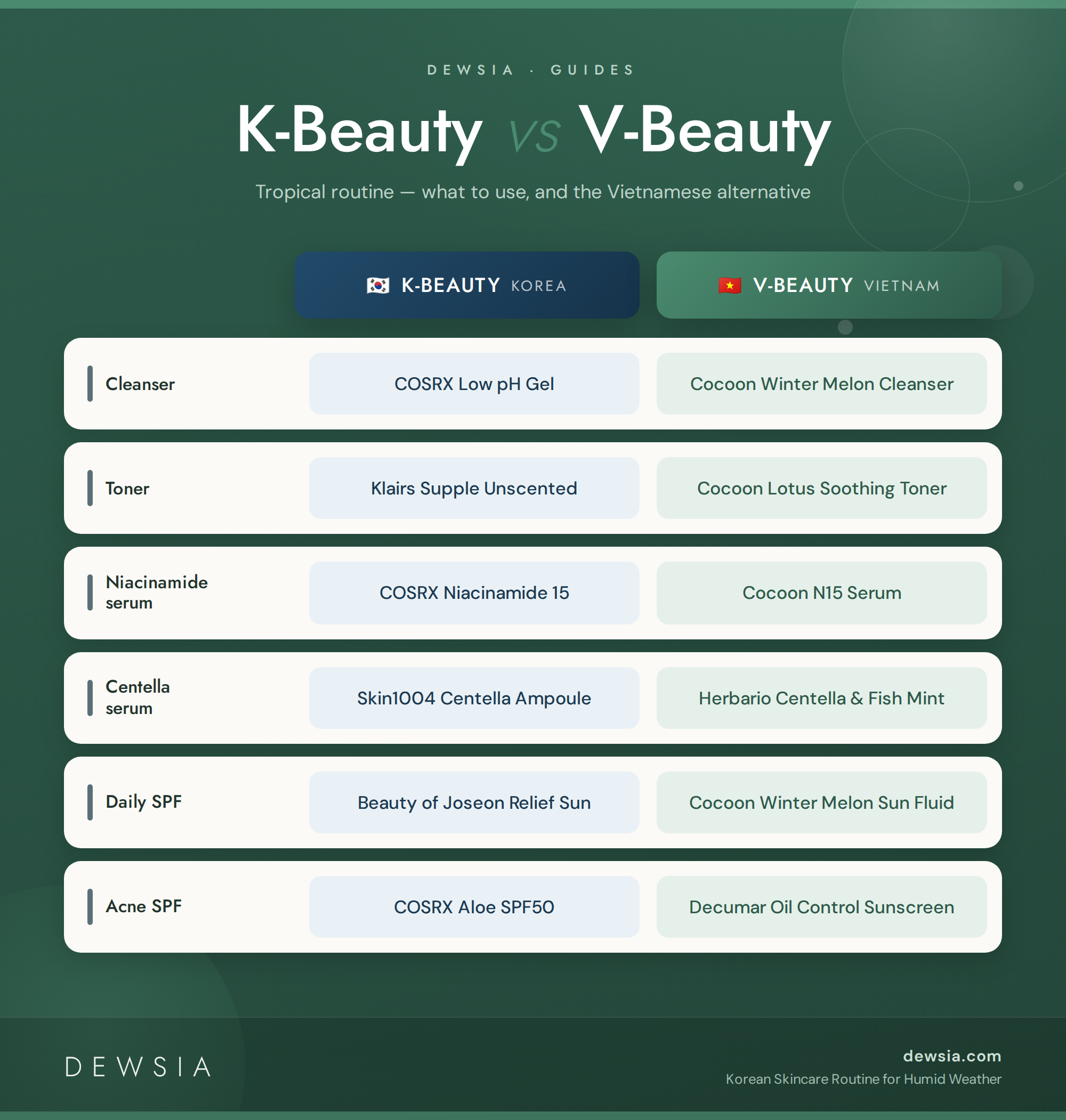
Recommended: COSRX Low pH Good Morning Gel Cleanser remains the benchmark. Cocoon Winter Melon Cleanser is a Vietnamese alternative with niacinamide and gentle cleansing action.
Step 3 – Exfoliator ⚠️ MODIFY (frequency)
What it does: Removes dead skin cells through chemical (AHA/BHA) or physical means.
In humid weather: Exfoliation remains useful, but frequency should decrease. In heat, skin barrier function is already stressed – daily AHA use that works in Seoul winters can cause sensitivity, redness, and barrier disruption in tropical summer conditions.
Modify: 2–3 times per week maximum for chemical exfoliation. BHA (salicylic acid) is more appropriate than AHA for tropical acne-prone skin – it penetrates pores and is oil-soluble, addressing sebum excess directly. Evening application only – AHAs and BHAs increase photosensitivity.
Step 4 – Toner ✅ KEEP (streamline)
What it does: Restores skin’s pH after cleansing, adds initial hydration layer.
In humid weather: Keep one toner. The K-beauty “seven skin method” (applying toner 7 times for maximum hydration) is designed for dry climates. In humidity, one or two applications of a watery toner are sufficient.
Choose: Lightweight, fast-absorbing formulas. Klairs Supple Preparation Unscented Toner is a solid fragrance-free option. Vietnamese alternative: Cocoon Hậu Giang Lotus Soothing Toner – fragrance-free, centella, lightweight.
Step 5 – Essence ⚠️ MODIFY (skin type dependent)
What it does: A concentrated hydrating step that prepares skin for subsequent actives.
In humid weather: Optional for oily and combination skin. In genuine tropical humidity, ambient moisture reduces the need for an additional hydration layer between toner and serum. If you have dry skin or spend significant time in air conditioning, an essence remains useful.
Modify: Make this step conditional – use it on days with heavy AC exposure or in cooler weather, and skip it on hot, humid days when your toner alone is sufficient.
Step 6 – Treatments/Serums ✅ KEEP (limit to one or two)
What it does: Delivers concentrated actives – niacinamide, vitamin C, hyaluronic acid, retinol, peptides – for specific skin concerns.
In humid weather: The step most worth keeping and investing in. The difference is quantity: in temperate climates, layering three or four serums is manageable. In tropical humidity, one or two serums that fully absorb outperform four that stack without absorbing.
Priority actives for tropical skin:
Niacinamide – oil control, barrier support, brightening. COSRX The Niacinamide 15 Serum or Cocoon N15 (15% + 4% NAG) are both well-formulated options.
Centella – anti-inflammatory, barrier repair. Skin1004 Madagascar Centella Ampoule remains the benchmark. Vietnamese alternative: Herbario Centella & Fish Mint Serum.
Vitamin C derivative – more stable than L-ascorbic acid in heat and humidity, appropriate for brightening PIH. Evening application only.
Step 7 – Sheet Masks ⚠️ MODIFY (frequency)
What it does: Delivers concentrated essence under an occlusive mask layer for intensive hydration.
In humid weather: Reduce to 1–2 times per week rather than daily. The occlusive mask layer in tropical heat can over-hydrate the barrier and trigger congestion for oily and acne-prone skin. Remove immediately if skin feels itchy or hot underneath.
Step 8 – Eye Cream ⚠️ MODIFY (texture)
What it does: Targets eye area concerns – dark circles, puffiness, and fine lines.
In humid weather: If you use eye cream, switch to lightweight gel formulas. Rich, waxy eye creams designed for cold climates can cause milia in the eye area in tropical heat. Alternatively, use your niacinamide serum up to the orbital area.
Step 9 – Moisturizer ⚠️ MODIFY (texture and timing)
What it does: Seals in previous steps and provides barrier-protective emollients.
In humid weather: The most commonly over-applied step in tropical K-beauty routines. Heavy creams and rich emulsions are often unnecessary and counterproductive in tropical heat.
Daytime: In outdoor tropical conditions, SPF often provides sufficient occlusion. If skin feels tight after toner and serum, a light gel-cream is appropriate – not a cream.
Nighttime: More relevant in AC environments. A light water-cream provides overnight barrier support without congestion risk.
Drop entirely: petroleum-heavy balms, thick shea butter creams, and anything marketed as “intensive moisture” or “rich night cream.”
Step 10 – SPF ✅ KEEP (non-negotiable, prioritize texture)
What it does: Protects against UV damage, photoaging, and hyperpigmentation.
In humid weather: The single most important step. In tropical conditions, the formula that feels acceptable at 8am must still be reapplicable at noon after sweating. Texture selection is more important than filter selection.
Prioritise: Lightweight gel or fluid formulas. Beauty of Joseon Relief Sun (dewy-natural finish), Cocoon Winter Melon Sun Fluid (7-filter stack, Vietnam-formulated for tropical conditions), Skin1004 Hyalu-Cica Water-Fit Sun Serum (serum format, pilling-resistant reapplication).
Full SPF comparison: → Best Sunscreens for Humid Weather
The Streamlined Tropical K-Beauty Routine
Morning (4 steps):
- Water-based cleanser – low foam, gentle
- Toner – one application, pat in with hands
- Serum – one active (niacinamide or centella)
- SPF 50+ – lightweight gel or fluid
Evening (5 steps):
- Oil cleanser – remove SPF and sebum
- Water-based cleanser
- Toner
- Serum/treatment – actives (vitamin C or retinoid, evening only)
- Light gel-cream moisturiser
2–3 times per week (evening):
- BHA exfoliant
- Sheet mask (skip if oily or in peak humid season)
Vietnamese Alternatives for Each Step
For full Vietnamese brand profiles: → 7 Best Vietnamese Skincare Brands
FAQ
Do I need to double cleanse in a tropical climate? In the evening, yes – if you’ve worn SPF. SPF requires an oil-based first cleanse for complete removal. In the morning, no – a single gentle cleanser is sufficient.
Is the seven-skin method useful in humidity? Not particularly. The method addresses dehydration in dry climates. In tropical humidity, one or two toner applications provide sufficient initial hydration. Additional layers don’t absorb meaningfully in high humidity.
Why does my K-beauty routine pill in tropical weather? Usually over-layering. Products that don’t fully absorb before the next layer is applied create a stacking film that pills when touched or reapplied. The fix is fewer layers with longer intervals between them – not different products.
Can I use retinol in tropical weather? Yes, but evening-only and with strong SPF discipline the following day. Retinol increases photosensitivity – in tropical UV conditions, morning retinol without rigorous SPF will worsen the concerns it’s meant to treat. Bakuchiol (Herbario’s Boosted Serum) is a less photosensitizing alternative.
Is K-beauty suitable for very oily skin in tropical climates? With the modifications above, yes. Key adjustments: remove the daytime moisturizer step, reduce essence use, and prioritize oil-control actives (niacinamide, BHA). The core K-beauty actives are well-suited to oily tropical skin.