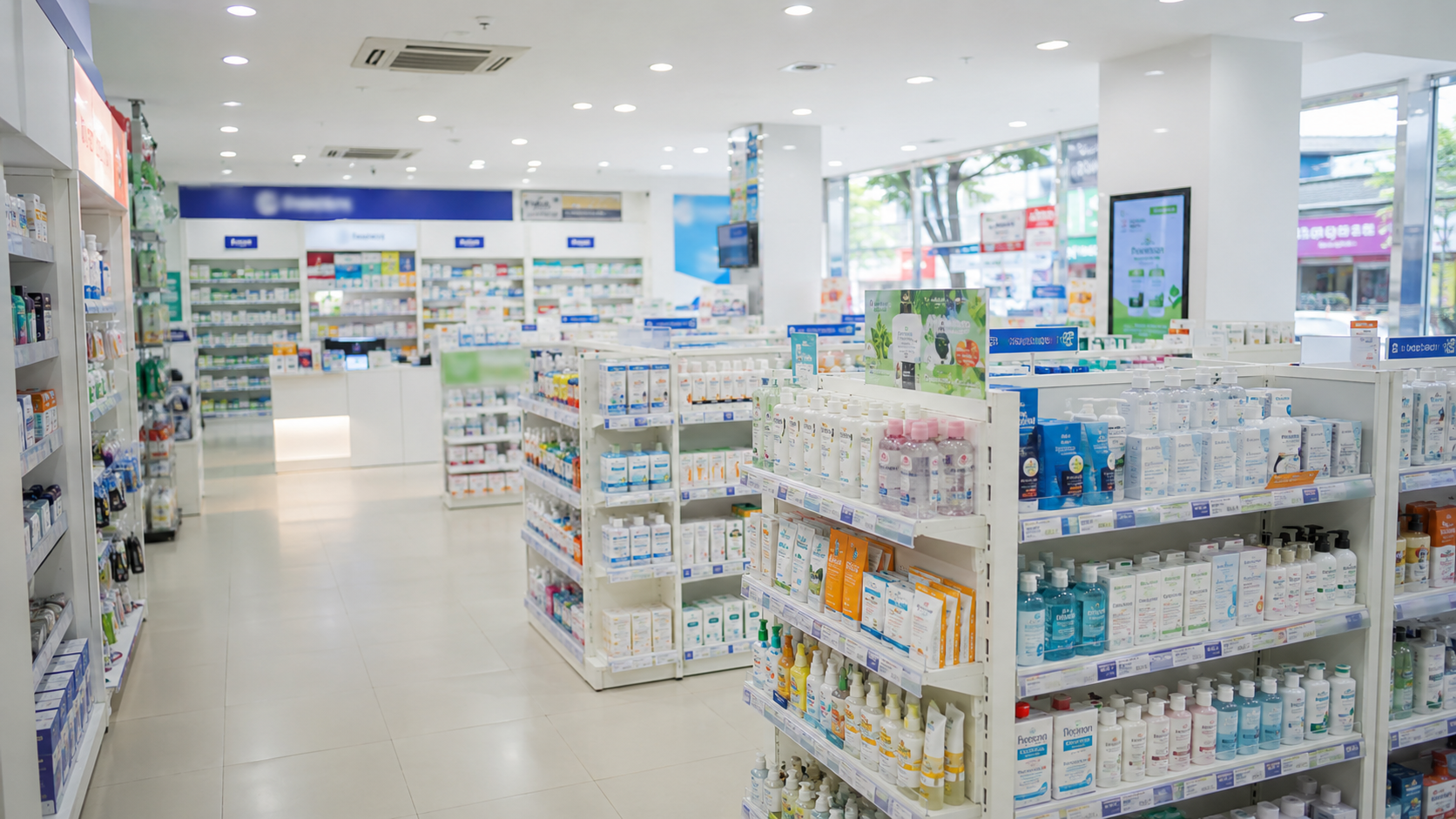
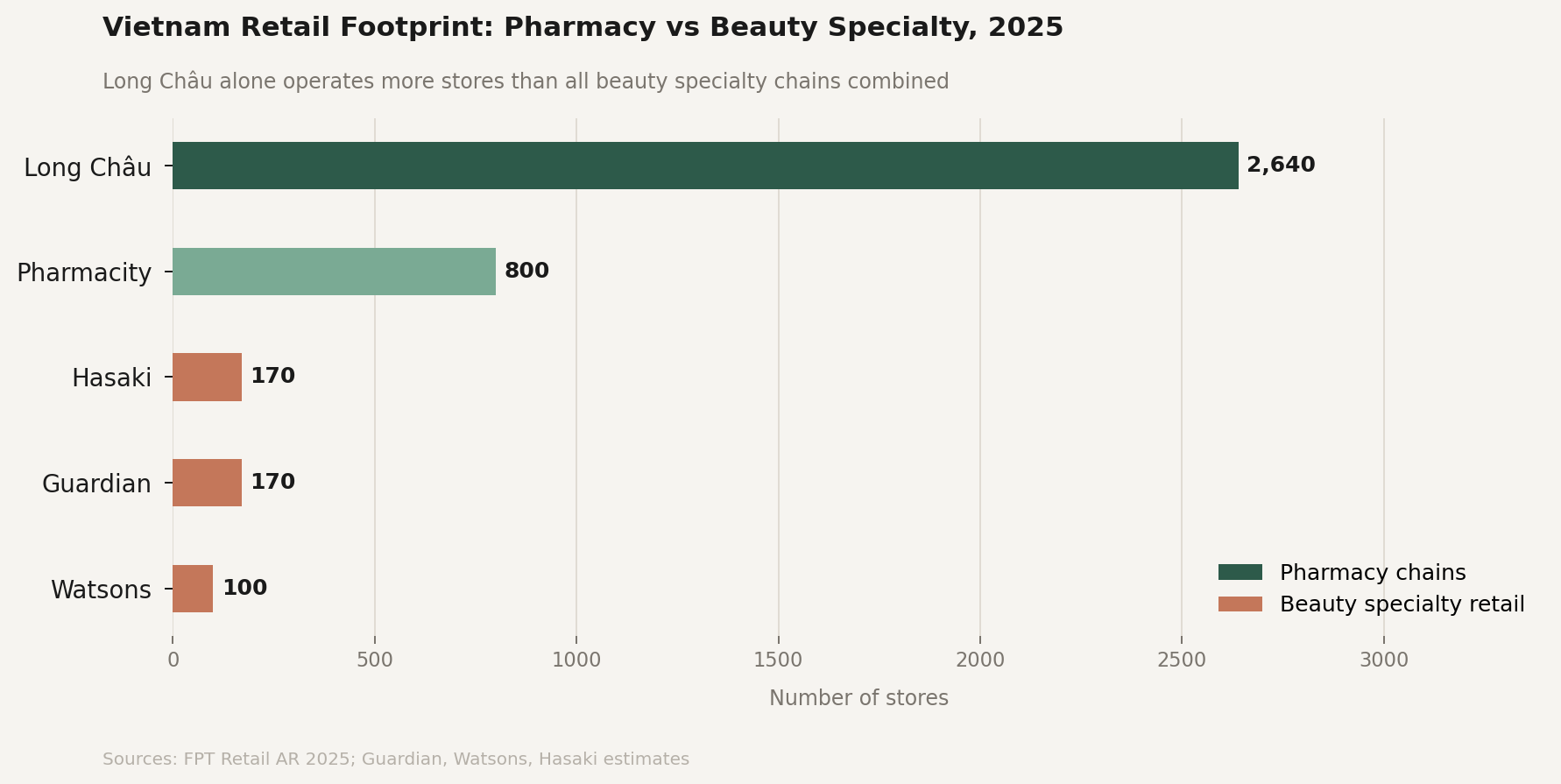
Long Châu Pharmacy operates 2,640 stores across Vietnam and serves approximately 33 million customers – one-third of the country’s population. Guardian, Vietnam’s most internationally recognised beauty retail chain, operates around 170 stores. The footprint differential is not a rounding error. It describes two entirely different distribution logics, and the one that matters more for Vietnamese beauty brands is the one that Western observers consistently overlook.
The Scale Contrast in Numbers
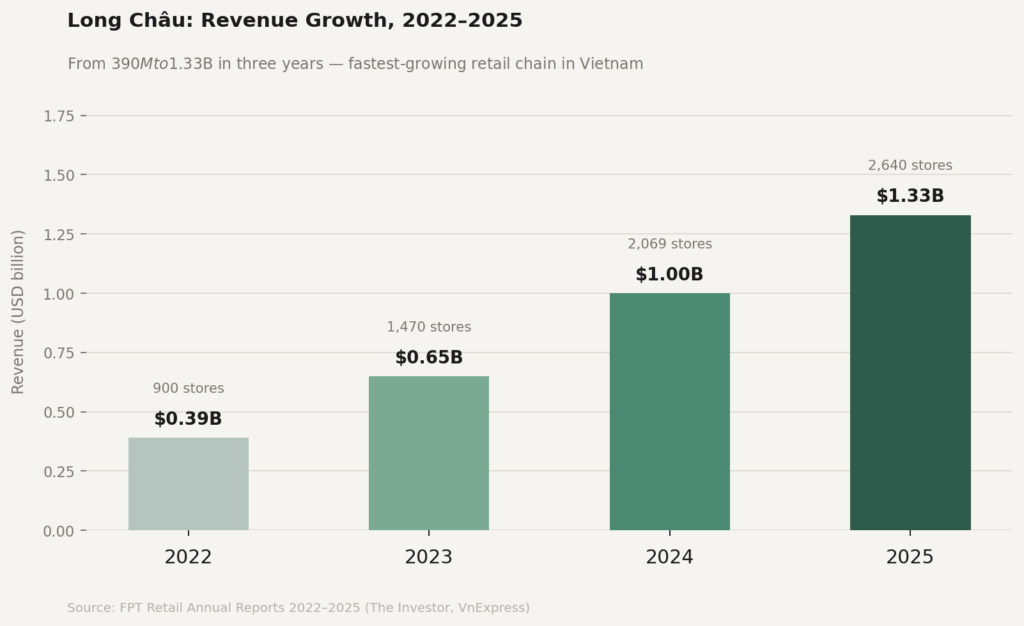
The pharmacy retail channel in Vietnam is growing at a pace that has no equivalent in specialty beauty retail. Long Châu, owned by FPT Retail and listed on the Ho Chi Minh Stock Exchange, opened 474 new pharmacies in 2025 alone, bringing its total to 2,640 locations. Its revenue reached VND 34,501 billion ($1.33 billion) in 2025, up 36% year-on-year, contributing 68% of FPT Retail’s consolidated revenue. The chain began in 2017 with eight stores. The growth trajectory – from just 8 outlets in 2017 to 2,117 stores as of June 2025 – represents an increase of more than 260 times in eight years.
The FPT Long Châu pharmacy chain saw a 59% revenue increase in 2024, reaching VND 25,320 billion ($1 billion) and accounting for 63% of FPT Retail’s total revenue. To contextualize that against the beauty specialty retail landscape: Guardian Vietnam operates approximately 170 stores, Watsons Vietnam approximately 100. The pharmacy channel’s physical footprint across Vietnam is not ten times larger than specialty beauty retail – it is closer to fifteen times larger, and the gap is widening every quarter.
The Vietnam pharmacy retail market was valued at approximately $8.3 billion in 2024 – more than three times the size of Vietnam’s entire cosmetics market. Pharmacy retail in Vietnam is not a niche health channel. It is the primary organized retail infrastructure for the country’s consumer health and personal care spending.
What Pharmacy Shelves Are Actually Selling
The distinction between pharmacy and beauty retail has narrowed significantly in Vietnam over the past five years. Long Châu and Pharmacity both stock personal care and skincare products alongside pharmaceuticals, supplements, and OTC medications. The market is seeing increased purchases of vitamins, dietary supplements, herbal remedies, skincare, and hygiene essentials, reflecting a broader shift toward preventive and holistic healthcare.
This product mix is not accidental. Vietnamese consumers approach personal care spending through a health-adjacent lens that makes pharmacy placement a credible channel for skincare products with functional claims – brightening, barrier repair, acne treatment, and sun protection. The same consumer who trusts a pharmacist’s recommendation for an OTC product extends that trust to the skincare products displayed in the same environment.
For imported dermocosmetic brands – La Roche-Posay, Eucerin, Bioderma – the pharmacy channel has been the primary Vietnamese distribution strategy from the beginning. These brands understood that the clinical credibility transfer from pharmacy environment to product perception was more valuable than the aesthetic environment of a beauty retailer. They built their Vietnamese distribution around pharmacy chains precisely because Vietnamese consumers associate pharmacy placement with efficacy, safety, and dermatological backing.
Domestic Vietnamese brands have been slower to recognize this dynamic. Cocoon’s distribution is built primarily around Guardian and Watsons, with significant e-commerce presence on Shopee and its own website. Its pharmacy presence is limited relative to its specialty beauty retail footprint. This reflects a distribution strategy built around the aesthetic channels – the ones that Western beauty media photographs and that international distributors recognise – rather than the trust channels where Vietnamese consumer health decisions are actually made.
The Trust Transfer Mechanism
Pharmacy placement does something for a beauty brand that Guardian placement cannot: it positions the product within a framework of health evidence rather than aesthetic aspiration. This distinction matters particularly for the functional skincare categories – brightening, anti-aging, and barrier repair – where Vietnamese brands are attempting to compete against imported dermocosmetics with clinical credentials.
A consumer choosing between a Vietnamese brightening serum at Guardian and a Eucerin brightening serum at Pharmacity is not making a purely aesthetic decision. The Pharmacity environment signals clinical substantiation by association. The Guardian environment signals beauty trend relevance. For a Vietnamese brand whose product quality is genuinely competitive but whose clinical documentation is underdeveloped relative to European dermocosmetics, the pharmacy environment is the harder placement to earn and the more valuable placement to hold.
The consumer data reinforces this. 84% of Vietnamese beauty consumers prioritize transparent ingredients, while 82% seek long-term effectiveness over short-term results, according to Q&Me’s Skincare Industry Report 2026. These are not metrics that favor trend-driven beauty retail. They are metrics that favor pharmacy-adjacent distribution where efficacy signals are embedded in the environment itself.
Long Châu’s customer base of 33 million – equivalent to nearly one-third of Vietnam’s population – skews toward health-conscious, regular purchasers who visit the chain for both pharmaceutical and personal care needs. This is precisely the consumer profile that premium domestic skincare brands should be targeting: engaged with product quality, not purely price-driven, and already in the habit of making considered purchasing decisions in a health context.
What the Channel Reveals About V-Beauty’s Strategic Blind Spot
Western beauty observers – investors, journalists, and distributors evaluating the Vietnamese market – conduct their market reconnaissance in Guardian stores and Watsons outlets. These are the channels that look familiar: the aesthetics, the brand mix, and the retail experience all resemble what they know from markets where they have operational experience. Guardian’s partnership with Dairy Farm International and Watsons’ global brand recognition make them legible to international observers in a way that Long Châu and Pharmacity are not.
This creates a systematic blind spot. The Vietnamese beauty market, as seen through Guardian and Watsons, represents roughly 5–10% of the country’s organized personal care retail footprint. The other 90% is pharmacy retail, traditional trade, and e-commerce – channels where domestic brands compete on different terms and where the rules of brand building are different from the rules that Western beauty retail experience would suggest.
For Vietnamese brands with international ambitions, the strategic implication is counterintuitive: the distribution channel that builds domestic consumer trust most effectively – pharmacy retail – is the channel that is least visible to the international observers whose attention is needed for export distribution partnerships. Building pharmacy distribution for domestic credibility and specialty beauty distribution for international visibility are not the same project, and most Vietnamese brands are not resourced to pursue both simultaneously.
The Opportunity Being Left on the Table
Long Châu’s expansion into non-central areas – alongside expansion into non-central areas, its operating efficiency remained stable, with average revenue per pharmacy at about VND 1.2 billion ($46,293) per month. This means the pharmacy channel is reaching Vietnamese consumers in provinces and cities where Guardian and Watsons have no presence. This is the consumer base that domestic brands should be building relationships with before imported brands establish distribution in those markets.
The Vietnamese cosmetics market is projected to reach $3 billion by 2026, with a CAGR of 8.3%. The pharmacy retail market that partially overlaps with that consumer spending is growing at over 8% annually on a base nearly three times larger. These two growth curves are compounding simultaneously, and the Vietnamese brands that build pharmacy distribution infrastructure are now building the domestic consumer trust base that will eventually support premium export positioning.
The irony is visible from any Long Châu store. Domestic brands with genuine ingredient provenance and functional positioning sit in a retail environment built for exactly the trust transfer they need – and most are not there in the way that their imported competitors have been for years.
Sources: The Investor, FPT Retail breaks out in 2025 on pharmacy chain expansion (January 2026); VnExpress International, Long Chau pharmacy chain revenues rise by 66% (January 2024); VietData, Vietnam’s pharma retail boom: Long Chau, Pharmacity, An Khang (June 2025); Vietnam.vn, Is the Long Chau pharmacy chain valued at $1.2 billion? (July 2025); Metric / Q&Me Skincare Industry Report 2026 via The Investor (March 2026); Statista, Vietnam Skin Care Market Forecast; UniDatos, Vietnam Pharmacy Retail Market Forecast 2033.