The Chinese skincare routine is sold on a thousand years of imperial ritual. Its actual competitive advantage is about fifteen years old.
Ginseng, pearl powder, snow fungus, dynastic beauty secrets – that is the story C-beauty tells about itself, and it is not a lie so much as a misdirection. The reason Chinese skincare now undercuts Korean and Western brands on efficacy and price has very little to do with Traditional Chinese Medicine and almost everything to do with barrier science, biotech-derived actives, and dermatological testing. Most “clinical” Western brands never match. The herbs are the signature. The science is the product.
This guide grades the four TCM ingredients that define the category honestly – what each one actually does and where the evidence runs thin – then explains where C-beauty’s real edge sits. What the routine looks like in practice and why one ingredient quietly connects Chinese and Vietnamese skincare.
Fast track:
- Where C-beauty actually sits → Asia is not Korea
- The four TCM actives, graded → TCM ingredients
- The real advantage → The biotech turn
- Building the routine → What it looks like
- The V-beauty connection → The licorice bridge
- Full three-way context → Asian Skincare Routine: Korea, Japan, and Vietnam Compared
- Ingredient evidence → Vietnamese Skincare Ingredients Glossary
Asia Is Not Korea: Where C-Beauty Sits
The default Western mental model of “Asian skincare” is Korean skincare – essences, sheet masks, the ten-step routine. That model is incomplete, and C-beauty is the clearest proof.
K-beauty exported on trends; C-beauty exports on data. Where Korean brands built global reach on texture, virality, and a maximalist routine, and where J-beauty leans toward minimalist, hydration-first restraint, the breakout Chinese brands have positioned themselves around something more clinical: barrier repair, allergen and patch-test rigor, biotech ingredients, and price points that routinely beat both.
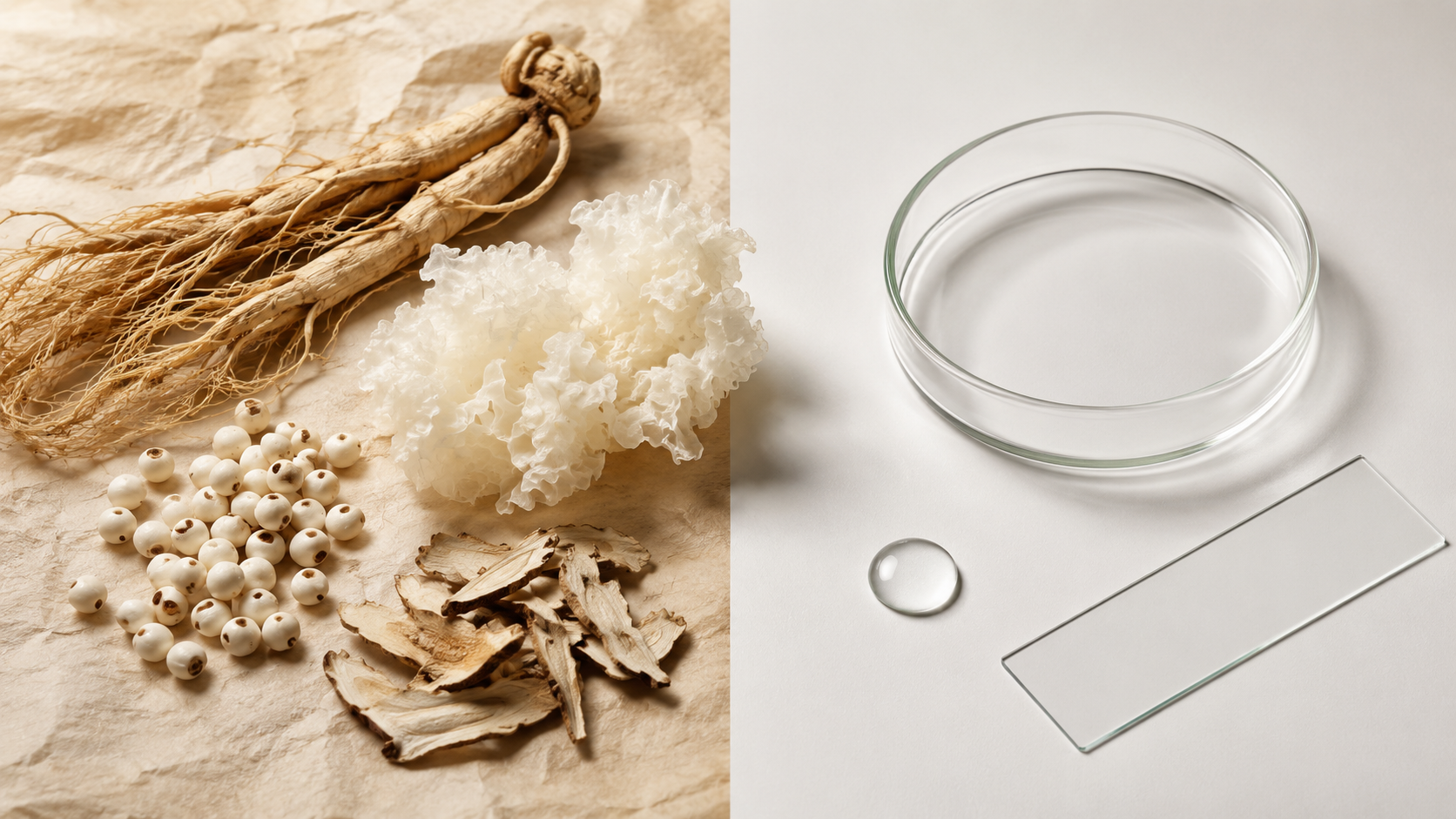
The TCM heritage is real, but it is not the engine. Traditional Chinese Medicine gives the category its cultural specificity and its marketing language, but in the current generation of products, it functions as differentiation, not mechanism. Strip the imperial storytelling away, and what remains is a dermatology-led formulation industry – which is exactly what makes it worth taking seriously, and exactly what the “ancient secrets” framing obscures.
The TCM Ingredients, Graded Honestly
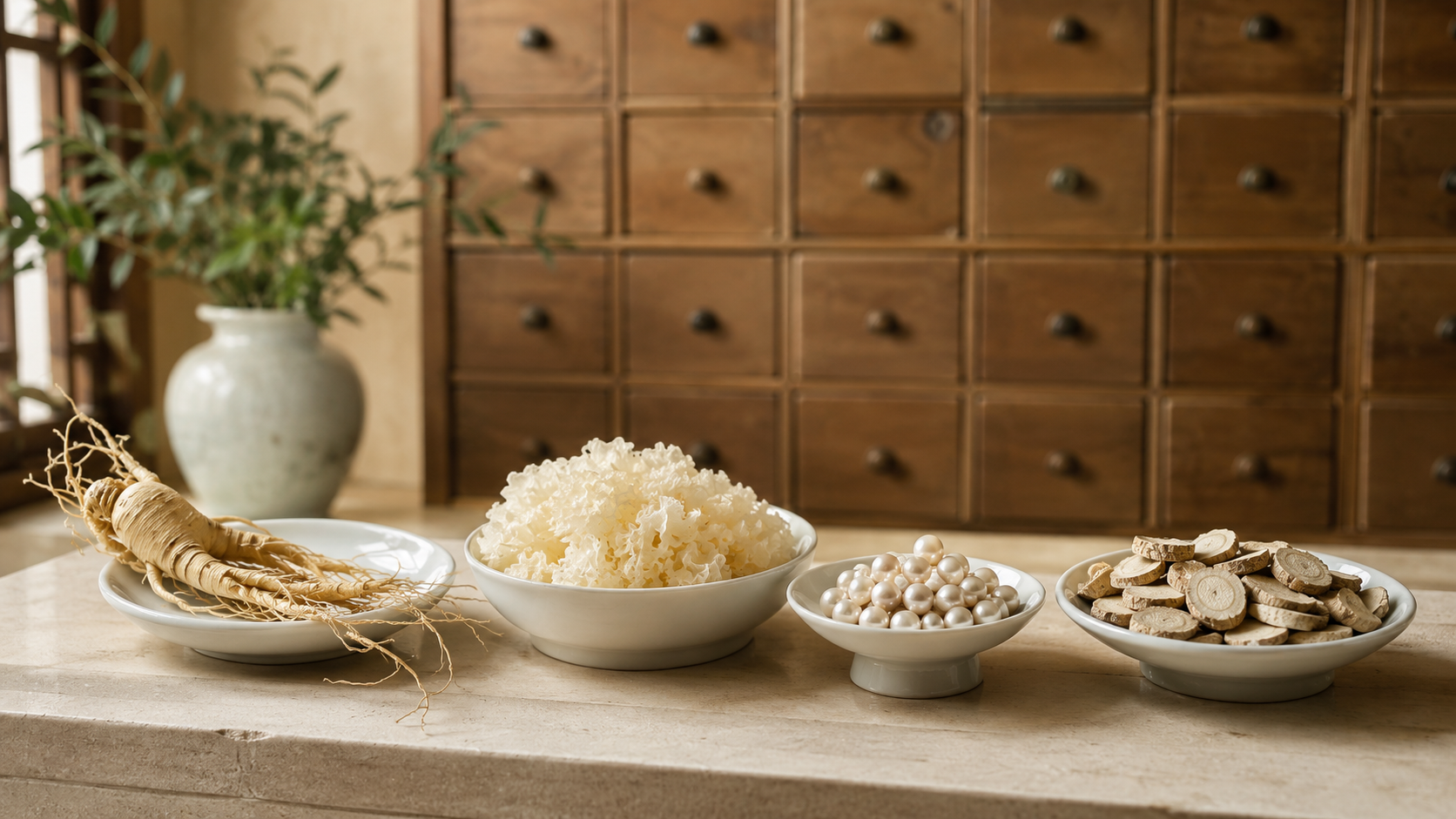
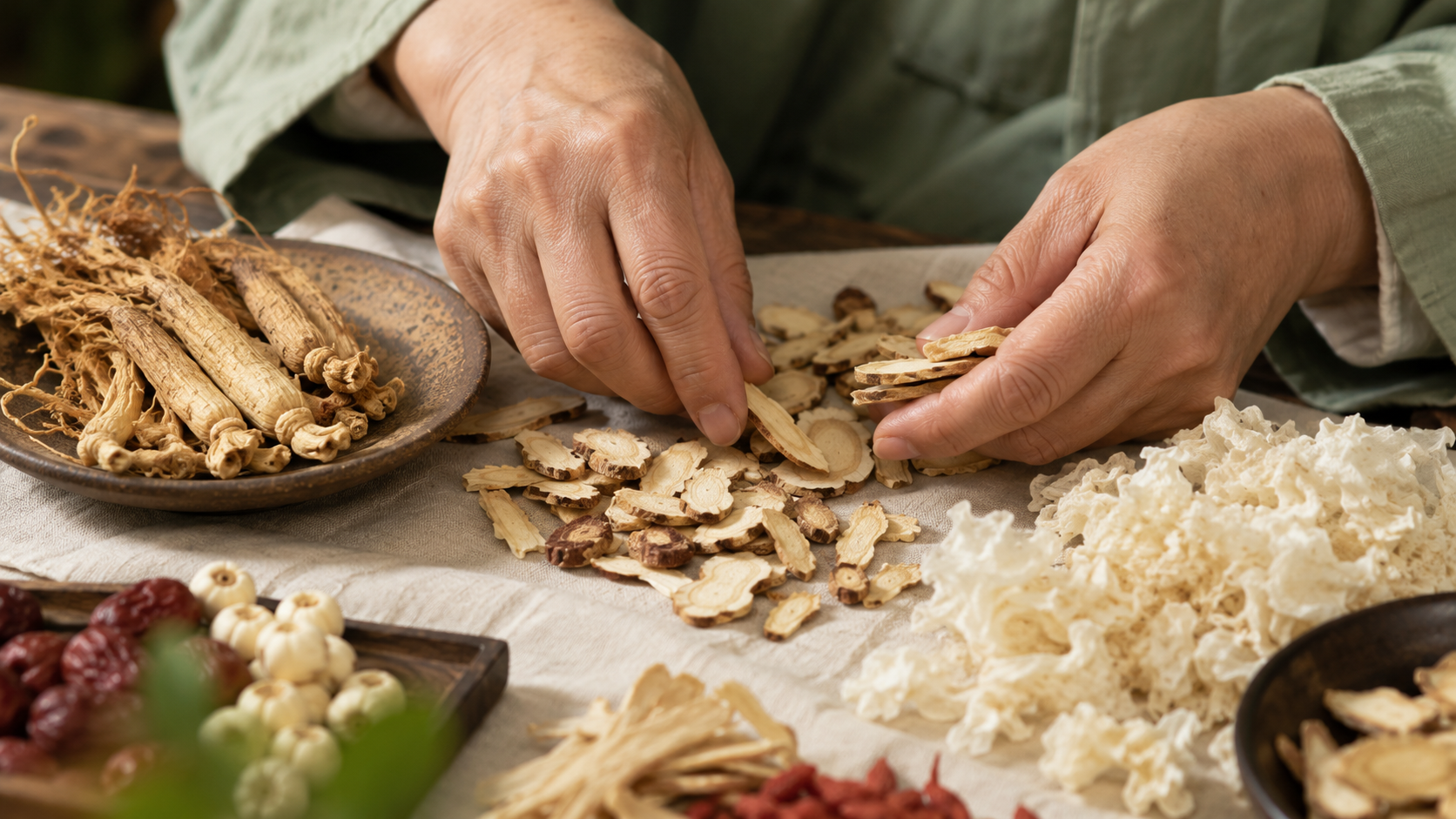
Four ingredients recur often enough to count as the canonical TCM-derived actives. Each gets the same treatment we give Vietnamese botanicals – an honest read on the evidence, not a heritage claim.
Ginseng
Ginseng (Panax ginseng) contains ginsenosides, compounds with documented antioxidant activity and a plausible role in local microcirculation. A handful of small clinical studies on ginseng-containing formulations have reported modest gains in wrinkle appearance and elasticity – moderate evidence, which is more than most botanicals can claim.
Honest limitation: almost all of that evidence comes from multi-ingredient products or oral supplementation, so isolating ginseng’s specific topical contribution is difficult, and the effect is dose-dependent. A serum listing ginseng tenth on the INCI is selling the word, not the actives.
Snow Fungus (Tremella fuciformis)
Snow fungus is the most defensible of the four. Its bioactive – Tremella fuciformis polysaccharide, a glucuronoxylomannan – is a genuine humectant that binds water and forms a hydrating film, broadly comparable to hyaluronic acid in function. As a plant-derived moisturizing agent, it works.
Honest limitation: the viral claims – “holds 500 times its weight in water,” “outperforms hyaluronic acid” – trace back to a narrow set of studies, several of them brand-linked, and in-vitro water-binding does not translate cleanly into measurable in-use hydration. It is a competent humectant, not a miracle one, and the comparison to HA is marketing more than data.
Pearl Powder
Pearl powder carries the most imperial mythology and the least modern human evidence. Its proposed brightening mechanism runs through conchiolin and its hydrolysates, which inhibit tyrosinase and suppress melanin synthesis. That mechanism is real – but it has been shown almost entirely in cell lines and mouse-melanoma models, not controlled human trials.
Honest limitation: there is little reliable evidence that topical pearl powder visibly brightens skin in use. Applied as a fine particle, much of its perceived effect is mild physical exfoliation and optical light-diffusion – cosmetic, not corrective. This is traditional use with emerging lab support, and it should be labeled as such.
Licorice Root
Licorice root is the quietest ingredient on the list and the best supported. Its actives – glabridin and licochalcone A – inhibit tyrosinase and carry real anti-inflammatory activity, with licochalcone A holding some human clinical support for calming redness and sensitized skin. For the two things C-beauty markets hardest, brightening and soothing, licorice does more honest work than ginseng or pearl.
Honest limitation: efficacy depends entirely on the specific extract and concentration. “Licorice root extract” on a label tells you nothing about whether glabridin is present at a level that does anything. We come back to this ingredient below – it is also the cleanest thread between Chinese and Vietnamese skincare.
The Biotech Turn: C-Beauty’s Real Advantage
If the herbs are the signature, the formulation science is the engine – and this is where C-beauty has quietly built a durable edge. The leading Chinese brands are not herbalists who learned chemistry; they are dermatology and biotech operations that treat TCM botanicals as one input among many.
Winona is the clearest case. Owned by the Botanee Group and built on research into highland medicinal plants from Yunnan, the brand is positioned almost entirely around sensitive-skin science – developed with hospital dermatology departments, supported by multi-center clinical observation. Several products carry medical-device classification rather than ordinary cosmetic status. That is a regulatory bar most Western “clinical” brands never clear. Dr. Yu occupies similar ground as an explicitly medical repair line with its dermatologist advisory committee.
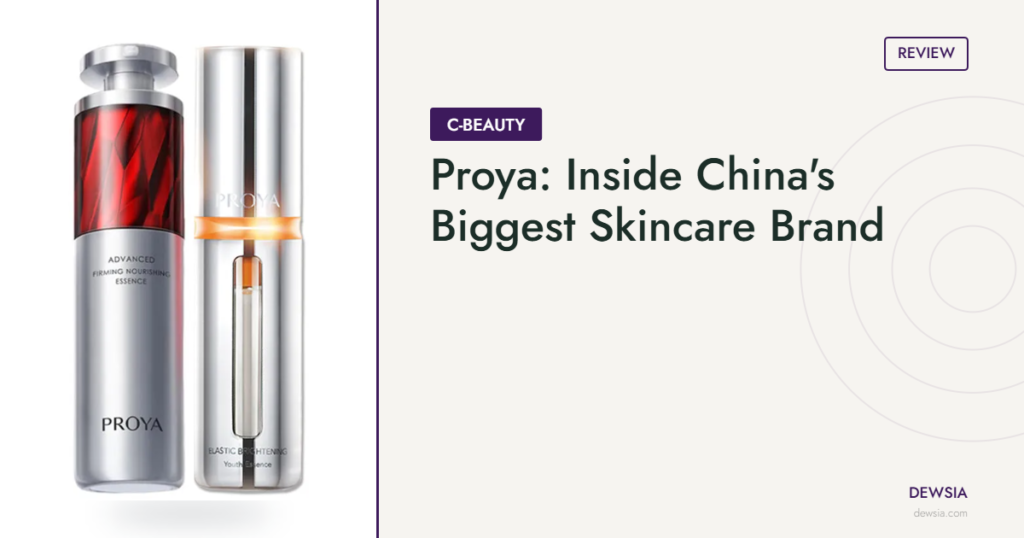
Proya repositioned from mid-market to research-led, leaning on ingredient pairings such as retinol with bakuchiol and on visible R&D. Herborist, under Shanghai Jahwa, was the first Chinese skincare brand to enter Sephora in France, built on integrating TCM concepts with modern cosmetic science. Pechoin and Chando Himalaya draw more directly on TCM botanicals but reframe them through dermatological research rather than folklore. Underneath all of it sits China’s biotech manufacturing base – large-scale hyaluronic acid production and a fast-moving recombinant-collagen industry now supplying actives the rest of the world is only beginning to adopt.
The honest read: C-beauty competes on efficacy and price because of barrier science, biotech actives, and testing rigor. The herbs are why it feels distinctive. The lab is why it works.
What a Chinese Skincare Routine Actually Looks Like
There is no single Chinese skincare routine, and any guide claiming otherwise is inventing one. In practice the modern Chinese approach sits between the two it is most often compared to – fewer steps than the Korean layering template, more actives than J-beauty minimalism.
Morning:
- Cleanser – gentle, low-foam, non-stripping
- Toner or essence – barrier-supporting, often built on a biotech humectant (Tremella polysaccharide or hyaluronic acid)
- Serum – one antioxidant or brightening active (ginseng, licorice, or vitamin C)
- Moisturiser – increasingly recombinant collagen or ceramide-based
- SPF – non-negotiable
Evening:
- Cleanse – double cleanse if SPF or makeup was worn
- Treatment – the one real actives step: retinol or retinol-bakuchiol for tolerant skin, a barrier-repair cream of the Winona type for sensitive or compromised skin
- Moisturiser – richer than daytime
The tropical caveat is the same one that applies to every Asian routine. As with K-beauty’s ten steps, the heavily layered version does not survive real humidity – occlusive stacking pills, slides, and traps heat. The lighter, barrier-focused interpretation of C-beauty travels into hot climates far better than the full Korean template, which is one reason Chinese sensitive-skin lines have found traction across Southeast Asia. The rule holds: subtract steps as humidity rises.
The Licorice Bridge: Where C-Beauty Meets V-Beauty
Licorice root is where “Asia is not a monolith” stops being a slogan and becomes specific. The ingredient sits in both Traditional Chinese Medicine and Vietnamese herbal medicine – cam thảo – and in skincare both traditions converge on it for the same two jobs: evening tone and calming irritation. At Dewsia, we use the term V-beauty for Vietnamese skincare, and licorice is one of the clearest points where the Chinese and Vietnamese herbal lineages overlap rather than diverge.
That overlap is a useful corrective to the habit of filing everything regionally under K-beauty. A shared ingredient is not a shared philosophy. Chinese brands tend to deploy licorice inside multi-active, clinically-tested formulas; Vietnamese brands more often present it as a single botanical in a lighter, lower-intervention product. Same plant, two formulation cultures – the same distinction that disappears the moment “Asian skincare” gets treated as one thing.
Who C-Beauty Is For
C-beauty’s strongest claim is not heritage – it is sensitive-skin science at an accessible price. For reactive or barrier-compromised skin, the category’s dermatology-led brands are among the best-reasoned products on the market, country of origin aside. If you are buying specifically for the TCM ingredients, calibrate: licorice and snow fungus earn their place, ginseng is plausible, and pearl powder is mostly tradition. The real obstacle is access – C-beauty’s expansion is digital-first and still patchy outside China, strongest through online channels and select Southeast Asian retailers. Buy it for the formulation, not the folklore.
FAQ
Is a Chinese skincare routine the same as a Korean one? No. K-beauty is more trend-led, texture-driven, and multi-step; C-beauty is more clinical, fewer steps, and built around dermatological testing and biotech actives. They share ingredients but differ in philosophy.
Do TCM ingredients like pearl powder actually work? It varies sharply by ingredient. Licorice root has the strongest evidence, snow fungus is a solid humectant, ginseng is moderately supported, and pearl powder is largely traditional with mostly cell-model rather than human data.
Is Chinese skincare good for sensitive skin? This is arguably its strongest category. Brands like Winona and Dr. Yu are built specifically on barrier science and sensitive-skin research, with several products carrying medical-device classification.
Does a Chinese skincare routine work in humid or tropical weather? The lighter, barrier-focused interpretation does. Heavy layering of essences and occlusives fails in humidity the same way the full Korean routine does – the fix is fewer, lighter steps.
Where can you buy C-beauty brands outside China? Expansion is digital-first, so online stores and marketplaces are the main route, with some availability through Southeast Asian retailers and select European clinic channels. Coverage is improving but still inconsistent.