The company that proved a Chinese skincare brand could lead its home market just posted the first revenue decline of its listed life – and chose the same moment to announce it wants to be a global top-ten beauty group. The two facts are not a coincidence. They are the same story told from opposite ends.
Fast track:
- The numbers that turned → The first contraction
- Why it happened → Spending more to reach fewer
- The strategy that follows → Buying, not building
- What it means for Southeast Asia → The V-beauty stakes
The First Contraction
For most of the past decade, Proya was the proof point: a homegrown Chinese brand that out-executed the multinationals in its market and, in 2024, became the first Chinese pure-play cosmetics company to cross 10 billion yuan in revenue. In 2025 the trajectory broke.
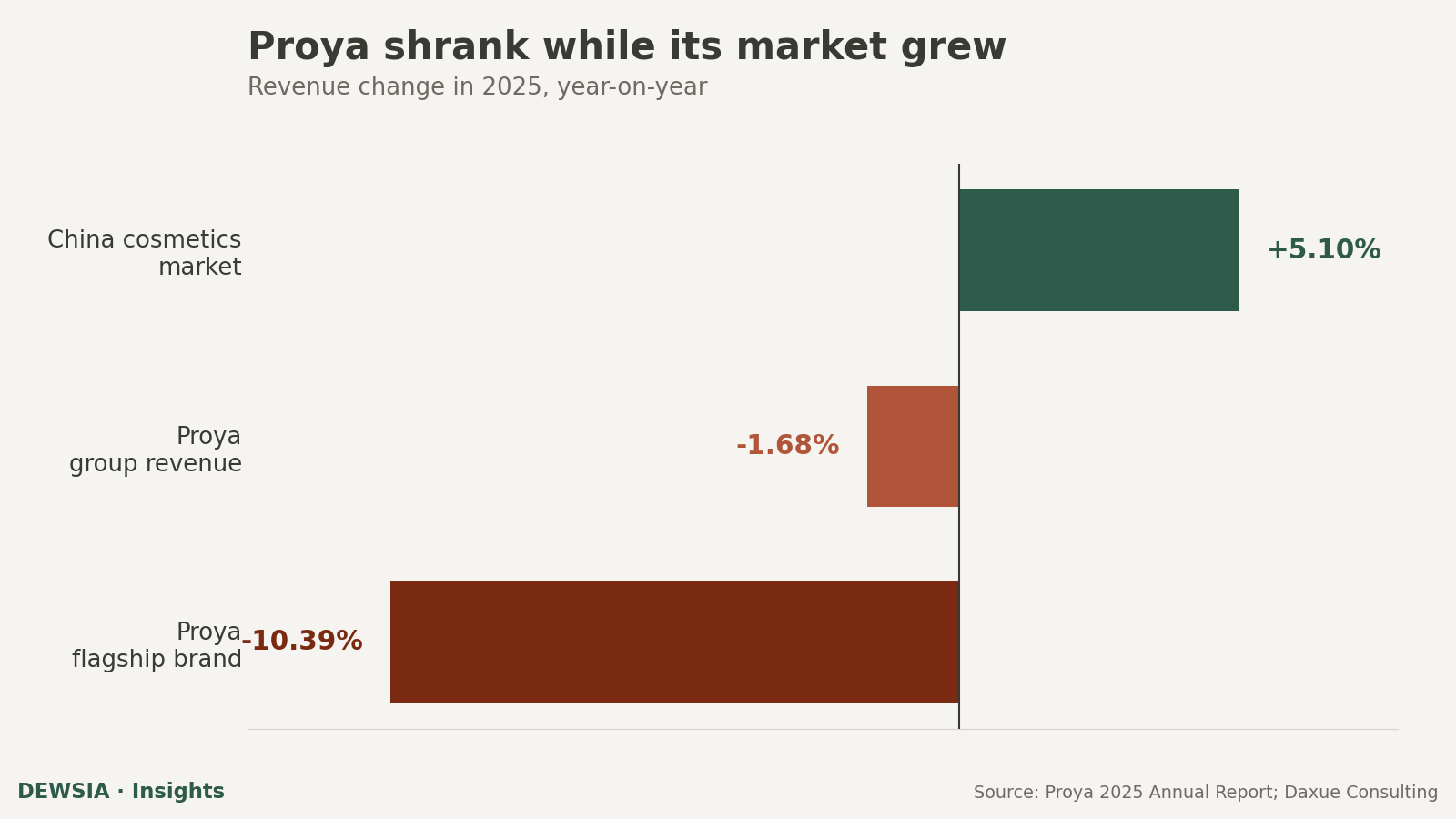
Full-year revenue fell 1.68% to 10.597 billion yuan, and net profit dropped 3.5% to 1.498 billion yuan – the first declines in Proya’s nine years as a listed company. The flagship brand, still more than 70% of the group, fell harder: down 10.39% to 7.689 billion yuan. The pressure did not ease into the new year. First-quarter 2026 revenue fell 2.29%, and attributable profit dropped further. This is not a single soft quarter; it is a trend the company has not yet arrested.
The detail that rules out easy explanations is the market itself. China’s cosmetics retail market grew 5.1% in 2025. Proya did not decline because the market turned; it declined while the broader market continued to grow. A contraction against a rising tide is a company problem, not a climate one.
Our full Proya brand review: Proya: Inside China’s Biggest Skincare Brand
Spending More to Reach Fewer
The instinct is to read a revenue drop as a product failure. The financials say the opposite, and that is what makes Proya’s position genuinely difficult.
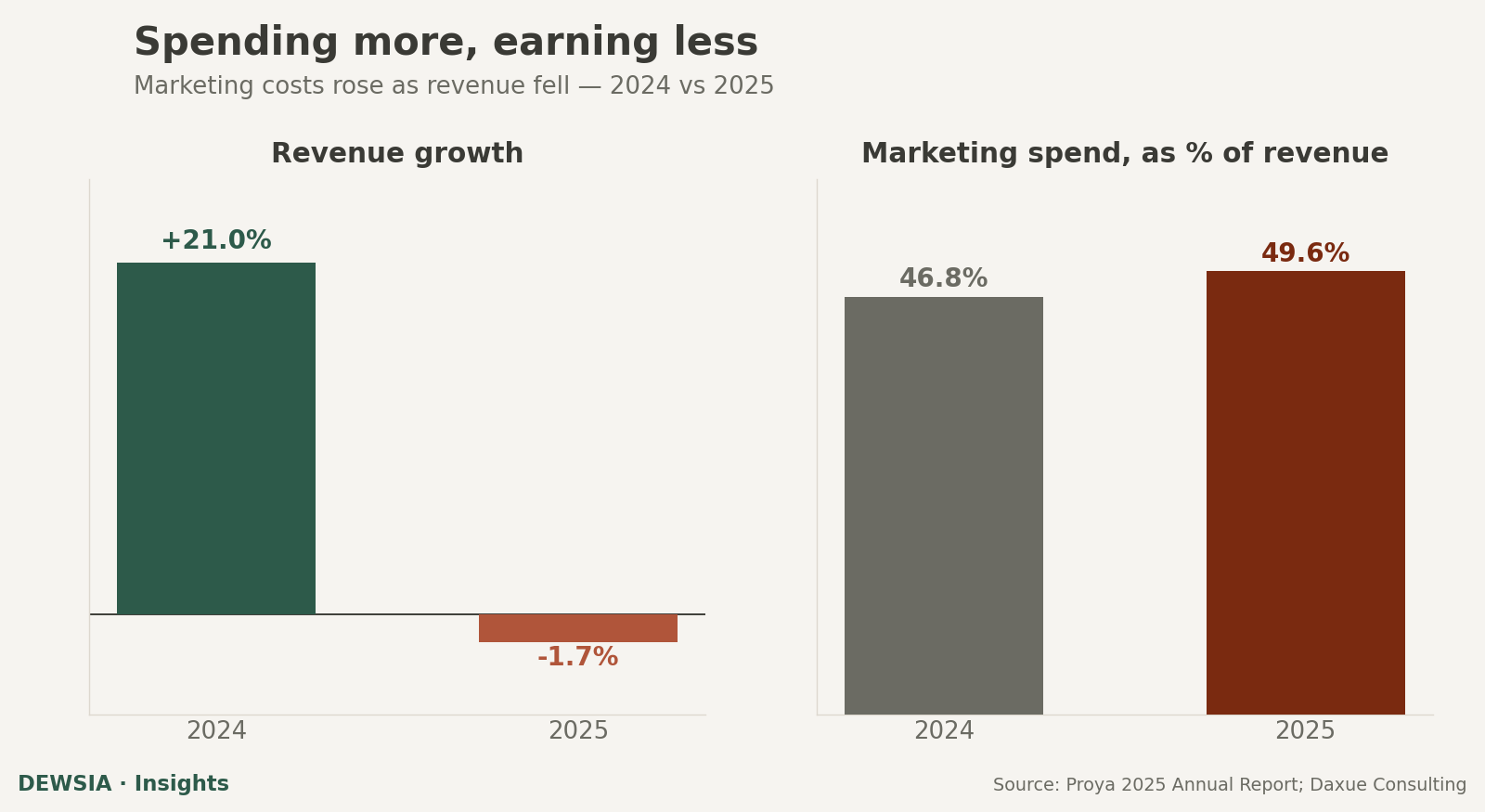
Proya’s gross margin rose to 73.26% in 2025, up 1.87 points year-on-year – the product is generating more value per unit than it did a year earlier. The problem sits on the other side of the ledger. The sales expense ratio climbed to 49.63% of revenue, up from 46.78%, even as revenue contracted. Marketing spend rose in absolute terms; revenue fell anyway. When a company spends a growing share of shrinking revenue to acquire customers and finds fewer of them, the campaign is not the issue.
The structural cause is exhaustion of a channel, not of a product. Over 95% of Proya’s revenue comes from online channels, and the brand is already present on every major platform – there is no new channel to enter and no cheaper audience left to reach. Proya built its rise on ingredient-led messaging delivered through abundant, growing e-commerce traffic. That traffic is no longer abundant or cheap, and the consumers most receptive to ingredient-led skincare have largely already been reached. The model that won the last decade has met its ceiling.
Buying, Not Building
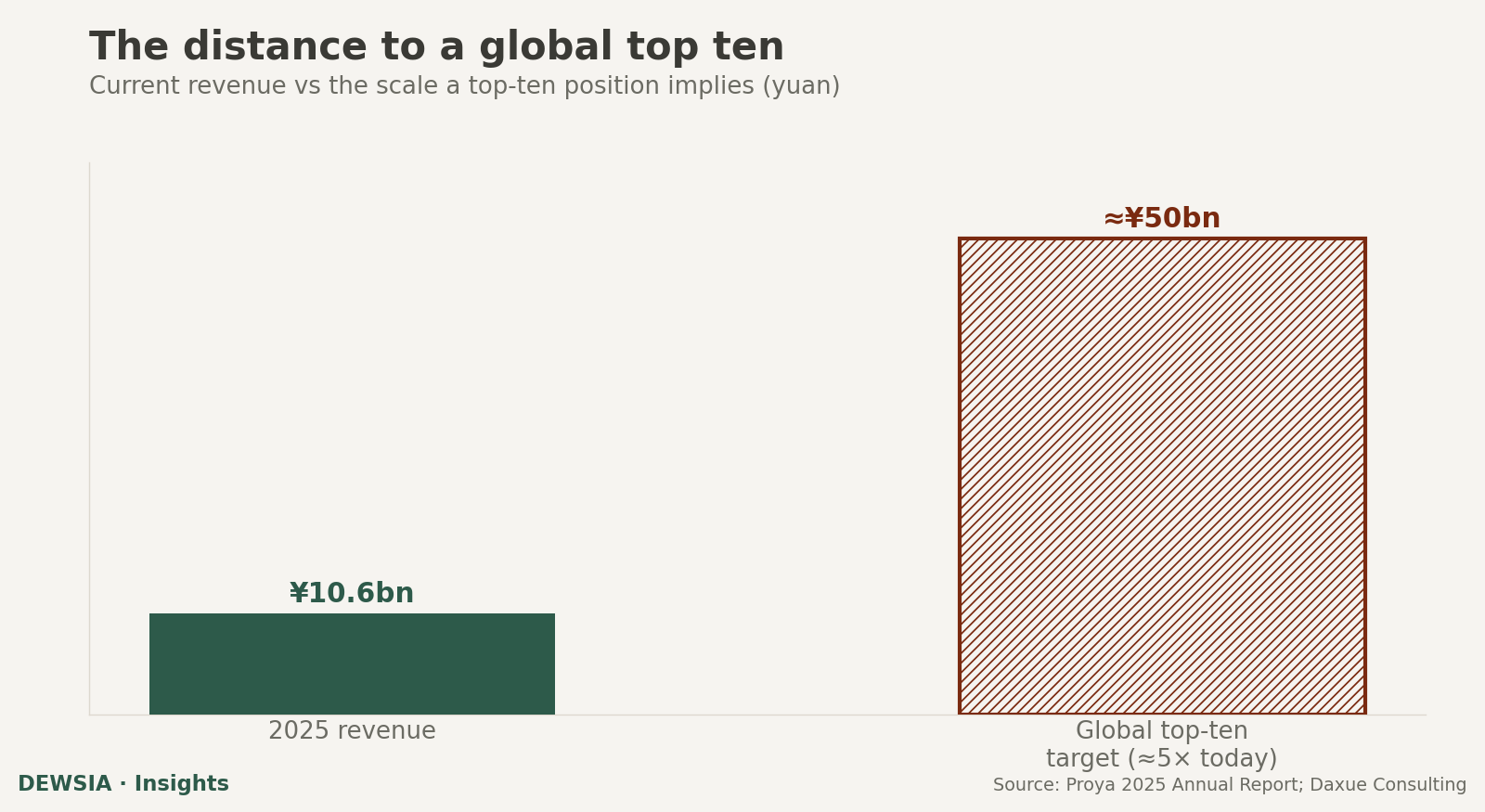
This is the context that makes Proya’s global announcement legible. In September 2025, it deepened its investment in the makeup brand Flower Knows and weeks later announced plans for a Hong Kong IPO with a stated ambition to become a global top-ten cosmetics group within a decade. A top-ten position would require roughly five times its current revenue – an extraordinary target for a company whose core brand just shrank 10%.
The tell is how Proya is pursuing it. It is lifting its Flower Knows stake to 51% for 351 million yuan, taking control of a brand that already out-scales its existing makeup line and will become the group’s second-largest. The logic is diversification away from the stalling flagship, bought rather than built. And the “global” framing deserves scrutiny: Proya’s 2021 acquisition of Japan’s Off&Relax is best read not as a Chinese parent growing a Japanese brand in Japan, but as acquiring a Japanese-positioned brand and scaling it inside China. Since the deal, Off&Relax has barely operated in Japan, with its real battleground on Tmall, Douyin, and JD.com. The Paris R&D center opened in 2024 fits the same pattern: infrastructure and prestige, not a storefront.
So the strategy resolves into something more honest than the slogan. Proya is not exporting the Proya brand. It is acquiring growth, building R&D credibility abroad, and importing foreign-positioned brands to sell to Chinese consumers – while the domestic engine that funds all of it slows.
The V-Beauty Stakes
For Southeast Asia, the relevant question is where a cash-rich Chinese major turns when its home market stops growing – and the answer points toward the region. Chinese exporters hold structural advantages here: shared e-commerce platforms, comparable payment infrastructure, similar shopping behavior, and proximity. Chinese cosmetics exports rose 12% year-on-year in the first half of 2025, flowing mostly to markets including Indonesia, and the trend is intensifying, not cooling.
At Dewsia, we use the term V-beauty for Vietnamese skincare – and this is where the pressure lands. A slowing domestic core pushes Chinese groups outward precisely toward the markets where Vietnamese brands are least equipped to defend themselves. No Vietnamese skincare company can match Proya’s R&D budget, its manufacturing scale, or its acquisition firepower. The competitive threat to Vietnam’s domestic brands is not Proya arriving with the Proya brand; it is Proya-style capital and capability entering the region through acquisitions and lower-priced, well-formulated products. Chinese beauty’s outbound turn – visible also in how intermediaries now package China market entry as a service – is the defining external force on Southeast Asian beauty for the rest of the decade.
Proya’s contraction is a domestic story with a regional consequence. The company most likely to shape V-beauty’s competitive environment is one whose own home market just stopped growing – and that is exactly why it is looking outward.
Sources
- Proya Cosmetics 2025 Annual Report – full-year revenue, net profit, flagship-brand decline, sales-expense ratio, and gross margin figures. [Primary filing, Shanghai Stock Exchange 603605]
- Bloomberg – “China’s Proya Cosmetics Earnings Drop as Core Brand Sales Weaken” (April 2026): https://www.bloomberg.com/news/articles/2026-04-21/china-s-proya-cosmetics-earnings-drop-as-core-brand-sales-weaken
- Daxue Consulting – “Proya (珀莱雅): How a domestic beauty brand reached the top charts and what it faces next”: https://daxueconsulting.com/proya-chinese-beauty-brand/ (sales-expense ratio, gross margin, market-growth context, channel-saturation analysis)
- Double V Consulting – “The Proya Global Expansion Playbook: Buying, Not Building, Abroad”: https://www.doublevconsulting.com/post/proya-global-expansion-playbook-buying-not-building-abroad (Flower Knows and Off&Relax acquisition strategy, Paris R&D base)
- Global Cosmetics News – “Proya reports earnings decline as core brand sales slow”: https://www.globalcosmeticsnews.com/proya-reports-earnings-decline-as-core-brand-sales-slow/ (Q1 2026 figures, restructuring)
- BigGo Finance – Flower Knows controlling-stake acquisition detail (351M yuan, 51% holding): https://finance.biggo.com/news/PD1BTp4BtCxy99G5Mhif