Aestura – Amorepacific’s dermatological skincare brand, distributed in 4,500 hospitals and clinics across South Korea – launched on Shopee Vietnam and in all 17 Beauty Box stores in January 2024. Its ATOBARRIER 365 Cream has exceeded 10 million cumulative units sold globally.
By March 2026, Aestura was in 17 European countries through Sephora and ranked among Sephora US’s top five moisturizers within months of launch. The brand that arrived quietly in Vietnam two years ago is now one of the fastest-expanding skincare brands in the world – and it is competing directly in the categories where Vietnamese brands are trying to build premium positioning.
What Dermocosmetics Actually Means
Dermocosmetics occupies the space between pharmaceutical skincare and mass-market beauty. The category’s defining characteristics are clinical distribution (hospitals, clinics, pharmacies), ingredient-level substantiation (published efficacy data, dermatologist endorsement), and accessible premium pricing – typically $20–35 for hero products. That pricing positions dermocosmetics above mass-market skincare but well below prestige, targeting the consumer who wants evidence-backed performance without the markup of a luxury brand.
In South Korea, the category grew 13% in 2024 against an overall beauty market growing at approximately 2%. The fast-growing players – Aestura, Physiogel, Medicube – are gaining share by delivering efficacy at price points that recession-glam consumers can justify. Aestura is backed by Amorepacific’s 40 years of dermatological research. Physiogel, a Haleon brand with clinical heritage in sensitive skin, has been distributed through Korean dermatology clinics for decades. Medicube, the most digitally native of the three, crossed one million cumulative overseas sales of its AGE-R beauty device by Q3 2024, with over 40% of total device sales coming from international markets.
The acquisition logic confirms the segment’s strategic importance. L’Oréal acquired DrG – Gowoonsesang Cosmetics, a Korean dermocosmetics brand – in January 2025, despite already owning La Roche-Posay, CeraVe, and SkinCeuticals. The deliberate addition of a Korean dermocosmetics brand to L’Oréal’s dermatological beauty division signals that Korean clinical skincare is not being treated as a geographic niche. It is being treated as a global category.
Why Vietnam Is a Priority Market
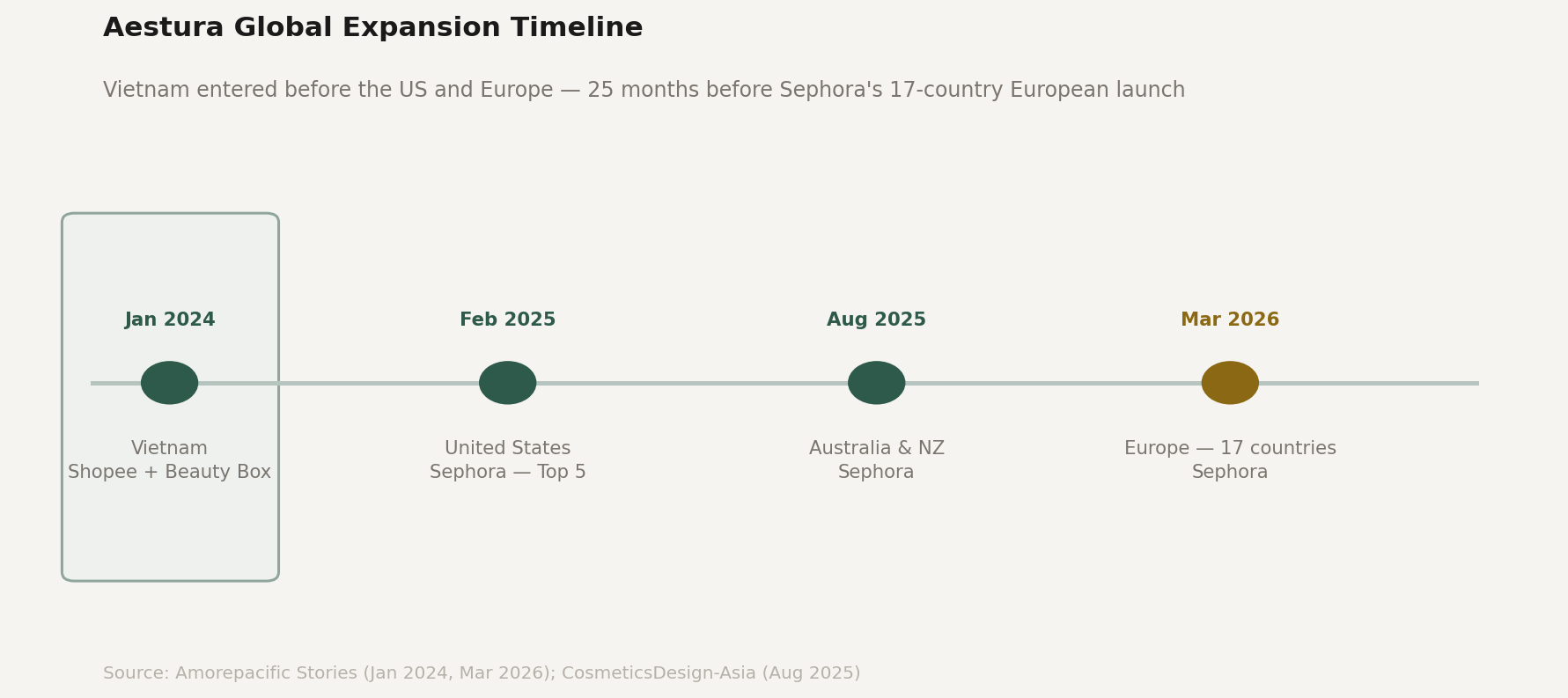
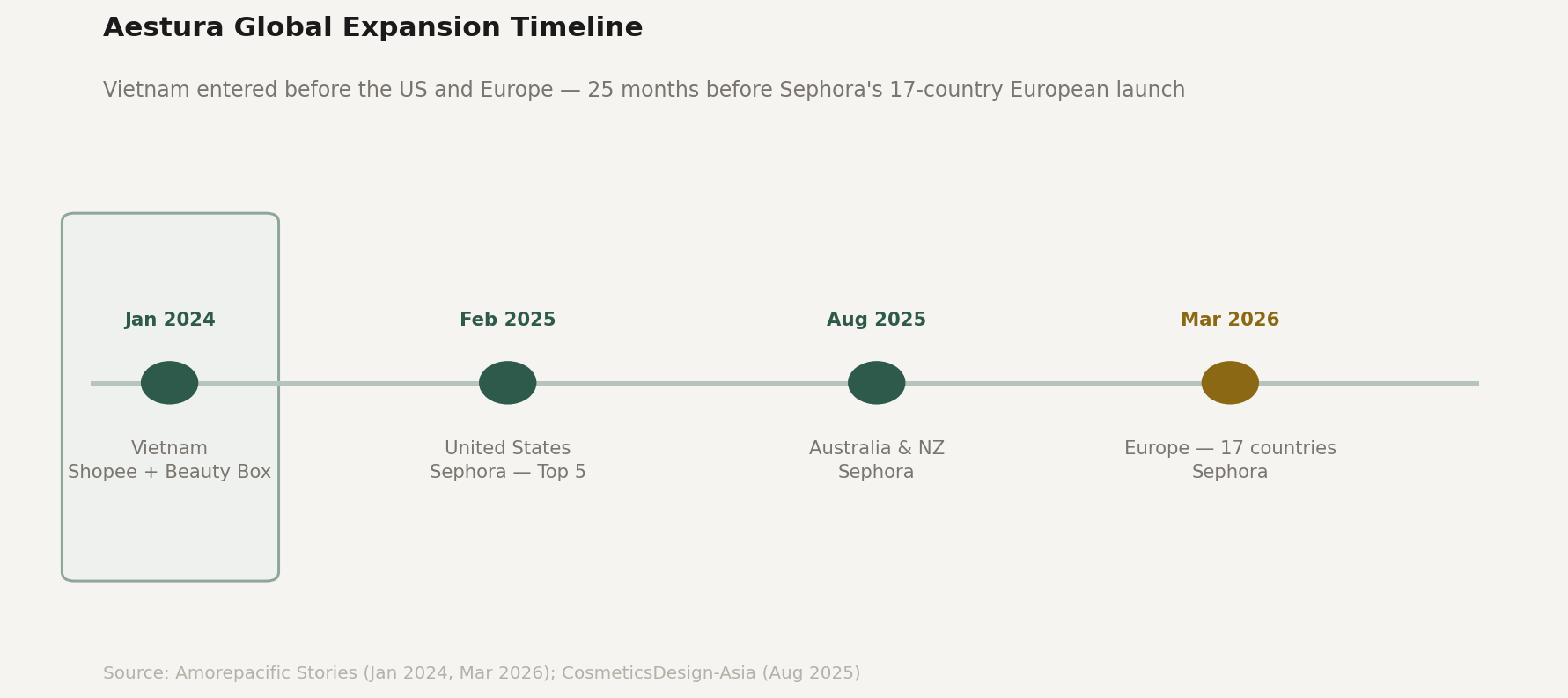
Aestura’s Vietnam entry was not a speculative bet on an unfamiliar market. It was a calculated first move in a regional expansion sequence: Vietnam in January 2024, Australia and New Zealand at Sephora in August 2025, the United States at Sephora in February 2025, and Europe across 17 countries in March 2026. Vietnam came before the US and Europe – which means the brand’s management assessed Vietnam as a higher-priority early market than the more obvious Western destinations.
The strategic logic is visible from the product selection. Aestura entered Vietnam with 16 products across four lines – A-CICA 365 (centella-based barrier and blemish), ATOBARRIER 365 (ceramide moisture), THERACNE 365 (acne-focused), and DERMA UV 365 (sunscreen). Three of those four lines address skin concerns that are primary in Vietnam’s climate: acne, sensitivity, and UV damage in high-humidity conditions. The A-CICA 365 line’s focal ingredient – centella asiatica – is also the most clinically documented ingredient in Vietnamese traditional skincare.
This is not coincidence. Aestura’s Vietnam entry is designed to compete directly against the ingredient positioning that Vietnamese brands have built. A-CICA 365 carries Amorepacific’s clinical documentation for centella efficacy. Vietnamese brands using centella carry traditional usage data and brand storytelling. The consumer choosing between them is choosing between clinical substantiation and cultural authenticity – and in a pharmacy-adjacent environment where the purchase decision is health-driven, the clinical argument has structural advantages.
The Pricing Trap for V-Beauty
The dermocosmetics price band – $20–35 for hero products – creates a specific competitive problem for Vietnamese skincare brands that is separate from the ingredient and clinical issue.
Vietnamese brands have historically competed either below this range (mass-market domestic products at $5–15) or attempted to enter it from below with accessible premium positioning. Cocoon’s hero serums price at approximately $15–25, which overlaps with the lower end of dermocosmetics pricing. At that price point, a Vietnamese consumer is now choosing between a domestic botanical brand with cultural provenance and a Korean clinical brand with hospital distribution credentials.
The pricing overlap makes the clinical credibility gap more damaging, not less. If Vietnamese brands priced significantly below dermocosmetics, the comparison would be less direct – different segments, different consumer decision frameworks. At comparable price points, the absence of clinical substantiation becomes the deciding factor for the segment of consumers who are making efficacy-first purchasing decisions. These are precisely the consumers that pharmacy channel growth in Vietnam – Long Châu’s 33 million customers, Pharmacity’s expanding footprint – is surfacing at scale.
Medicube’s overseas pricing compounds this. The brand’s skincare lines in SEA markets price at $15–30, closer to accessible mass-market than clinical premium, while maintaining the clinical language and aesthetic of medical dermatology. It is undercutting the price band where Vietnamese brands were attempting to build premium positioning while maintaining the efficacy claims that Vietnamese brands cannot yet match.
The Acquisition Signal and Its Implications
L’Oréal’s acquisition of DrG is the clearest signal that global beauty conglomerates have decided Korean dermocosmetics is not a trend. It is infrastructure.
The rationale L’Oréal stated publicly was to “strengthen its dermatological beauty division in Asia and expand K-beauty reach globally.” The dermatological beauty division already contains La Roche-Posay, one of the world’s most distributed clinical skincare brands, and CeraVe, the fastest-growing mass-market dermocosmetics brand in the United States. Adding DrG to that portfolio is not diversification – it is doubling down on a strategic bet that clinical beauty positioning is the dominant growth driver in Asian skincare for the next decade.
For Southeast Asian markets, the implication is structural. Global beauty companies are building Korean dermocosmetics distribution infrastructure in the region while Korean brands are investing in their own direct distribution. Aestura in Vietnam, Medicube expanding internationally through e-commerce, Dr. Jart+ debuting on TikTok Shop USA – these are not isolated events. They are the early distribution investments of a category that is being systematically built for global reach.
Vietnamese beauty brands are watching this infrastructure being built in their home market. The brands being distributed through Long Châu and Pharmacity alongside domestic products – CeraVe, La Roche-Posay, and now Aestura – are the reference points against which Vietnamese consumers will increasingly benchmark clinical skincare claims.
What V-Beauty Has and Lacks
V-beauty’s ingredient foundation is relevant to the dermocosmetics segment in a way that creates both genuine opportunity and genuine risk.
Centella asiatica, the ingredient at the center of Aestura’s A-CICA 365 line, is also the most clinically documented ingredient in Vietnamese skincare. Vietnamese brands have been using centella in formulations for longer than most Korean brands – rau má has been a staple of Vietnamese traditional medicine for generations. The difference is that Amorepacific has funded clinical trials documenting centella efficacy in controlled conditions, registered those results, and built product claims on top of them. Vietnamese brands have the ingredient and the cultural provenance. They do not have the clinical documentation.
The same gap exists in barrier care, the other primary dermocosmetics category. Vietnamese brands formulating moisturizers and barrier creams with botanical oils and plant extracts are working in the same functional space as Aestura’s ATOBARRIER 365 – but without the ceramide concentration data, the occlusion testing, or the clinical trial results. This allows a dermocosmetics brand to make substantiated claims in a medical distribution channel.
Closing this gap requires investment that most Vietnamese brands are not yet making. Clinical trials for a single product category cost between $50,000 and $200,000 depending on scope and duration. Vietnamese beauty brands whose annual revenues range from a few million to tens of millions of dollars face a front-loaded investment that does not generate domestic revenue but is required to enter the premium export and clinical distribution channels. This would allow them to compete with Aestura on even terms.
The honest assessment is that V-beauty does not have a current answer to K-beauty dermocosmetics. It has the ingredients, the formulation heritage, and the cultural narrative that would support a dermocosmetics positioning. It does not yet have the clinical investment, the medical distribution relationships, or the regulatory documentation that would make that positioning credible in the channels where dermocosmetics competes.
The window to build those capabilities is not closing – clinical investment is a long-term project, and the Vietnamese market for evidence-based skincare is still developing. But Aestura is already on Shopee Vietnam, already in Beauty Box, and already building the consumer relationships that dermocosmetics brands retain through efficacy rather than through loyalty programs or brand identity. The answer V-beauty does not yet have is one it will need before the market decides it does not need to wait.
Sources: Euromonitor International, 2025 Asia Pacific Beauty: What’s Driving Growth in China, Japan and South Korea (August 2025); Amorepacific Stories, AESTURA Enters the Vietnamese Market (January 2024); Amorepacific Stories, AESTURA Announces Official Launch at Sephora Across 17 European Countries (March 2026); Amorepacific Group Q1 2025 results; APR Corp Q3 2024 results (Medicube AGE-R overseas sales); L’Oréal Groupe, acquisition of Gowoonsesang Cosmetics including Dr.G (December 2024/January 2025); CosmeticsDesign-Asia, AESTURA enters Oceania via Sephora (August 2025); AESTURA International, Brand Story.