A Vietnamese skincare product can carry several reassuring signals at once: a notification number, a GMP reference, a vegan logo, a cruelty-free claim, the word “natural”, or a “Made in Vietnam” statement.
They may look like different versions of the same thing. They are not.
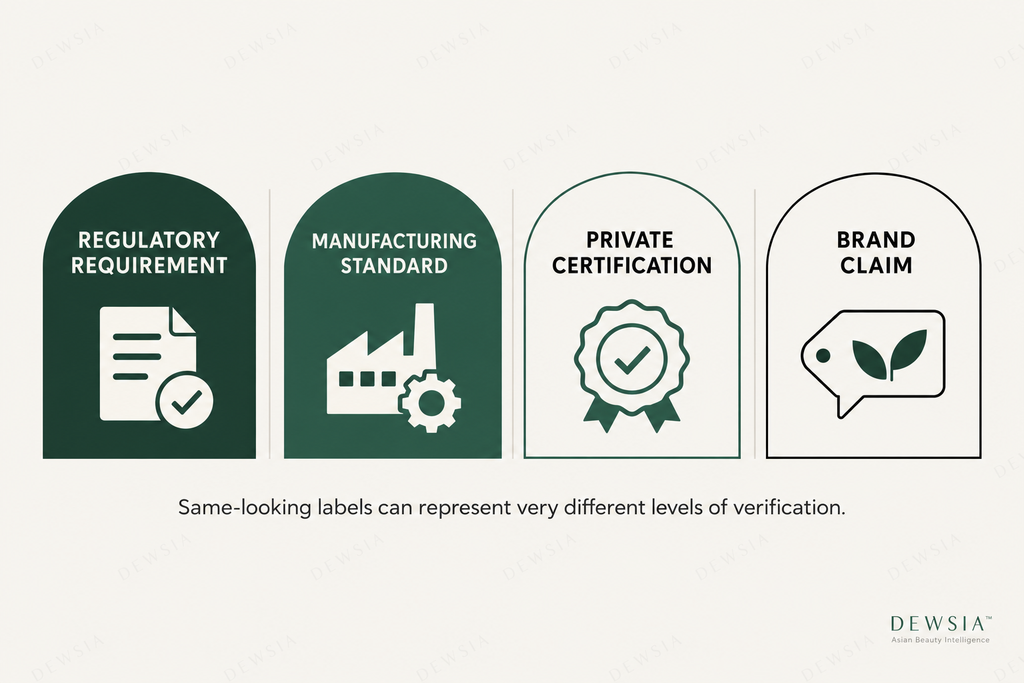
Some come from Vietnam’s regulatory system. Some relate to how a factory operates. Others come from private international certification schemes. Some are simply claims made by the company selling the product.
Understanding which is which tells you much more than simply counting the logos on the packaging – particularly if you are new to skincare in Vietnam and unfamiliar with how the local market is regulated.
Are Cosmetics Regulated in Vietnam?
Yes – but not through a conventional pre-market product approval system.
Cosmetics in Vietnam fall under the Ministry of Health, with the Drug Administration of Vietnam playing a central regulatory role. Circular 06/2011/TT-BYT remains a core instrument governing cosmetics and was amended in 2025 by Circular 34/2025/TT-BYT, including changes to administrative and electronic filing procedures. A broader replacement cosmetics decree has also been under development; in the latest official material reviewed for this article, it remained in draft form.
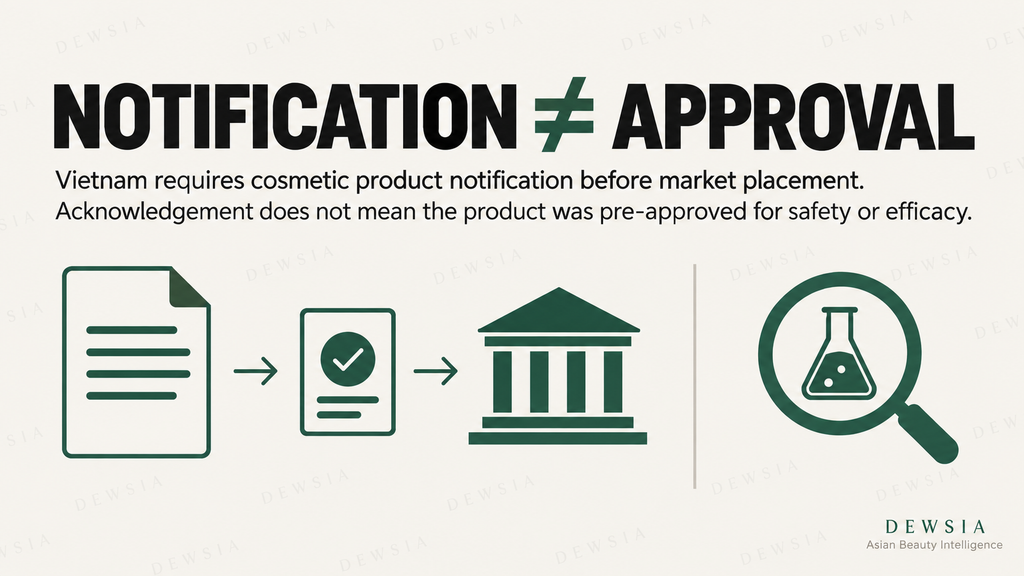
The key distinction for consumers is between notification and approval.
Before a cosmetic is placed on the Vietnamese market, the responsible company must complete a cosmetic product notification procedure and receive a notification acknowledgement or receipt number.
That number does not mean the authority has approved the product as safe or effective.
The ASEAN Cosmetic Directive is explicit on this point: acknowledgement of a product notification does not mean the regulator has confirmed that the product complies with every regulatory requirement. Responsibility remains with the company or person placing the cosmetic on the market.
Vietnam’s system, therefore, relies heavily on company responsibility combined with post-market surveillance rather than a government authority testing and approving every cosmetic before sale.
A Vietnamese notification number tells you something important: the product has gone through the required notification process.
It does not tell you that the Ministry of Health independently proved that the product works, that every claim has been clinically demonstrated, or that the product received the equivalent of pharmaceutical approval.
The notification number is generally valid for five years.
Vietnam’s regulatory system also goes considerably further than notification alone. Cosmetic formulas must comply with ASEAN rules covering prohibited and restricted substances, permitted preservatives, colorants, and UV filters.
The responsible company must also maintain a Product Information File, or PIF. This includes product information and safety documentation and must be available to regulators when required.
The PIF should not be confused with a pre-market government approval dossier. It is maintained by the responsible company and forms part of the compliance system that authorities can inspect.
Vietnam also uses post-market enforcement. Products can be suspended or recalled when authorities identify regulatory violations, including discrepancies between products on the market and their notified dossiers.
For consumers, that makes both formal compliance and the authenticity of the sales channel important — particularly when buying through online marketplaces, where counterfeit cosmetics in Vietnam remain a separate consumer risk from the regulatory status of legitimate products.
What GMP Actually Means
GMP stands for Good Manufacturing Practice.
For Vietnamese cosmetics, the relevant framework is CGMP-ASEAN – the ASEAN principles and standards for cosmetic manufacturing.
Vietnam introduced the ASEAN cosmetic GMP framework through Ministry of Health Decision 24/2006/QĐ-BYT. In September 2026, the Ministry issued consolidated text 18/VBHN-QĐ-BYT, reflecting the current form of that framework after subsequent legal changes.
GMP is primarily about the manufacturing system.
It covers areas such as:
- personnel and training;
- factory premises;
- equipment;
- sanitation;
- manufacturing procedures;
- quality control;
- documentation and batch records;
- storage;
- contract manufacturing;
- complaints;
- recalls;
- internal auditing.
In other words, GMP asks whether a manufacturer has systems capable of producing cosmetics consistently and under controlled conditions.
It does not independently determine whether every product manufactured at that site is effective for a particular skin concern.
Does “GMP-certified” mean a cosmetic has been independently proven safe or effective?
No.
A CGMP-ASEAN certificate concerns the manufacturing site and its quality-management system.
It does not independently certify the safety, efficacy, or marketing claims of every individual product manufactured there.
Product-specific safety information belongs elsewhere in the regulatory system, including the Product Information File that the responsible company must maintain.
This distinction matters because several regulatory documents are often treated as though they mean the same thing.
They do not.
Three Documents That Are Often Confused
1. The manufacturing eligibility certificate
Vietnamese cosmetic manufacturers are subject to manufacturing conditions under Decree 93/2016/NĐ-CP.
A cosmetic manufacturing establishment must obtain the relevant Certificate of Eligibility for Cosmetic Manufacturing from the competent provincial health authority.
This concerns whether the establishment is legally qualified to manufacture cosmetics.
It is not certification of an individual face cream, sunscreen, or serum.
2. CGMP-ASEAN compliance and certification
Vietnamese manufacturers are required to apply CGMP-ASEAN principles.
But applying those principles and holding a separate CGMP-ASEAN certificate are not identical concepts.
The formal certificate involves a separate application and inspection process carried out through the relevant health authorities.
That means consumers should distinguish between:
a manufacturer being subject to cosmetic GMP requirements
and
a manufacturer presenting a specific CGMP-ASEAN certificate issued after an inspection process.
Even when such a certificate exists, its scope remains the manufacturing site’s quality system. It does not transform every product leaving that factory into an independently approved cosmetic.
3. The product notification
The notification applies at the product level.
It records that the required product notification procedure has been completed.
It is separate from both the manufacturing establishment’s legal eligibility and its GMP status.
That distinction can be summarized simply:
Manufacturing eligibility concerns the factory’s legal ability to operate;
CGMP concerns manufacturing controls;
product notification concerns the product being placed on the market.
None of these, alone, is a government guarantee that the cosmetic will work for a particular consumer.
One practical limitation remains verification. We did not find a single consolidated public register of Vietnamese cosmetic CGMP certificates in the official sources reviewed for this article.
Where no searchable public database is available, a certificate displayed by a company may require separate verification with the issuer.
What Does “Made in Vietnam” Actually Mean?
Origin claims are more complicated.
A Vietnamese company can own a beauty brand without necessarily manufacturing every product itself. A product can also be manufactured in Vietnam using imported ingredients, foreign-developed formulations, or contract manufacturing.
This distinction becomes especially visible when looking at the wider market for Vietnamese makeup brands, where brand ownership, product development, and manufacturing location do not always point to the same country.
None of those facts automatically make the product better or worse.
They simply describe different parts of the supply chain.
Vietnam has rules governing product labeling and rules of origin, but the specific question of when goods circulating on the domestic market may claim Vietnamese origin has been an area of regulatory development.
In June 2026, Vietnam’s Ministry of Industry and Trade reported that it had submitted a draft decree to the Government setting specific criteria for determining “Vietnamese origin” for goods circulating domestically.
The Ministry also acknowledged that existing origin rules had historically focused heavily on imports and exports, leaving the domestic market without an equally specific framework for cases where goods undergo only limited processing before being marketed as Vietnamese.
The draft framework was designed in part to distinguish meaningful production from simple processing or assembly.
For consumers, the safest interpretation is therefore not:
Made in Vietnam = every component of the product originated in Vietnam.
A Vietnamese-origin claim does not automatically tell you:
- where every ingredient came from;
- where the formula was developed;
- whether the brand owns the factory;
- whether manufacturing was outsourced;
- whether packaging materials were imported;
- how much of the product’s value was created domestically.
Existing Vietnamese rules for export origin already distinguish substantial production from simple operations such as packaging or labeling. The domestic-origin framework under development has followed a similar concern: preventing minimal processing from being presented as evidence of genuinely Vietnamese manufacture.
So when evaluating a Vietnamese cosmetic, it is useful to separate four different questions:
Who owns the brand?
Where was the formula developed?
Where was the product manufactured?
Where did the ingredients come from?
They may have four different answers.
Vegan, Cruelty-Free, Natural, and Organic
These terms sit in a different part of the system.
There is no single mandatory Vietnamese cosmetics certification framework that gives all of these front-of-pack claims one government-defined meaning.
At the ASEAN level, cosmetic claims must be supported by appropriate evidence and must not mislead consumers. That is different from requiring every claim to be certified by an external organisation.
A beauty claim can therefore be self-declared or connected to an external certification standard.
Vegan
“Vegan” usually communicates that a product or brand meets a particular standard concerning animal-derived ingredients.
But consumers should ask who defines that standard.
A company’s own vegan claim and a product licensed to use a third-party vegan certification are not the same type of evidence.
Private systems such as the Vegan Society’s Vegan Trademark provide their own published standards and verification procedures.
They are private certification systems – not Vietnamese government approvals.
Cruelty-free
The same principle applies to cruelty-free claims.
Different certification schemes define their requirements differently.
A self-declared cruelty-free statement is a company claim. Certification through organizations such as Cruelty Free International’s Leaping Bunny program adds an external set of criteria and a verification process.
The certification still should not be interpreted as a government safety or efficacy approval.
Cocoon as an example
Vietnamese brand Cocoon provides a useful real-world example.
Cocoon appears in both PETA’s Beauty Without Bunnies database and Cruelty Free International’s Leaping Bunny listings.
That makes those particular claims independently checkable through the organizations that operate the programmes.
This is the practical difference between seeing a claim on packaging and being able to verify it with an outside certifier.
Natural and clean beauty
“Natural” and especially “clean beauty” require caution because consumers often treat them as though they were fixed regulatory grades.
They are not.
Vietnam does have a national standard, TCVN 12972-1:2020, addressing definitions relating to natural and organic cosmetic ingredients.
However, a technical standard is not the same thing as a mandatory government certification program for every cosmetic carrying the word “natural”.
“Clean beauty” is even less useful without knowing what criteria a brand has chosen to apply.
The important question is therefore not simply:
Is this product natural?
It is:
According to which definition, standard, or certification scheme?
Organic
“Organic” can similarly refer to different standards.
Vietnamese organic agricultural standards should not automatically be treated as certification standards for finished cosmetics.
International private schemes such as COSMOS or Ecocert can provide defined criteria for cosmetic products or ingredients, but participation in these schemes is voluntary.
A brand using “organic” language without an external certification should therefore be evaluated according to the evidence behind the claim rather than the word alone.
How to Check Any Cosmetic Claim
Six questions can clarify almost any certification or label:
- Who issued it?
A government authority, a private certifier, or the brand itself? - Is it required by law or voluntary?
- Is it independently audited or self-declared?
- What does it apply to?
The company, the factory, or this specific product? - Can the certificate be independently verified?
Is there a public database, certificate number, or another way to confirm it with the issuer? - Is there a published standard behind the claim?
A claim that cannot be independently verified is not automatically false.
It simply belongs to a different category of evidence.
And a logo without a defined standard behind it is ultimately just a logo.
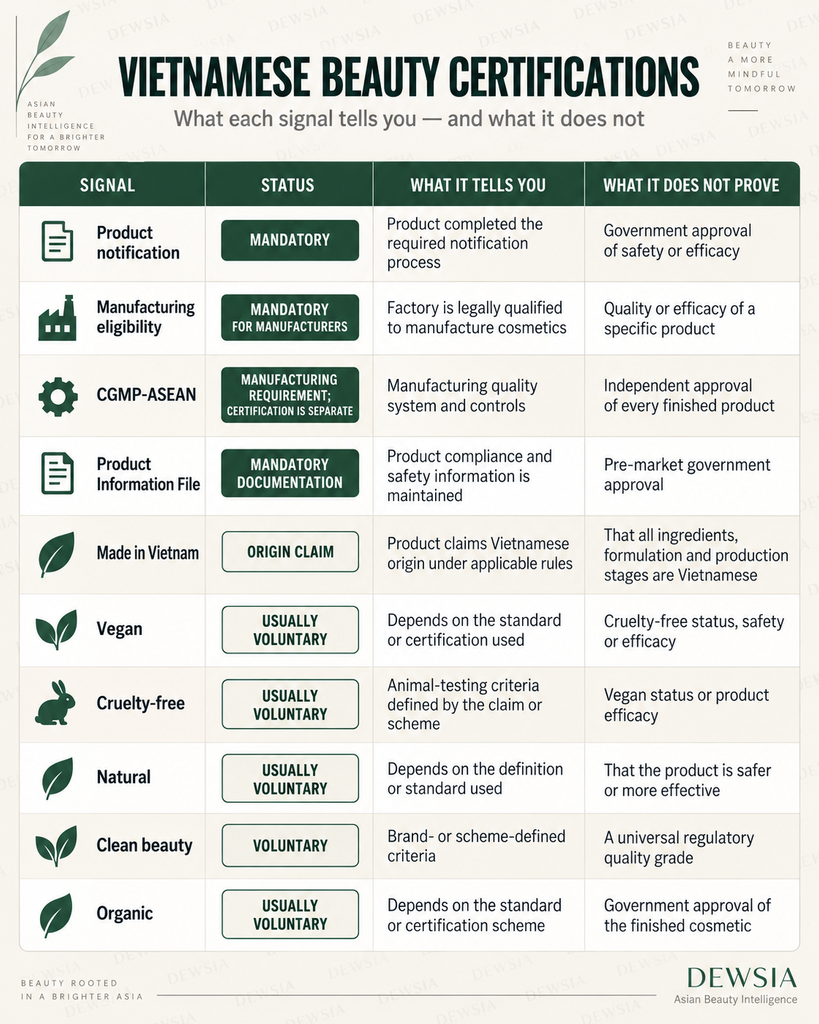
Vietnamese Beauty Certifications Compared
What Certifications Cannot Tell You
Vietnam’s cosmetics system combines ASEAN-based notification, manufacturing requirements, and post-market surveillance.
Those mechanisms should not be confused with voluntary consumer-facing certifications.
A notification number records a regulatory filing.
CGMP-ASEAN concerns the manufacturing site’s quality system.
A manufacturing certificate concerns whether the establishment can legally operate.
Vegan, cruelty-free, natural, and organic claims depend on the definitions, standards, and evidence behind them.
And an origin claim tells you far less about the full supply chain than consumers often assume.
No single badge proves that a cosmetic will be effective, suitable for your skin, or superior to a competing product.
The useful question is not:
“Does this Vietnamese cosmetic have certifications?”
It is:
“What exactly has been certified, by whom, against which standard?”
Vietnamese cosmetics should be judged using the same evidence-based approach applied to products from Korea, Japan, Europe, or elsewhere: check the manufacturer, understand what regulatory identifiers actually mean, look for independent verification where relevant, buy from trustworthy distribution channels, and treat marketing claims as claims until you know the standard behind them.
If you are starting from scratch, our guide to the best-known Vietnamese skincare brands is the best next step for understanding the companies behind the market.