Vietnam’s beauty brands market themselves on naturalness. The words “thiên nhiên” (natural), “thuần chay” (vegan), and “organic” appear across product lines from Cocoon to Herbario to dozens of smaller independent brands – and in the Vietnamese market, none of these terms carries a legal definition, a certification requirement, or an enforcement mechanism. That regulatory gap is not a minor technicality. It is the primary structural barrier preventing V-beauty from accessing premium retail channels in the EU and the United States.
What Vietnam’s Cosmetics Regulation Actually Says
Vietnam’s cosmetics sector is governed by the Ministry of Health through the Drug Administration of Vietnam, operating under the ASEAN Cosmetic Directive framework. The most recent major regulatory update – Circular 34/2025/TT-BYT, effective August 18, 2025 – modernised the product notification process by adding digital submission and clarifying signature requirements. A Draft Decree submitted to the WTO in June 2025 is expected to take effect July 1, 2026.
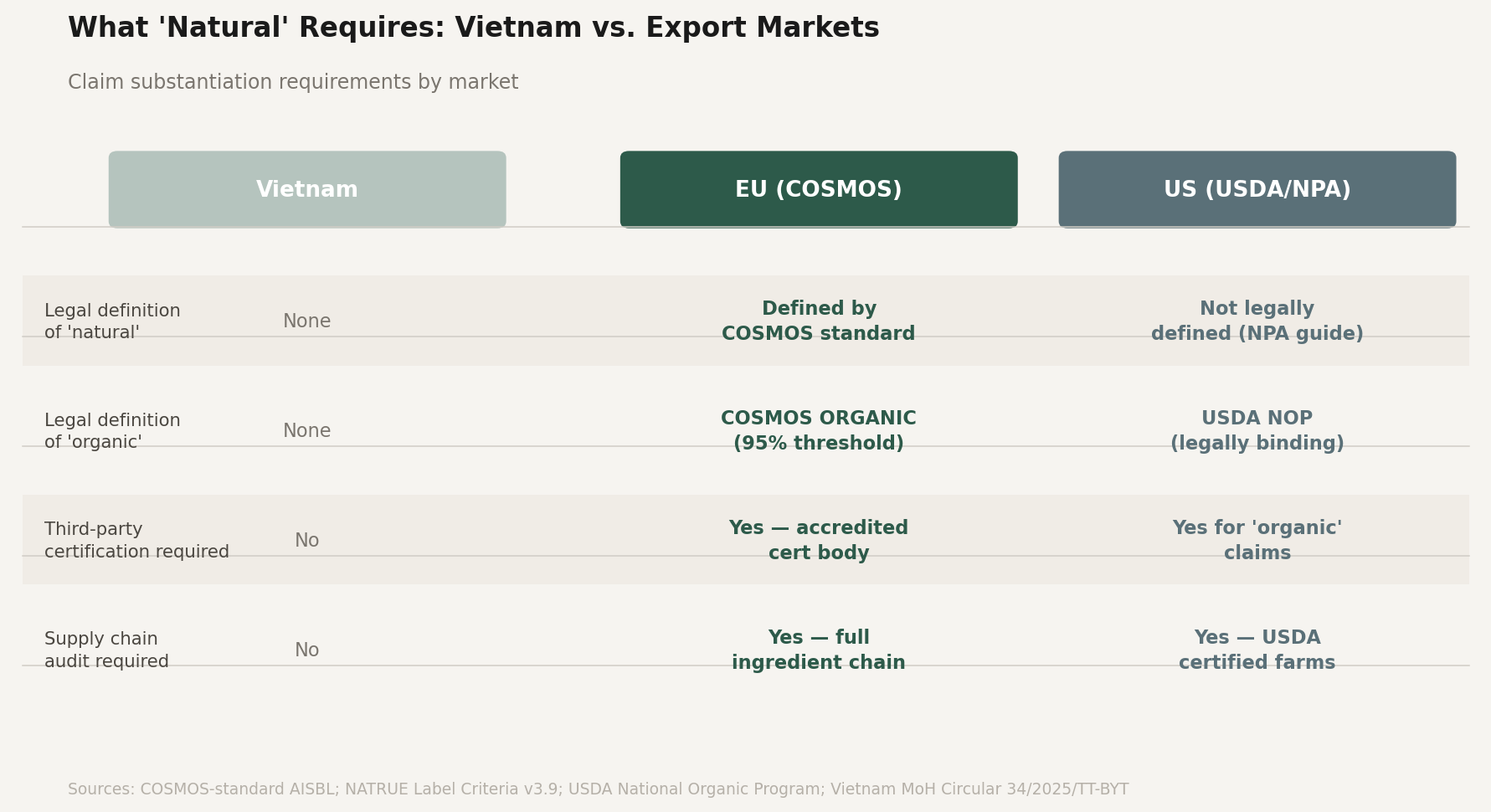
Neither document defines “natural,” “organic,” or “clean” as cosmetic claims. The draft decree requires that advertising “avoid misleading claims” and prohibits phrases like “instant whitening” or “miracle cure” – but it establishes no substantiation framework for ingredient origin claims. A Vietnamese brand can label a product as “100% natural” or “organic” without holding any certification, without documenting its supply chain, and without demonstrating that the ingredients meet any defined standard of naturalness or organic cultivation.
This is not unusual in Southeast Asia. The ASEAN Cosmetic Directive, which Vietnam follows, does not regulate marketing claims around naturalness or organic status. It governs safety, ingredient restrictions, and labeling requirements, but the marketing language that differentiates premium natural beauty from conventional beauty sits entirely outside its scope.
The result is a market where “natural” is a positioning choice rather than a verified attribute. Vietnamese consumers buying a product labeled “từ thiên nhiên” (from nature) have no regulatory assurance that the claim means anything beyond the brand’s own interpretation.
What the EU and US Markets Actually Require
European and American premium retailers operate in a fundamentally different environment – one where “natural” and “organic” claims, while not always legally mandated, are functionally required to be substantiated through third-party certification.
In Europe, the dominant certification standards are COSMOS and NATRUE. Neither is legally mandated by EU Cosmetics Regulation 1223/2009 – the EU does not define “natural” in law any more than Vietnam does. The difference is that European premium retail has made COSMOS the de facto gating criterion: Biocoop, Naturalia, La Vie Claire, and online platforms that curate natural beauty all treat certification status as a prerequisite. COSMOS – managed by a Brussels-based non-profit with 29,000 certified products across 71 countries – defines two tiers: COSMOS NATURAL and COSMOS ORGANIC. The COSMOS ORGANIC certification requires that at least 95% of the product’s plant-based natural substances come from certified organic farming or wild collection, with full supply chain documentation at every stage. The COSMOS NATURAL standard requires compliance with manufacturing and formulation criteria without the organic percentage threshold. Both require a third-party audit by an accredited certification body before any COSMOS claim can be made on a label.
NATRUE, headquartered in Brussels and founded in 2007, applies similarly rigorous criteria. Its organic certification requires that 95% of natural substances of plant and animal origin derive from controlled organic farming or wild collection, certified to standards approved by the International Federation of Organic Agriculture Movements.
For the United States, the “organic” claim is governed by the USDA National Organic Program – a legally binding standard that requires certification for any product making an organic claim on its label. The NPA (Natural Products Association) standard applies to “natural” claims, though its enforcement depends on retailer requirements rather than federal law.
The practical consequence for a Vietnamese brand entering European or American premium retail is straightforward: without COSMOS, NATRUE, or an equivalent certification, the product cannot credibly make natural or organic claims in the channels where those claims drive purchase decisions. Whole Foods, Sephora’s clean beauty sections, independent natural beauty retailers, and online platforms that curate certified natural beauty all use certification status as a gating criterion. A Vietnamese brand with genuine botanical ingredients and traditional formulation knowledge cannot access these channels based on brand narrative alone.
The Certification Gap on the Ground
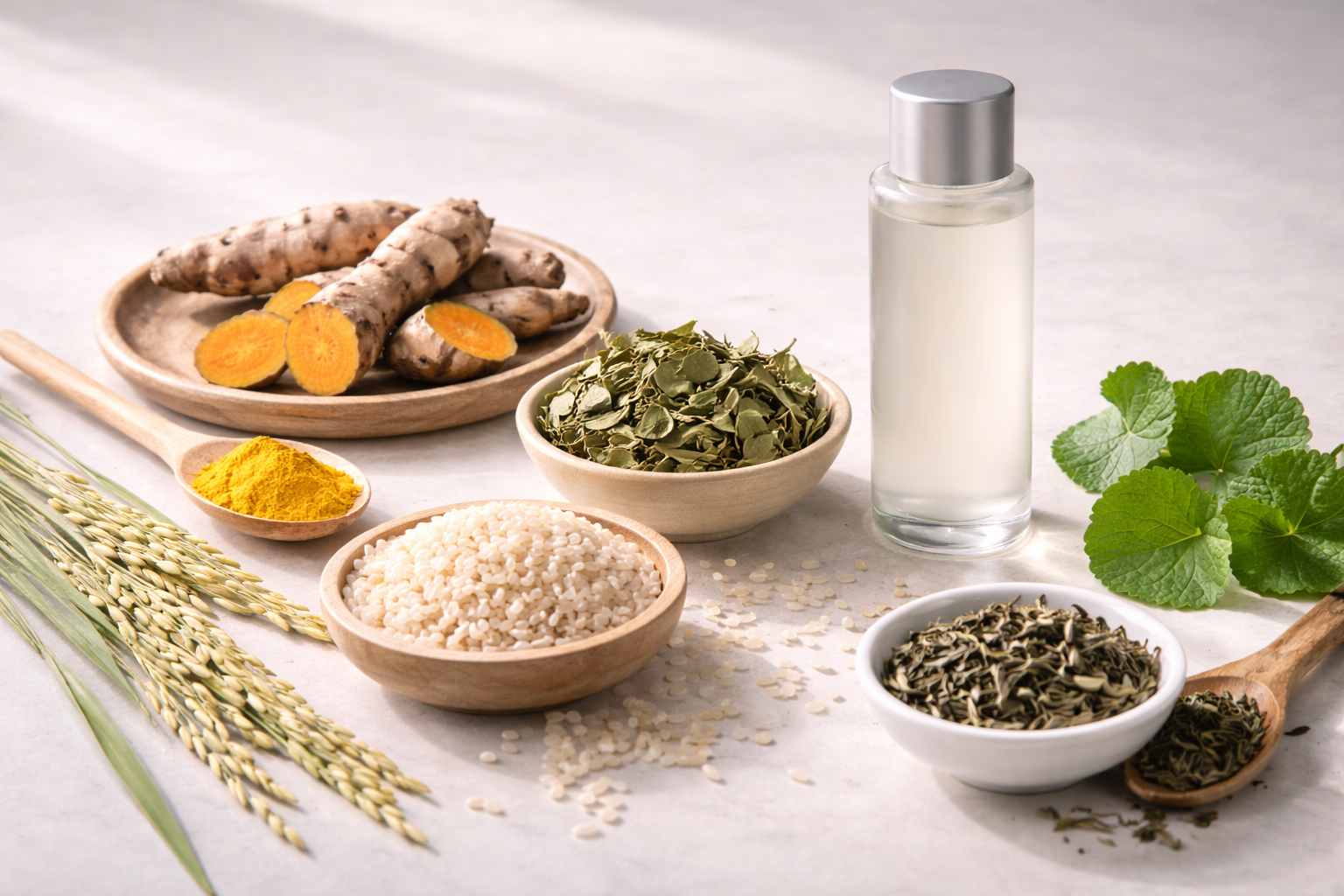
Walking through beauty retail in Hanoi and Ho Chi Minh City, the gap becomes visible in a specific way. Vietnamese brands display claims that would require certification documentation in export markets – “organic turmeric,” “100% natural,” “chemical-free” – without any certification mark. The products themselves are often genuinely formulated with high-quality local ingredients. Cocoon’s Hung Yen turmeric sourcing is real. The rice water in multiple brands’ brightening lines comes from actual Vietnamese agricultural regions with documented provenance. The ingredient quality is frequently not the issue.
The issue is the documentation layer that connects ingredient quality to internationally recognized certification. COSMOS certification requires a complete supply chain audit: the turmeric farm must hold organic certification, the extraction process must comply with COSMOS-permitted methods, the manufacturing facility must be inspected, and the finished product must pass formulation review. A brand can have genuinely organic turmeric from Hung Yen and still fail COSMOS certification if the farm lacks organic documentation or if the formulation includes a preservative not on the approved list.
Cocoon is the most instructive case precisely because it is the furthest along. The brand holds PETA’s Beauty Without Bunnies certification, Cruelty-Free International’s Leaping Bunny certification, and The Vegan Society’s vegan trademark – three internationally recognized marks that document its cruelty-free and vegan status. These certifications required genuine investment: supply chain audits, ongoing ingredient monitoring, and annual renewal. They have opened international retail doors that are closed to uncertified Vietnamese brands.
What Cocoon does not hold, as of this writing, is COSMOS or NATRUE certification for its natural or organic claims. Its marketing describes products as made from Vietnamese natural ingredients – which is accurate – but the natural ingredient claims are not third-party certified to the standard that European premium retail requires. The gap between what Cocoon has achieved and what full access to EU natural beauty retail would require is not insurmountable. It is, however, a gap.
Cocoon’s April 2026 Paris activation through Orien Trade – a distributor specializing in Asian cosmetics in Europe – illustrates both the opportunity and the constraint simultaneously. The brand now has a distribution foothold in France, the country where COSMOS and Cosmebio were founded and where certified natural beauty dominates premium shelf space. Accessing that shelf space – Biocoop, Naturalia, La Vie Claire, and prestige pharmacy chains – requires the certifications Cocoon does not yet hold. The Orien Trade route is a real market entry. It is not yet a premium natural beauty entry.
Why the Gap Persists
COSMOS certification for a finished product costs between €1,500 and €5,000 per product, depending on the certification body and complexity, plus annual renewal fees. For a brand with thirty SKUs, the certification investment runs to €50,000-€150,000 before manufacturing changes and supply chain upgrades are factored in. For most Vietnamese beauty brands operating at current revenue scales, this is not a trivial expense.
The supply chain requirement is the more significant barrier. COSMOS and NATRUE do not certify products – they certify supply chains. Every ingredient above a defined threshold must come from a certified source or comply with permitted processing methods. Vietnamese agricultural suppliers, including those supplying turmeric, rice, centella asiatica, and green tea to beauty brands, are generally not organically certified under standards recognized by COSMOS or NATRUE. Building that certification infrastructure at the agricultural level requires investment and time that run ahead of the brand’s export revenue.
The regulatory environment in Vietnam provides no pressure to make this investment. In a domestic market where “natural” claims are unregulated and consumers have no mechanism to distinguish certified from uncertified natural, the certification premium is not recoverable through domestic pricing. The investment only pays off in export markets – which creates a classic chicken-and-egg problem: brands need export revenue to justify certification investment, but certification is required to access the export channels that generate revenue.
What Closing the Gap Would Require
The brands most likely to close the clean beauty certification gap are those that can absorb the front-loaded investment cost before export revenue justifies it. This points toward either well-capitalised independent brands or brands with FMCG backing that can treat certification as a market access investment rather than a revenue-driven cost.
Cocoon’s existing certification infrastructure – PETA, Leaping Bunny, and Vegan Society – demonstrates that the investment capacity and operational systems required for international certification already exist within the brand. COSMOS certification would be an extension of work already undertaken, not a new capability. It would require organic certification at the ingredient level, which in turn requires working with Vietnamese agricultural suppliers to build that documentation.
The alternative route is ingredient-level positioning that sidesteps the “organic” claim entirely. COSMOS NATURAL certification is achievable without organic agricultural sourcing – it requires compliance with manufacturing and formulation standards, not organic farming certification. A Vietnamese brand that pursues COSMOS NATURAL for its botanical lines would be able to make substantiated natural claims in European markets without the higher burden of organic supply chain documentation.
The regulatory trajectory in Vietnam is moving slowly toward greater claim specificity. The 2026 draft decree tightens advertising restrictions and introduces clearer labeling requirements. It does not yet create a framework for natural or organic claim substantiation – but the direction of travel in ASEAN cosmetics regulation, as seen in Singapore and Malaysia, is toward greater alignment with international standards over time.
For Vietnamese beauty brands with genuine ingredient heritage and serious international ambitions, the clean beauty certification gap is a solvable problem. The solution requires capital, time, and supply chain development that most brands have not yet started. The window to close that gap while the global appetite for Asian botanical ingredients remains high is not unlimited.
The paradox is genuine. Vietnam’s beauty brands have some of the most compelling natural ingredient stories in Asian skincare. The regulatory environment that allowed those stories to develop unchallenged domestically is the same environment that makes them difficult to verify internationally – and in export markets where verification is the price of entry, the story alone is not enough.
Sources: Vietnam Ministry of Health, Circular 34/2025/TT-BYT (effective August 2025); Vietnam Draft Decree on Management of Cosmetics, WTO notification G/TBT/N/VNM/349 (June 2025, effective July 2026) via CIRS Group and GPC Gateway; COSMOS-standard AISBL, certification criteria; NATRUE, Label Criteria v3.9; Tilleke & Gibbins, Vietnam Updates Regulations on Cosmetic Notification (July 2025); Dewsia, Vietnamese Skincare: The Complete Guide to V-Beauty; Dewsia, Where to Buy Vietnamese Skincare Products.